Pope at Angelus: Let us not retreat into our convictions but be open to Christ
By Isabella H. de Carvalho
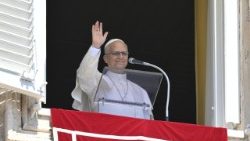
In order to transform our lives and the world we must develop a personal relationship with Jesus and renew it every day, Pope Leo XIV said in his Angelus message on Sunday, August 23, in St. Peter’s Square.
“Let us seek not to retreat into our own convictions and religious certainties, but to remain open to an authentic relationship with Christ,” he highlighted, addressing the many people gathered in the sunny square.
“At times, when it comes to the Christian faith, we may be content with what we have merely ‘heard,’ with common assumptions or with what has been handed down to us, perhaps even with the best of intentions,” he said.
“Yet Jesus calls us to give a personal response, to know him more closely and to allow ourselves to be shaped by friendship with him through an ever new encounter.”
Overcoming the temptation to think that we know everything
Pope Leo XIV was reflecting on this Sunday’s Gospel, taken from Matthew, in which Jesus asks his disciples “But who do you say that I am?”
The Pope emphasized that “this is a fundamental question for the disciples of every age, and for each one of us,” as faith is a process in which we need to continually rediscover Christ’s Gospel, in order to “renew the choices we make in our lives, so that they may be consistent with what we profess.”
“In this way, we can overcome the temptation to think that we already know everything and to reduce faith to mere habit,” the Pope underlined.

Following new and unfamiliar paths personally and in the Church
Renewing our friendship with Christ daily “may also ask us to follow unfamiliar paths and to make choices different from those we had imagined,” the Pope explained, noting that “this is true both for our personal journey and for the journey of the Church” and our “pastoral choices.”
He warned against the temptation to think “that it is enough simply to continue doing things as we have always done them,” and encouraged us to ask ourselves a series of questions:
“Who is the Lord for me? Do I truly know him? What is his Gospel asking of me today? What steps and what choices am I called to make?”

Discovering Christ who brings love in our daily lives
The Pope pointed out how these questions concerning who Jesus is for us and what he represents in our lives, “emerges especially in prayer and when we meditate on the Gospel.”
However, the Pope reflected that they also arise “when we encounter the wounds and needs of our brothers and sisters, and in those relationships and situations that most deeply challenge our conscience.”
“In our daily lives, in short,” the Pope continued, “we can discover whether the Lord Jesus is for us merely a great figure of history, who said and did important things, or the Christ of God, the One sent to bring us into the love of the Father and to transform our lives and the world in which we live.”
Thank you for reading our article. You can keep up-to-date by subscribing to our daily newsletter. Just click here.