

Daily readings
Liturgical Feasts
The section dedicated to the Liturgical feasts accompanies us along some of the most important moments of the year according to the Vatican calendar.
Transfiguration
06 August

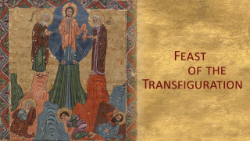
The Feast of the Transfiguration commemorates the dedication of the basilicas on Mount Tabor. It originated as early as the end of the 5th century, after the Feast of the Exaltation of the Holy Cross (September 14) came to be celebrated. 6 August, the date set for the Feast, is 40 days prior to the Feast of the Exaltation of the Holy Cross, manifesting its close connection with it. In the West, it began to be celebrated from the 9th century. In 1457, Pope Calixtus III included it in the Roman Calendar in grateful memory of the victory obtained the year before against the Turks, who had presented a serious threat against Western Europe. The mystery of the Transfiguration is, of course, at the heart of the Feast: the vision of the "old man" on the fiery throne and the appearance of the "Son of Man" (cf. First Reading).
See All... Year C Year B Year ASolemnity of the Assumption of the Blessed Virgin Mary
15 August
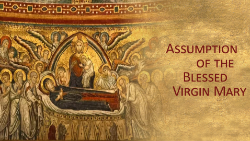
The Solemnity of the Assumption of the Blessed Virgin Mary was already being celebrated on 15 August in the 5th century. It bore the sense of Our Lady’s “Birth into heaven”, or in the Byzantine tradition, her “Dormition”.
The feast began to celebrated in Rome in the middle of the 7th century. It was not until 1 November 1950, that Pope Pius XII proclaimed the Dogma of Mary’s assumption body and soul into heaven.
In the Apostles’ Creed, we profess our faith in the “Resurrection of the body” and in “life everlasting”. This is the ultimate goal and meaning of our life’s journey. This promise of faith is already accomplished in Mary, who is the “sign of sure hope and comfort” (Preface). It is a privilege granted to Mary, and closely connected to her being the Mother of Jesus. Since death and the corruption of the human body are consequences of sin, it was not right that the Virgin Mary – who is free from sin – should be affected by this natural law. Hence the mystery of her “Dormition” or “Assumption into heaven”.
The fact that Mary has already been assumed into heaven is a reason to celebrate, to rejoice, to hope in the “already and the not yet”. One of God’s creatures – Mary – is already in heaven. With her, and like her, we too, who are God’s creatures, will one day be there too. Mary’s destiny, united to the transfigured and glorious body of Jesus, is, therefore, the destiny of all those who are united to the Lord Jesus in faith and love.
It is interesting to note that the liturgy – through the biblical texts taken from the Book of Revelation and the Gospel according to Luke (the Canticle of the Magnificat) – helps us, not so much to reflect, as to pray. In fact, the Gospel suggests that Mary’s mystery be read in the light of her prayer, the Magnificat, that is, through the lens of gratuitous love that extends from generation to generation, and the predilection of the least and the poor. Its choicest fruit, you could say its masterpiece, is Mary, a mirror in which the entire people of God can see its own features reflected.
The Solemnity of the Assumption of the Blessed Virgin Mary, body and soul, is an eloquent sign of how not only the “soul” but also the “body” is included in the biblical observation that “God found it very good” (Gn 1:31), so much so that in the Virgin Mary, “our flesh” would be assumed into heaven. This does not exempt us from committing ourselves to life here on earth, but rather that with our gaze fixed on the goal, on Heaven, our Homeland, we are driven to commit ourselves during our present life to reflect the Magnificat: to rejoice in God’s mercy, to be attentive to all our brothers and sisters we meet along the way, beginning with the weakest and most vulnerable.
Memorial of the Passion of Saint John the Baptist
29 August

The Memorial of the Passion of Saint John the Baptist complements the Solemnity of his birth, celebrated on 24 June. John is the cousin of Jesus. He was conceived when his parents, Zechariah and Elizabeth, were elderly. Both his parents were descendants of priestly families. John’s birth took place about six months prior to that of Christ, and coincides with the Gospel episode of the Visitation of Mary to Elizabeth. The liturgical celebration of his martyrdom, which occurred between 31 and 32, has ancient origins. It was already celebrated in France in the 5th century, and in Rome the following century and can be traced to the dedication of a small basilica that dates back to the 5th century where he was buried in Sabaste in Samaria. Tradition holds it was on this day that his head was found. Pope Innocent II had it later transferred to Rome to the Church of Saint Sylvester in Capite.
See All...


