Pope at Audience: The liturgy leads us back to what is essential
By Isabella H. de Carvalho
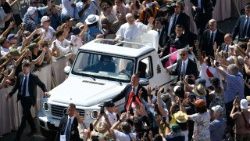
In our hectic lives marked by busyness and commotion, the rite of the liturgy, along with its signs and symbols, helps us pause and connect with our inner spiritual life as it draws us closer to Christ and his love, Pope Leo XIV said during the Wednesday General Audience in St. Peter’s Square on June 3.
“With the solemn simplicity of its rhythms, the rite interrupts our frenetic activities, leading us back to what is essential,” the Pope emphasized.
“We thus discover another dimension of action, not guided by calculations of productivity, and another experience of time and space. In the rite we experience a logic of gratuitousness, we find a pause that regenerates the heart, we recognize that we are preceded by divine grace, we learn to live in a rhythm inhabited by the Holy Spirit.”
This week, Pope Leo continued his catechesis series on the Documents of the Second Vatican Council, and reflected on the 1963 Constitution on the Sacred Liturgy, Sacrosanctum Concilium.
Sacrosanctum Concilium was the first text to be promulgated at the Second Vatican Council and brought about important changes to the liturgy, such as allowing it to be celebrated in vernacular languages and encouraging a more active participation of the faithful.
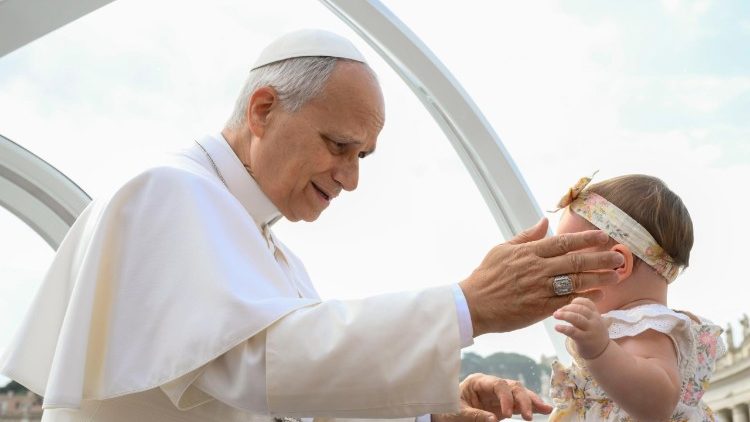
Do not be silent spectators
In this regard, the Pope explained that the Council – by building on the Liturgical Movement that pushed for these changes – helped highlight how the rites of the Christian liturgy are not “a mere external covering of the sacramental mystery, a collection of arbitrary ceremonies, but are the ecclesial mediation through which the divine gift reaches us.”
“Rite gives shape to liturgical action” and thus to our lives by “generating in us a spiritual sensibility that makes us capable of savouring the presence of God through Jesus Christ,” Pope Leo explained.
However, he noted that this can only happen if we participate actively in the liturgy “with our full selves – body, mind and heart –” and avoid being “strangers or silent spectators.”
He also underlined that through the sacred rite we are “formed in listening to the Word of God, in giving thanks and in adoration, in fraternal sharing and in ecclesial communion,” which leads us to recognize that we are one assembly, made up of different people, but united by the same faith.
Pope Leo acknowledged that the rite is made up of “well-defined sequence of gestures and prayers, which can sometimes be at odds with our individual tendency towards spontaneity.”
However, he insisted that its logic “is not to constrain freedom within rigid frameworks” but rather to connect us to our inner spiritual dimension by bringing us to what is essential.
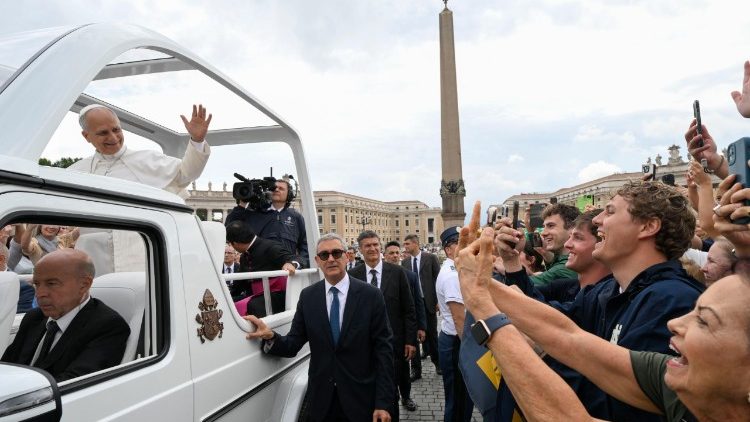
The importance of signs and symbols
The Pope then turned to the signs and symbols of the liturgy that are interwoven with the rite, which help support “the sanctification of man” and are also rooted in creation and human culture.
Pope Leo explained that "sign" and "symbol" are often used as synonyms but in reality “a sign is symbolic when it is able to refer not only to an idea, but to an entire system of meanings and values.”
For example, “when we are sprinkled with holy water, our awareness of the gift received at Baptism and our commitment to new life in Christ is rekindled.”
Pope Leo also highlighted how the sign of water is especially emblematic, as represented in the Bible: “from the origins of creation to the Flood, from the crossing of the Red Sea to the Jordan, right up to the water flowing from Christ’s side, which becomes a sacramental sign of immersion in His death and resurrection.”
Symbols, he continued, are instead practical and first and foremost actions “such as kneeling and exchanging the sign of peace” or “the constitutive acts of each Sacrament.”
“Above all, symbols have a unique performative and transformative dimension,” he said, “both in relation to the material elements of which they are composed and to those who come into contact with them, engendering a sense of belonging, touching the heart and mind, and giving rise to authentic ecclesial relationships.”
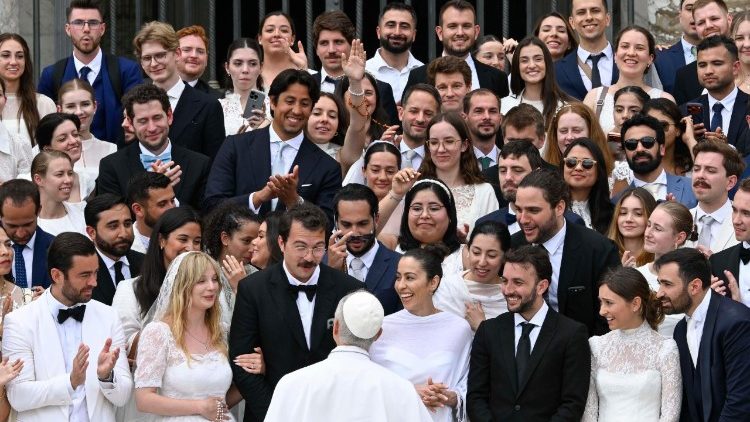
Reawaken an openness to an encounter with God
The Pope ended his catechesis by calling all “to allow ourselves to be educated by the rites of the liturgy, caring for the beauty of our celebrations with a delicate touch and without arbitrariness.”
“The experience of a living and devout liturgy, accompanied by appropriate mystagogical catechesis, is the best resource for reawakening in everyone that openness to the encounter with God which, in the logic of the Incarnation, can only take place by involving the whole person: spirit, soul and body,” he concluded.
Thank you for reading our article. You can keep up-to-date by subscribing to our daily newsletter. Just click here.