
Why Pope Leo's visit to Spain’s Parliament was historic
By Kielce Gussie – Madrid
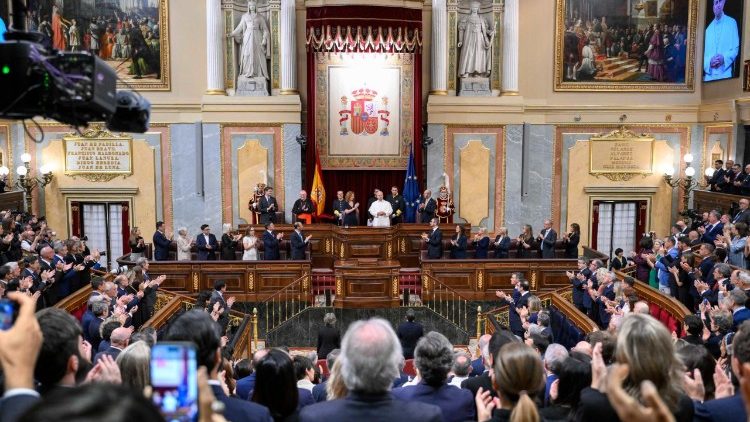
On Pope Leo's third day in Spain, he began with a historic meeting with the Spanish Parliament at the Congress of the Deputies in Madrid.
Vatican News spoke with Prof. Emilio Sáenz Francés, historian and professor of International Relations at Comillas Pontifical University in Madrid, about the impact of this visit and some of the main points on which the Pope spoke.
The professor argued that even without the stop at Parliament, Pope Leo’s journey to Spain was already historic. “It has been about 15 years since the last papal visit,” he explained. So far, Prof. Sáenz highlighted how the visit will continue to be historical because of the different and important stops on the 6-day trip.
The Church has a say
Starting off the work week on Monday—his third day in Spain’s capital city—Pope Leo spent his morning in the political sphere, which, Prof. Sáenz highlighted was a very powerful message. The Pope’s speech “put into a real debate the ideas of the Pope, the ideas of the Pope, this is the ideas of the Catholic Church, and the current Spanish political debate.”
As Spain has a centuries long history and tradition tied to the Catholic Church, the opportunity for these two environments to come together is especially significant because this meeting showed, as the professor said, the relation between the two as alive.
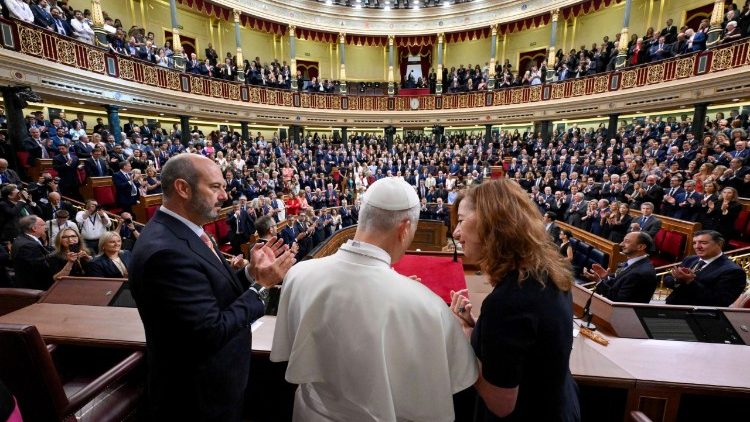
Yet, the Pope’s speech began with an important distinction: the balance between Church and state. The current political situation in the country sees a struggle in this as some would argue the Pope or Church should even have the opportunity to address the Parliament.
For that reason, Prof. Sáenz highlighted the wisdom the Pope had in saying the Church’s role is not to question the legitimacy of political institution.
“Nevertheless, the Church is—and the Pope is—completely entitled to share some reflections about the current social, economic, political reality of the world,” he stressed. Even more, the message needs to be communicated in a language that can reach a Parliament that is very polarized, and topics that are up for debate should also be on the table.
Salamanca: An intellectual history
A critical point of the speech, according to the International Relations professor was when the Pope referenced the School of Salamanca, which at the height of Spanish power, was “a pioneer in developing different topics, like capitalism and human beings.”
In the context of Pope Leo’s message to Parliament, the School of Salamanca is an example of quality intellectual thought with a deep connection to Christianity. Specifically, Prof. Sáenz said it noted the need to limit temporal power—something that in today’s world is relevant. He warned against the declining quality of checks and balances found in democracies.
“We live now in an era of superpowers willing to develop their aims without any kind of control or completely reluctant to fulfill, to commit to the necessary controls within their political culture,” he explained.
Spain, in particular, is coming from years of transition to democracy and now faces a tension between democracy and Parliament and how to balance the two powers. The Pope recalled how in the country, considered one of the cradles of Western culture, there is a greater understanding of the pitfalls that come from what is being valued in global politics.
Prof. Sáenz noted that the papal message was directed at Spain, but he was also talking to “European political frame of mind.”
Dignity challenged on all sides
Governments must create laws based on the recognition of a human dignity that is inherent to everyone. If this is the case, then the law be a safeguard. This is the standard to which the Pope called every country. But the professor recognized that looking at the wider world, this is “extremely difficult.”
He highlighted how the Pope and the Church as a whole today acts as the “necessary beacon to say that there are wrongs in the horizon, that there are wrongs in the present, growing wrongs, and that this is not the way.”

Professor Sáenz argued even history has proven that ignoring this standard does not work. Still, there are challenges to defending this “countercultural position.” Simply look at the state of world politics—war in the Middle East, war in Ukraine, conflicts in Africa.
“It is very difficult to promote precisely what is now being challenged from all quarters,” the professor stressed. At the same time, he explained, it is more important than ever to promote these beliefs with the moral guidance and authority of the Pope.
He pointed out that Pope Leo has seemingly made this one of his onjectives. “He became Pope in one of the moments of greatest geopolitical uncertainties and dangers since precisely the end of World War II.”
A recipe for change
With ongoing conflicts around the world, rearmament has reappeared on the table. Pope Leo made sure to denounce this as a response to the insecurity and challenges we see on the global stage. Rather, he reiterated prioritizing dialogue, international law, and diplomacy over added violence.
Yet, Professor Sáenz recognized that this call goes against the flow of the majority. “It is counter-cultural to, nowadays, defend ideas against rearmament.” But before even getting to weapons, the Pope called for the need to disarm our words. Big things can be accomplished through little steps.
Here, the professor of International Relations invited everyone to recover the “ability to talk from very different political positions, moral positions, political claims and geopolitical ambitions. Let us talk to find common ground as to move forward.”
It worked in the past. It can work again today. Turning to Spain as a “microcosm of the wider world”, Professor Sáenz pointed out that we “can return to the use of words and dialogue as a starting point to make little changes.” Starting there, little by little, even bigger changes could happen.
Thank you for reading our article. You can keep up-to-date by subscribing to our daily newsletter. Just click here.


