
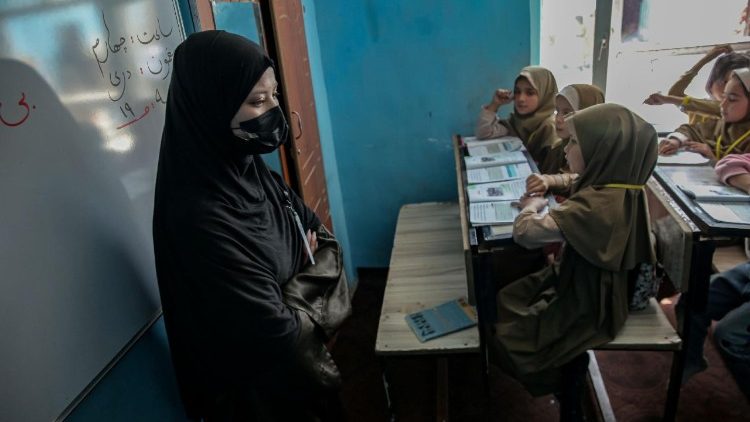
Over 1 million Afghan girls denied education since 2021 ban
By Deborah Castellano Lubov
The UN Children's Fund, UNICEF, reports that over the past five years, at least 1 million girls have been directly affected by restrictions on secondary education, warning that if current decrees remain in place, this number could exceed 2 million by 2030.
According to UNICEF's new analysis "The Cost of Inaction on Girls’ Education and Women’s Labour Force Participation in Afghanistan," over a million girls have been denied the right to learn since the ban on secondary education was imposed in 2021.
UNICEF's Executive Director, Catherine Russell appeals, “We urge the de facto authorities to lift the ban on secondary education for girls and call on the international community to remain committed to supporting girls' rights to learn.”
Grim prospects
Restrictions on girls’ education and women’s employment, UNICEF cautions, could lead to a loss of over 25,000 female teachers and health workers by 2030 in the Middle Eastern country.
The UN agency found that female representation in civil services fell from 21 percent to 17.7 percent between 2023 and 2025, and warns that the diminishing number of trained women professionals in schools and hospitals will devastate children's learning, health outcomes, and future opportunities.
The report warns that removing women from these fields, where they are permitted to work and are critically needed, directly harms children, as it will lead to fewer girls in schools and reduced care for women and children.
Impact on maternal, newborn, and child health services
The declining number of female health workers, UNICEF states, will directly limit maternal, newborn, and child health services, where societal context often prevents women from receiving medical services from men.
“Afghanistan,” Catherine Russell said, “cannot afford to lose future teachers, nurses, doctors, midwives, and social workers, who sustain essential services. This will be the reality if girls continue to be excluded from education.”
Loss of another generation of skilled professionals
The report draws attention to the serious issue of losing trained female professionals while preventing the next generation from replacing them.
"As experienced women retire or leave," the agency notes, "girls are barred from continuing their education and stepping into these roles."
Each year of delay, the UN Children's Fund warns, costs Afghanistan another generation of skilled professionals.
Faced with this struggle, UNICEF appeals for urgent action to restore girls' rights to secondary and higher education and to sustain investment in primary education, which has a significant role in Afghanistan's health, education, and economic future.
“Denying Afghan girls,” Russell said, “access to secondary education robs an entire nation of its potential – locking girls, their families, and their communities into poverty, weakening health outcomes, and silencing the economic engine that an educated generation of women could ignite.”
UNICEF's commitment
UNICEF, the United Nations agency for children, works to protect the rights of every child, everywhere, especially the most disadvantaged children and in the toughest places to reach, in more than 190 countries and territories.
Despite restrictions, the UN agency continues to support children’s education in Afghanistan. In 2025, over 3.7 million children in public schools received emergency support; 442,000 children, 66 percent of whom are girls, benefited from community-based learning initiatives, and 232 schools were built or rehabilitated.
Thank you for reading our article. You can keep up-to-date by subscribing to our daily newsletter. Just click here.


