

Regularisation of migrants in Spain: ‘Every person is an end in themselves'
By Joseph Tulloch
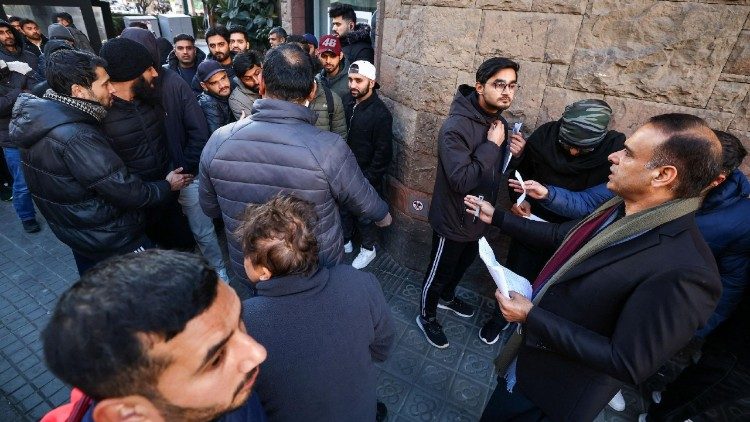
Last month, the Spanish cabinet approved a decree granting legal residency to hundreds of thousands of undocumented migrants.
At a time when deportation and detention dominate discussions on migration elsewhere, it was a striking choice.
In Spain, irregular migrants had lived “for years in the shadows,” said Amaya Valcárcel, International Advocacy Advisor at Jesuit Refugee Service. For the estimated 500,000 to one million affected, regularisation means “recognition of their civil existence” and “a step toward legal security.”
Speaking to Vatican News via email, Valcárcel, who is Spanish, emphasised that irregular migrants carry out “indispensable” work in Spain, in sectors such as agriculture, hospitality, construction and domestic work. However, without access to formal job contracts or safety nets, they live “under constant risk”.
A moral, not economic, issue
Often, arguments in favour of migration are made from an economic standpoint: Western countries need immigrants to contribute to the labour force and pay the pensions of rapidly aging populations.
In a much-discussed New York Times article written earlier this month, however, Spanish PM Pedro Sánchez insisted that the “first and most important” reason for the regularisation was moral, not economic. These migrants, he said, are already part of Spanish society, and deserve to be treated as such.
“On weekends,” Sánchez wrote, “they walk in the parks, go to restaurants and play on the local amateur soccer team”, and yet until now they could not “receive a higher education, pay taxes, or contribute to Social Security”.
Valcárcel highlighted the important overlap here with Catholic Social Teaching, which emphasises that migrants may not “be viewed merely as useful resources for the economy”.
In opposition to such “utilitarian” approaches, Valcárcel stressed, the Church reminds us that “every person is an end in themselves”, a bearer of “inviolable dignity”, and not an “instrument serving short-term needs”.

Next steps
At the same time, Valcárcel stressed, the regularisation “is not a definitive solution”.
It is initially set to last for just one year, naturally creating uncertainty regarding what comes afterward - and, Valcárcel highlighted, it does not remove the need for deeper structural reforms.
Among the necessary changes, Valcárcel pointed to long-term integration policies, robust labour protections, and, crucially, clear pathways for legal migration.
‘Synodal civic engagement’
Finally, Valcárcel also highlighted the decision-making process that lay behind the measure.
The regularisation began with a petition, one which gathered more than 700,000 signatures, and the support of more than 900 civil society organizations. These included the Catholic Church, as Sánchez underscored in his New York Times article.
More than 17,000 volunteers knocked on doors, and visited universities, community centres, and churches, starting discussions and collecting the signatures necessary for the petition to be discussed in Parliament.
In bringing together individuals and organisations from across Spanish society, Valcárcel suggested, the process became – to use ecclesial language – a form of “synodal civic engagement”, an “unprecedented” mobilisation in otherwise polarised times.
Thank you for reading our article. You can keep up-to-date by subscribing to our daily newsletter. Just click here.


