
Mayor of Rome: 2025 Jubilee Year ‘will remain in memory’
By Francesca Sabatinelli and Andrea De Angelis
It was an “extraordinary” Jubilee, in which “collaboration and hospitality” were powerfully evident.
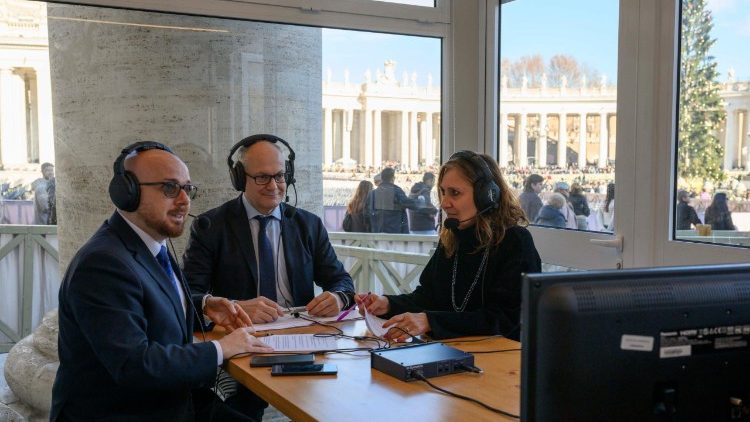
In an interview with Vatican Radio-Vatican News, Rome’s mayor, Roberto Gualtieri, offered that first assessment of the 2025 Jubilee of Hope. The mayor discussed the million young people who took part in the Jubilee of Youth at Tor Vergata, and the major infrastructure projects carried out in Rome in advance of the event.
The following is an English-language transcript of the interview with Roberto Gualtieri.
Vatican News: Mr Mayor, with seven days to go before the closing of the Holy Door of St. Peter’s Basilica, what assessment do you make of this Jubilee?
Roberto Gualtieri: My assessment is very positive. It has been—and continues to be—an extraordinary Jubilee in terms of the level of participation and in terms of the spirit of genuine, tangible hope we have seen in the millions of pilgrims who have come, and who continue to come, to Rome. I also think of the million young people who offered a positive image of the world. It was a Jubilee of very rich content and very deep spiritual values, which called forth signs of hope, as Pope Francis asked in the Bull of Indiction. And it was also a very important Jubilee for the city, because it prompted Rome to renew itself and to transform itself, as Pope Francis indicated when he came to the Capitoline Hill in 2024 and spoke of the Jubilee as a prayerful and penitential pilgrimage to obtain from divine mercy a fuller reconciliation with the Lord. At the same time, he recalled how the Jubilee could—and he hoped it would—have a positive impact on the face of the city, improving its decorum and better connecting the city center with the outskirts. The Pope invited us to welcome pilgrims in the best possible way and, at the same time, to let the values of the Jubilee be visible in the face of the city. Through many actions, we tried to put into practice this message, and I therefore think that Rome embraced this Jubilee perhaps as never before, from the standpoint of encounter and contact. For this reason as well, together with Archbishop Rino Fisichella [pro-prefect of the Dicastery for Evangelization and the Holy See’s official point man for the Jubilee], we wanted many Jubilee events to have stages within the city itself. The jubilees of teenagers, of marching bands, of confraternities—these all experienced moments spread throughout the city’s squares; they mingled with Romans and conveyed the meaning of their pilgrimage and their hope. It was a beautiful, extraordinary Jubilee that will remain in memory and also in the works of our city for a long time to come.
Q: As a Roman, and of course as mayor, how did you experience this Holy Year?
A: I experienced it with a very strong sense of responsibility, because the role of Government Commissioner for the Jubilee that was entrusted to me was added to that of mayor. I have a very beautiful, very intense memory of it—at times very tiring, but also an immense satisfaction. The city must be grateful to the Jubilee. Rome gave the Jubilee great commitment and many volunteers, but we must not forget that the city received an enormous amount from this Jubilee, thanks to which the face of the city has improved.
Q: What moment or event of the Jubilee struck you most? You've already mentioned something about the Jubilee of Young People…
There were several very moving moments. For example, I went to have breakfast with some of the groups of young people who came from various parts of the world for the Jubilee of Young People. I was also deeply struck by the moment of confessions at the Circus Maximus, with all those young people lined up, expressing values of peace and fraternity—they were the face of a possible and real world, one that perhaps clashes with many of the images we see of wars, of a culture of waste, of a world that does not care for the environment. Instead, they represented a possible and at the same time real world—more beautiful, more just, more solidary. Seeing them under the scorching sun, standing in line yet joyful, was truly moving on a personal level. And then again, the Jubilee of Teenagers and that of the Confraternities—seeing these forms of religiosity rooted in the most ancient history of popular sensibilities. The people of the Jubilee who came here to Rome displayed many facets; observing them showed how human beings, though different in history and culture, are at the same time all brothers and sisters.
Q: How did the collaboration between the city administration and the Vatican go? Starting of course with Archbishop Fisichella and the Jubilee Committee ...
A: We worked together, always in a positive way, even during the most difficult moments. I have often spoken of Piazza Pia [the square at the beginning of the main street leading to the Vatican] as the “square of the embrace,” meaning that, although in today’s world the principle of the secular nature of politics and the state is firmly established—without the need for mutual fears or concerns about overstepping boundaries—at the same time the presence of the Holy See in Rome is a positive resource. That is why I like to speak of Piazza Pia as the square of the embrace: it is a square that belongs to the Italian state but that, together with St. Peter’s Square, forms a binational square which, from a logistical point of view, has also made it possible to create a single space capable of holding between 150,000 and 200,000 people. This bears witness to the fact that, in the face of the tragedy of wars and poverty, and of the need to draw upon values of fraternity—which are universal as well as deeply Christian—it is essential to be able to embrace one another, each in their own distinctiveness, yet united by values, including spiritual and religious ones, that unite the vast majority of Italians. This Jubilee has cemented a particularly close and intense form of collaboration; it is a positive legacy, a demonstration of the possibility of working together to help the world become the kind of world we saw in the young people at Tor Vergata and at the Circus Maximus—a world of fraternity and peace. This Jubilee has shown that such a world is possible.
Q: Mr Mayor, you mentioned Pope Francis. What was your relationship with him like, and what is your relationship with Pope Leo like?
A: My relationship with Pope Francis was very intense and very profound. He chose to return to the Capitoline Hill just a few years after his previous visit precisely to deliver an important message about Rome’s role in the Jubilee. He showed great attention to our city, guiding not only the spiritual aspect with the extraordinary Bull of Indiction Spes non confudit, but also offering direction regarding the type of works and interventions—naturally without ever entering into specifics. Pope Leo, from the very beginning, chose to offer a very important sign. I was struck—and it was also moving—that he chose to stop at the Capitoline Hill when he went to take possession of St. John Lateran, as a sign of attention toward the city’s civil government. He used very important words; I was struck by his very deep spirituality and, at the same time, by his attention to issues of great importance, such as work and the impact of new technologies. In short, a relationship has begun that I am sure will be profound, intense, and positive.
Q: You have described Rome as a city of welcome during this period, from which a universal message of peace has arisen and continues to arise. Could the legacy of the Jubilee also consist in new major international events for the capital?
A: First of all, there will be another Jubilee, because in 2033 there will be the Jubilee dedicated to the death and resurrection of Jesus. And then, of course, this strengthens Rome’s ability to host many major events, many of which take place precisely thanks to the Holy See, which hosts summits on peace, on the environment—and this too is part of the added value of close collaboration between Italy and the Holy See. We have done many positive things, but the fact that the Jubilee went well does not make problems, poverty, or exclusion disappear. I hope that this positive energy will also be transformed into the capacity to address these problems and to reduce divisions and fractures. Our city’s vocation to hospitality must be directed to the challenges that await us.
Thank you for reading our article. You can keep up-to-date by subscribing to our daily newsletter. Just click here.


