
Analysing AI's impact on media, communities and inequalities
By Isabella H. de Carvalho
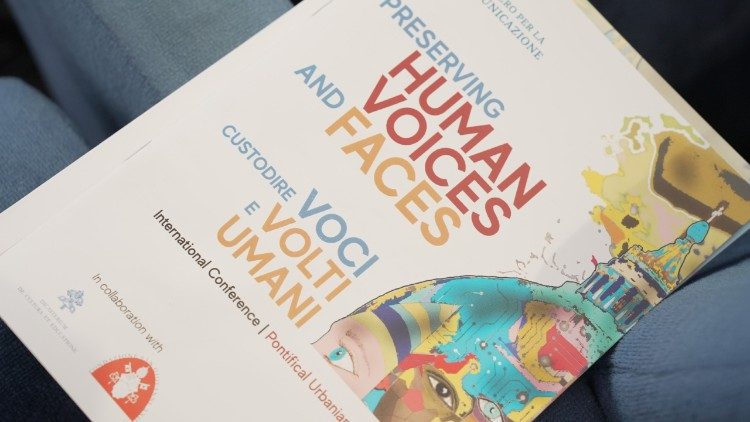
A few days before the publication of Pope Leo XIV’s first encyclical, Magnifica humanitas, on preserving the human person in the age of artificial intelligence, the Vatican’s Dicastery for Communication gathered international academics, technology experts, journalists, and more to reflect and discuss on this very topic.
The theme of the international conference, “Preserving Human Voices and Faces,” echoes Pope Leo’s message for the 60th World Day of Social Communications (celebrated Sunday, May 17) and focuses on the impact of AI on the lives of individuals, communities and nations.
The event was held on May 21 at the Pontifical Urbaniana University in Rome and was organized in collaboration with the Vatican's Dicastery for Culture and Education and the John XXIII Foundation.
What does preserving mean today
“Preserving” is a word that challenges us, it means “taking care of someone with love and responsibility,” said Paolo Ruffini, Prefect of the Dicastery for Communication, in his introductory remarks.
“The greatest danger,” he continued, “lies in passively accepting the idea that knowledge no longer belongs to us; and that something we ourselves have built—algorithms, platforms, or automated systems—can then be entrusted with thinking for us, with completely programming our lives and even the way we communicate with others.”
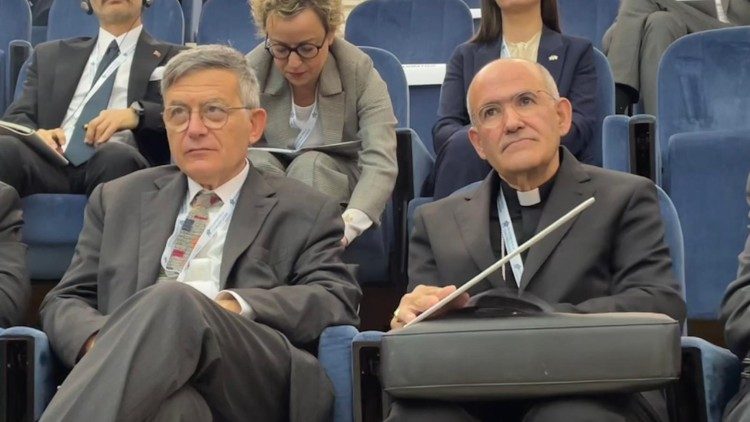
Cardinal José Tolentino de Mendonça, Prefect of the Dicastery for Culture and Education, highlighted in his introduction how the theme “preserving human voices and faces” is “a program—indeed, a profession of faith in humanity—at a time when the boundaries between reality and simulation are becoming increasingly blurred.”
“Human beings can never be reduced to a statistic, a profile, or an algorithm. What is human is always something more, a mystery, a call,” he said.
The Cardinal emphasized that “preservation isn’t about locking something away in a display case,” but rather about “protecting what is fragile so that it may continue to flourish,” such as human voices and faces that can be “cloned, manipulated, silenced,” but also “reborn in every genuine encounter.”
AI’s impact on journalism, society and community
The morning sessions were focused on the topic “To be or not to be: simulating relationships and reality,” with the first panel reflecting on AI’s impact on journalism, society and community.
Marijana Grbeša Zenzerović, a Professor at the University of Zagreb and Vice-Chair of the Committee of Experts on Online Safety and Empowerment of Content Creators and Users (MSI-eSEC) at the Council of Europe, underlined how artificial intelligence has disrupted journalism, how people consume their news, and political communication, through phenomena such as disinformation, rage baiting or others.
She noted how we are already in what years ago seemed like the “darkest scenario,” as people do not trust anyone or anything anymore, but she added that she believes the only solution lies in the three pillars identified in Pope Leo XIV’s message for the World Day of Social communications meaning education, responsibility and cooperation.
Eli Pariser - co-founder and co-director of New_Public, a nonprofit dedicated to building digital public spaces where people can flourish, thrive and connect – insisted in his address that “there is another path available to us” today when it comes to AI as it “can be engineered to be parasitic or pro-social.”
“We need a positive vision of human sociality that co-exists and is supported by a world with powerful AI,” he said. He highlighted that this idea can bring together policy makers from across the political spectrum, as well as religious institutions and other actors.
Then, Kashmir Hill, a Tech reporter for The New York Times, shared how through her reporting she has seen how many people have lost touch with reality by entertaining relationships with AI chatbots. She underlined however that the risks that come with not being able to tell what is real or true extends to all users of these systems.
Lastly, Vineet Khosla, Chief Technology Office of The Washington Post, shared instead how they are trying to do “ambitious journalism” by creating AI tools that can support their reporters and enhance their jobs. This means offloading certain tasks or helping readers find reliable information produced by the media outlet.
“There is already a generation of users who have gone to ask AI for news,” he said. “We want to be there where our next generation of news consumers already are and show them there is a right way" to consume news.
Are AI models intensifying social inequalities and injustices?
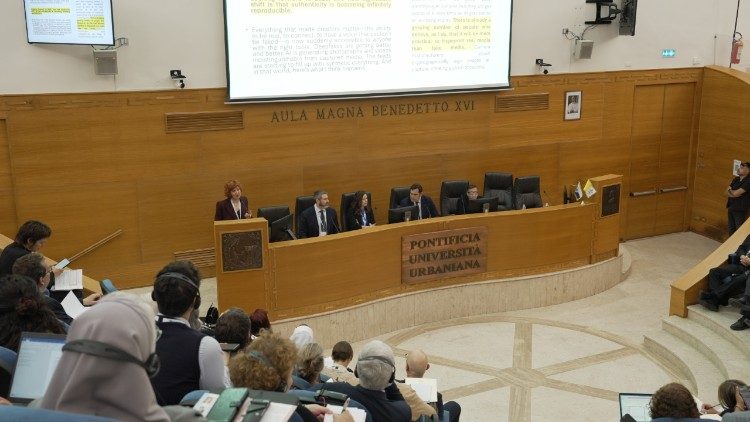
The morning’s second panel, instead, reflected on the question of whether AI models are intensifying social inequalities and injustices. Paola Ricaurte Quijano, Professor at the Department of Media and Digital Culture at Tecnológico de Monterrey (Mexico), explained “how the dominant model of AI development reproduces structural violence and inequality at the macro, meso and micro level,” which affects disproportionately communities and countries on the margins.
She noted for example how an AI chatbot could not write something in Mixe - an indigenous language spoken in Mexico by over 100,000 people – when asked, so “a millenary language, knowledge and community that did not exist for this system.”
“Who is harmed by AI, how, and whose lives, bodies, faces, voices and knowledge count?,” she asked.
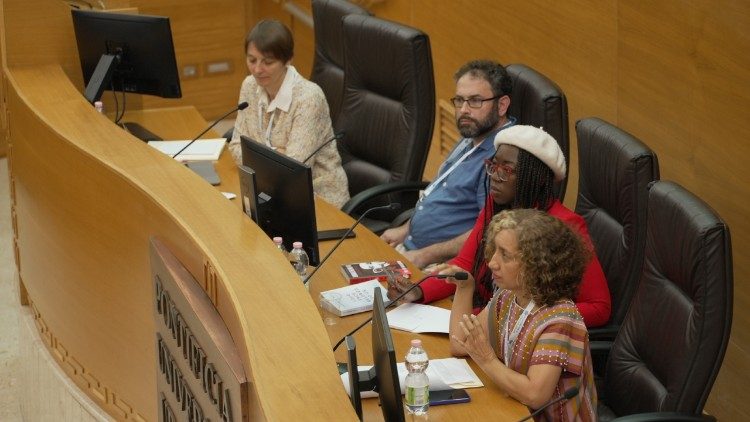
Benjamin Rosman, a Professor of Computer Science and Applied Mathematics and Director of the MIND Institute at the University of the Witwatersrand in South Africa, emphasized instead how the world is currently experiencing a race when it comes to AI development and that the real inequality for him lies not “in those who have it and those who don’t” but rather those who have the opportunity to shape it.
He noted he is trying to build grassroots initiatives and movements in Africa across countries that can involve people and make them participate in the global conversation on AI.
“If the future of communication, trust and simulated relationships is shaped only by a handful of companies, countries and world views then the result will not reflect the richness of humanity,” he said.
Lastly, Dr. Joy Buolamwini, Founder of the Algorithmic Justice League, fellow at Oxford University's Institute for Ethics in AI, and an AI researcher and poet, underlined the plight of the “excoded,” a term she developed to define “those who live the nightmares of AI discrimination and exploitation.”
This ranges from artists whose works are being stolen, to people being killed due to military systems using AI to identify targets, to those being misidentified through AI identification.
“It is not too late to unmask AI and protect what is human in a world of machines,” she said.
Thank you for reading our article. You can keep up-to-date by subscribing to our daily newsletter. Just click here.


