
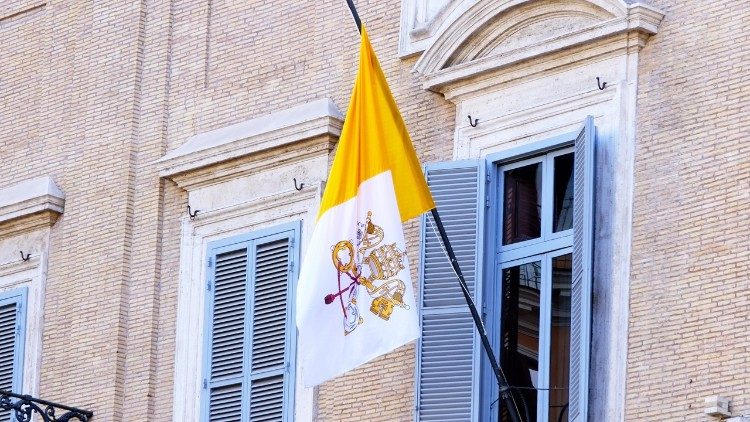
Pontifical Ecclesiastical Academy's mission to build peace in a conflictual world
By Salvatore Cernuzio
“Building bridges of peace and justice, restoring authentic relationships, and promoting a civilization founded on love and respect for the dignity of every person.”
With these words, Archbishop Salvatore Pennacchio, President of the Pontifical Ecclesiastical Academy, summed up the mission and diplomatic action of the Holy See in the face of the many new challenges confronting the world today.
This is precisely the focus of a conference taking place on Saturday, 17 January, in the Vatican Apostolic Palace, which will open with a message from Pope Leo XIV.
The programme includes a lectio magistralis by the Grand Chancellor of the Pontifical Ecclesiastical Academy, Cardinal Secretary of State Pietro Parolin, followed by a historical overview of the Academy by Professor Silvano Giordano and a reflection on the reform of the institution by Professor Vincenzo Buonomo, Scientific Director.
The final address will be delivered by the Ambassador of Cyprus, George Poulides, Dean of the Diplomatic Corps accredited to the Holy See.
The conference opens with a prayer and greeting by Archbishop Pennacchio himself, who, speaking with Vatican News in the following interview, reflects on the themes of the conference in the light of current events.
Q: Archbishop Pennacchio, what is the diplomatic action of the Holy See in the face of the new and numerous challenges of today’s world?
The diplomatic service of the Holy See is a service of communion, drawing its strength from Christ and the Gospel, and expressed through concrete closeness, attentive listening, and constant dialogue.
Today, in a world marked by conflict, geopolitical shifts, cultural change, and environmental transformation, Vatican diplomacy is called to engage daily with a reality that is increasingly globalized and interconnected.
Its mission responds to an urgent need: to build bridges of peace and justice, to restore authentic relationships, and to promote a civilization founded on love and respect for the dignity of every person.
For those who work alongside the Successor of Peter, it is essential to cultivate an attentive, far-sighted, and practical outlook, capable of listening to the voice of God and translating it into concrete action, especially in service to those most in need.
Q: In an era marked by conflict, what value does the widespread presence of the network of Apostolic Nunciatures across the five continents hold?
The presence of Apostolic Nunciatures in different parts of the world—some of them deeply scarred by conflict and division—concretely expresses the Pope’s constant concern for the universal Church and for the particular Churches.
It makes visible a pastoral solicitude that is not exercised from afar, but is rooted in the real contexts in which peoples live.
As Cardinal Secretary of State Pietro Parolin emphasised during the Jubilee Year of the Pontifical Ecclesiastical Academy, the diplomatic service is a living part of the Petrine ministry, through which the Pope exercises a closeness capable of reaching everyone, bearing witness to a Church that is a caring and merciful mother.
The task of Pontifical Representatives, therefore, is to foster direct and ongoing listening to local realities, enabling the Holy See to carry out a role of discreet and patient mediation, orienting its action towards peace, dialogue, and respect for the dignity of the human person.
Q: In April 2025, Pope Francis updated the formation programme of the Pontifical Ecclesiastical Academy—commonly known as the “School of Nuncios”—through a chirograph. How has this reform changed the training of future Pontifical Representatives, and what new impetus has it provided?
With the chirograph Il Ministero Petrino, Pope Francis restructured the Academy as an Institute of Advanced Formation in Diplomatic Sciences, aligning it with the vision set out in the Apostolic Constitution Veritatis Gaudium and with international standards for university studies.
The start of the 2025–2026 academic year has already seen the reform put into practice, granting new students access to formation programmes designed to integrate essential canonical training and diplomatic sciences with the history of international relations, diplomatic practice and style, international law, and the study of modern languages.
This renewal, however, is not limited to a purely technical approach aimed solely at the acquisition of theoretical knowledge. Rather, it outlines a comprehensive and demanding path that promotes the integral formation of the Academy’s students.
We remain convinced that an academic must first and foremost be a man of God, capable of becoming an instrument of ecclesial communion, sent to accompany the journey of local episcopates and of all the baptized, and therefore a qualified representative, able to face the responsibilities ahead with human depth, institutional sensitivity, and solid professional competence.
Q: The Ecclesiastical Academy has a centuries-long history. How has it managed to navigate periods of profound change?
The Jubilee Year currently being celebrated by the Pontifical Ecclesiastical Academy is, above all, an opportunity to give thanks to God for the journey begun in 1701 at the will of Pope Clement XI.
This significant anniversary is not merely a moment to recall the past, but also an opportunity to embody that principle intrinsic to the central governance of the Church—semper reformanda—by adapting and renewing the formation of priests destined for the diplomatic service of the Holy See.
This anniversary marks not only an important historical milestone, but also invites each of us to renew the Academy’s commitment to its mission.
We are living a time of memory and gratitude that, on the one hand, strengthens and sustains the institution, and on the other, urges it to engage with the challenges of our own time.
We believe that the Academy’s ability to guide future diplomats through changing eras lies precisely in its fidelity to the Gospel. Through this fidelity, the institution can continue to serve the Pope and the Church, always finding appropriate ways to read and interpret history through the eyes of faith.
Q: On the occasion of the Jubilee of staff serving in the Pontifical Representations, Pope Leo XIV urged them to bring hope even in contexts of conflict and absence of peace. How can this be achieved?
During the meeting, Pope Leo XIV recalled the urgent need for peace, not only for the Church but for the entire world.
For diplomats of the Holy See, this commitment is rooted in the virtue of hope, in the conviction that peace is born above all as a gift from God.
It is the task of the Pontifical Representative to nurture this hope in the light of Christ, through a spiritual life grounded in daily listening to the Word of God and in prayer.
As the Pope reminded those present, Vatican diplomacy is not merely a technical endeavor, but one that springs from the Gospel, which inspires, guides, and sustains it.
Even in contexts of conflict, or where building bridges of peace is particularly difficult, the diplomat is called to bear witness to the Father’s love, bringing closeness to those who suffer and attention to the poorest and most marginalized.
As Saint Paul VI observed, it is “a unique and privileged service, often hidden and unknown”, which allows seeds of hope to take root even in the most challenging situations.
Thank you for reading our article. You can keep up-to-date by subscribing to our daily newsletter. Just click here.


