
Commitment to peace born from contemplating face of the Christ Child
By Andrea Tornielli
“Nothing has the power to change us as much as a child. Perhaps it is precisely the thought of our children and of others who are equally fragile that cuts to the heart.”
These are the words Pope Leo XIV used in his Message for the World Day of Peace.
God, the Almighty, in becoming human, accepts becoming a Child totally dependent on the care of a mother and a father, according to the logic of smallness, and chooses to come into the world in the poverty of a stable and in the obscurity of a peripheral corner of the Roman Empire. He is “a defenseless God, in whom humanity can discover itself as loved only by caring for Him.”
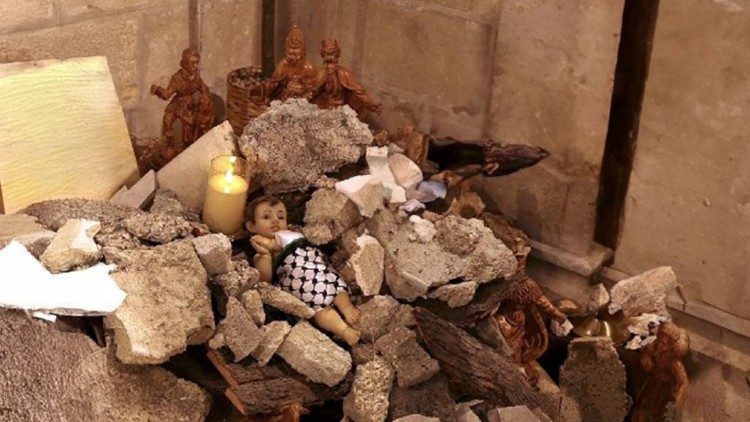
To look upon that Child, the central figure of our Nativity scenes, cannot leave us indifferent to the tragedy of the many children who are victims of war: those who have died under the bombs in Ukraine; those killed in Gaza—first by a rain of missiles and now by the cold, because humanitarian aid struggles to reach them; and those who have died in the many forgotten conflicts in so many other parts of the world.
The invitation that the Successor of Peter addresses to believers and non-believers alike is to welcome and recognize peace, overcoming the temptation to regard it as distant and impossible.
For Christians, peace and non-violence have profoundly evangelical roots in the words and attitude of Jesus, who ordered Peter—when he tried to defend Him—to put his sword back into its sheath.
The peace proclaimed to the world by the Risen Christ is unarmed and disarming; it is a reality to be safeguarded and nurtured in our hearts, in our relationships, in our families, in our communities, and in our countries. History teaches us how often, even as Christians, we have forgotten this, making ourselves complicit in tragic wars and acts of violence.
Today, Pope Leo XIV reminds us that we too risk seeing peace as a distant ideal, to the point of justifying war as a means to achieve it.
In public debate and in the media, an aggressive and confrontational logic seems to prevail, according to which it becomes a fault “not to be sufficiently prepared for war.”
This is a destabilizing and extremely dangerous logic that goes far beyond the principle of legitimate defence and leads us towards the abyss of a new world conflict, with unpredictable and devastating consequences.
“Today more than ever, we must show that peace is not a utopia by fostering attentive and life-giving pastoral creativity,” the Pope writes.
Instead of continuing down the path of a constant increase in military spending—which has reached 2.5 percent of global GDP; instead of investing thousands of billions in instruments of death and destruction destined, as we have seen, to level schools and hospitals; instead of persuading ourselves that our security lies in rearmament and deterrence—we need the courage of peace.
We need to reopen the path of diplomacy, negotiation, mediation, and international law, also by strengthening international institutions.
Let us not allow Pope Leo’s words to become a voice crying in the wilderness. Let us not leave the Bishop of Rome standing alone. Let us place our trust in his words and look to history to understand how much realism there is in his interventions, as there was in those of his predecessors, too often ignored.
We are called to “encourage and support every spiritual, cultural, and political initiative that keeps hope alive, countering the spread of ‘fatalistic terms, as if the dynamics involved were the product of anonymous impersonal forces or structures independent of the human will’.”
Peace is possible, and the reckless rush towards rearmament is not the way to defend it. For Christians, peace bears the defenseless face of the Child who is God, fragile like every child.
May we allow our hearts to be pierced by that Face and by the proclamation of peace that rang out on the night of the first Christmas.
Thank you for reading our article. You can keep up-to-date by subscribing to our daily newsletter. Just click here.


