Pope to human traffickers: Repent! Divine justice awaits you
Vatican News
Pope Leo has one again called for a renewed commitment to migrant integration insisting that welcome must go beyond emergency assistance and become a process that restores dignity, belonging and opportunity.
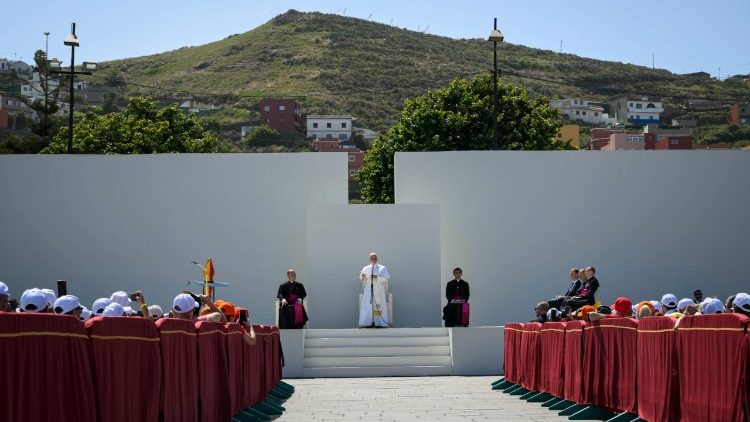
Addressing Church groups, charities and civil organisations in San Cristóbal de La Laguna on Friday, during the final day of his Apostolic Journey to Spain, the Pope reflected on the role the Canary Islands continue to play as one of Europe's principal migration routes.
The meeting took place in Plaza del Cristo de La Laguna, in Tenerife, where the Pope praised the work of organisations accompanying migrants after their arrival on the islands and challenged societies to move beyond fear and indifference.
"A city without walls"
Beginning his address, Pope Leo referred to a description he had heard of La Laguna as "a city without walls." The image, he suggested, points to a deeper challenge. He explained that "the barriers that are the hardest to break down are not always made of stone" and that instead they "sometimes they lie in our attitudes, in fear or in indifference."
The Canary Islands have become one of the European Union's busiest migration frontiers in recent years. Located around 100 kilometres off the northwestern coast of Africa, the Spanish archipelago is often the first European territory reached by migrants and refugees departing from countries such as Senegal, Mauritania, Mali and Gambia.
The Atlantic route is considered one of the world's most dangerous migration corridors, with thousands attempting the crossing each year in overcrowded and often unseaworthy boats. Many arrive exhausted after days or weeks at sea, while countless others never complete the journey.
"The sea which surrounds these islands brings us stories that we do not always know how to interpret: stories of pain, of hope and of searching," the Pope said.
Learning to see differently
Pope Leo's reflection emphasised the idea that integration requires a different way of seeing. Drawing on the example of Braille and tactile forms of communication, he suggested that people must learn to "read" the lives of migrants through closeness and encounter rather than statistics or administrative categories.
"There are those whose gazes see and yet do not recognize," he said. "They turn a face into a number, a story into a file and a difference into distance." Instead, he argued, the Gospel teaches a way of seeing rooted in patience, accompaniment and practical solidarity.
Beyond charity
The Pope went on to stress that solidarity cannot be reduced to philanthropy or occasional acts of generosity. "Welcome opens the door; integration helps one cross the threshold," he said. "Assistance applies a salve to the wound, and integration rebuilds the future."
He went on to reject approaches that either force migrants to abandon their identity or encourage communities to live separately without meaningful interaction. Rather, integration, he explained, is "a reciprocal journey" in which newcomers learn the language, laws and customs of their new home while those receiving them learn to widen their horizons without losing their own identity.
Addressing migrants directly, Pope Leo encouraged each person to participate fully in the life of their new communities and to offer their talents and experiences for the common good.
More than a problem to be managed
Pope Leo also challenged attitudes that reduce migration to political or administrative questions. He explained that "we are speaking, above all, of people created in the image and likeness of God," he said, "rather than legal categories or problems to be managed."
He then reflected on some of the testimonies he had heard just moments before, including those of two migrant men named Khalid and Mbacke. The Pope noted that many people arriving on the islands are searching not only for safety but also for the possibility of rebuilding their lives. "They are looking for someone to tell them through actions rather than with words: your life is not a waste; your suffering is not invisible; your dignity has not been washed away in the waters you have crossed."
At the same time, he added, they seek opportunities to work, contribute and participate, rather than remaining permanently defined by vulnerability.
Preventing a "second shipwreck"
Pope Leo then went on to speak about what he described as a "silent shipwreck" that can occur after migrants arrive safely. While many die attempting to cross the sea, he said, others face isolation, exploitation and exclusion after reaching their destination.
"There is also a silent shipwreck that occurs after arrival," he warned, describing those left "without a voice, without ties, work or a sense of security."
"Integration means preventing that second shipwreck", he said. For this reason, he praised the work of diocesan Caritas, migration offices, parishes and local organisations that accompany migrants beyond the immediate emergency phase and help them establish stable lives within society.
A warning to traffickers
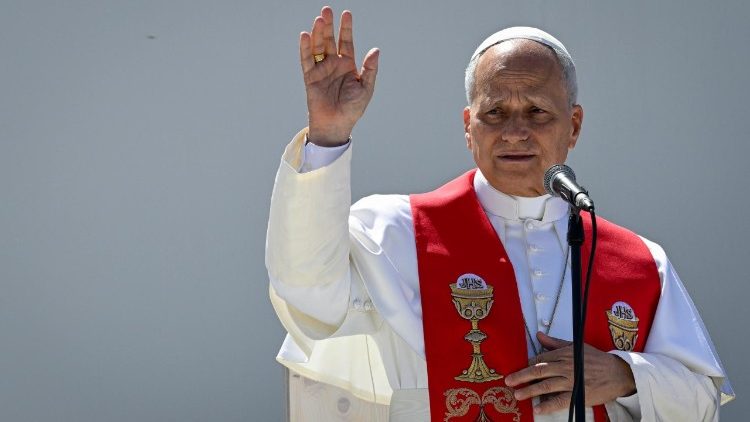
Pope Leo then turned his appeal torwards those who profit from migration and human suffering. Addressing human traffickers, exploiters and criminal networks involved in the movement and abuse of vulnerable people. "Stop. Repent," he said. "For every life lost, every family deceived, every body subjugated, every woman threatened, every worker exploited, you will have to appear before divine justice", he said.
He then condemned those who organise dangerous migration routes, exploit workers, threaten women and profit from desperation, warning that "the tears and blood of these brothers and sisters cry out to God."
"The money wrested from the vulnerability of the poor will bring neither peace, nor honour, nor a future," he added, before urging those responsible to free those they exploit, return what has been taken and seek reconciliation before it is too late.
A Christian response
The Pope then went on to remind those present that integration cannot be viewed solely as a social project.
Along with practical support such as housing, language assistance, employment and legal protection, migrants should encounter Christian communities capable of offering friendship, witness and accompaniment. "A Church that welcomes is also a Church that proclaims," he said, stressing that the Gospel must be shared "without imposing" it and always with respect for freedom of conscience.
Bringing his address to a close, Pope Leo pointed to the Holy Family's flight into Egypt as a lasting symbol for migrants and refugees throughout history.
"The Holy Family of Nazareth," he concluded, "remains for all time a model and refuge for every refugee family, every migrant and every person forced to leave their homeland."
Thank you for reading our article. You can keep up-to-date by subscribing to our daily newsletter. Just click here.