Pope: War is gravest attack possible against life and public health
By Isabella H. de Carvalho
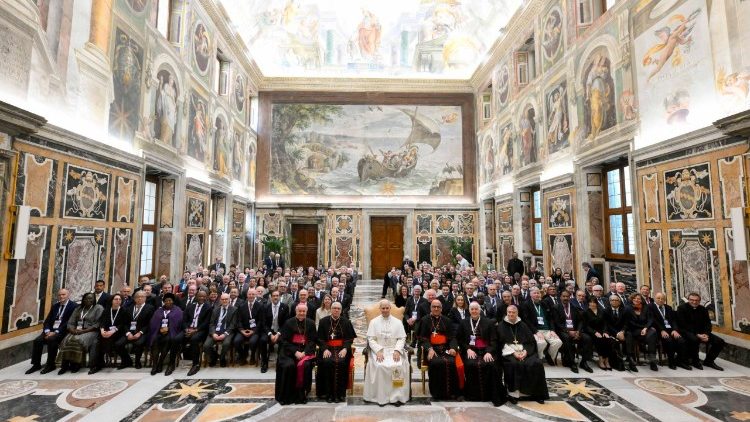
In a world consumed by conflicts, we must dedicate time and resources to promote life and health, while addressing inequalities by strengthening our understanding of the common good, Pope Leo highlighted on Monday, February 16.
Today, we are faced with “wars that impact civilian structures, including hospitals, which constitute the most grave attacks that human hands can make against life and public health,” he said, in his address at the Vatican to the participants in the Plenary Assembly of the Pontifical Academy for Life.
“In a world scarred by conflicts, which consume enormous economic, technological, and organizational resources in the production of arms and other types of military equipment, it has never been more important to dedicate time, people, and expertise to safeguarding life and health.”
The Pontifical Academy for Life’s Plenary Assembly takes place in Rome on February 16-17 and focuses on the theme “Healthcare for all: Sustainability and equity.”
Health is not promoted in same way for everyone
Pope Leo expressed his appreciation for this theme. "It is often said that life and health are equally fundamental values for all, but this statement is hypocritical if, at the same time, we ignore the structural causes and policies that determine inequalities," he said.
“Despite declarations and statements to the contrary," he continued, "all lives are not equally respected, and health is neither protected nor promoted in the same way for everyone.”
He explained that “the situations in which communities find themselves,” in terms of their quality of health and life, “are the result of social and environmental policies,” which affect variables such as income, education or the neighborhood one lives in.
“When we look at life expectancy and the quality of health in different countries and social groups, we discover enormous inequalities,” he said.
One health and our interdependence
The Pope emphasized in this regard the importance of recognizing “the connection between the health of all and that of each individual," adding how the COVID-19 pandemic demonstrated this reality.
Our responsibility, he said, lies “not only in taking measures to treat diseases and ensure equitable access to healthcare, but also in recognizing how health is influenced and promoted by a combination of factors, which need to be examined and confronted in their complexity.”
He compared this to a mosaic where different fields such as “medicine, politics, ethics, management, and others” need to come together to confront all-encompassing issues and find solutions. He added that this also means not focusing “on immediate profit, but on what will be best for everyone.”
Continuing on this line of thought, the Pope insisted on the importance of promoting the concept of “one health,” which “emphasizes the environmental dimension and the interdependence of the various forms of life and ecological factors that enable their balanced development.”
“One health” can be “a basis for a global, multidisciplinary, and integrated approach to health issues,” as it reminds us that “human life is incomprehensible and unsustainable without other creatures,” the Pope said.
In terms of public health, Pope Leo explained that this concept “calls for the integration of health considerations into all policies (transportation, housing, agriculture, employment, education, and so on).”
Strengthening our understanding of common good
Therefore, to promote this concept, the Pope reflected that “we need to strengthen our understanding and promotion of the common good,” so it does not succumb to specific individual or national interests.
He added that the common good is “one of the fundamental principles of the Church’s social teaching," and it “risks remaining an abstract and irrelevant notion if we do not recognize that it is rooted in the fostering of close relationships between people and bonds between members of society.”
The Pope noted that this is the ground upon which a “democratic culture” uniting “efficiency, solidarity, and justice” can grow, calling for all to “rediscover the fundamental attitude of care as support and closeness to others, not only because someone is in need or is sick, but because they experience vulnerability, which is common to all human beings.”
He insisted that only in this way “will we be able to develop more effective and sustainable healthcare systems, capable of satisfying every health need in a world of limited resources as well as restoring trust in medicine and healthcare professionals, notwithstanding any misinformation or skepticism regarding science."
In this regard, Pope Leo XIV reiterated his call to strengthen international and multilateral relations so that conflicts can be prevented and no actor prevails over another “with the mindset of force.”
“This vision also applies to the cooperation and coordination carried out by supranational organizations engaged in the protection and promotion of health,” he concluded.
Thank you for reading our article. You can keep up-to-date by subscribing to our daily newsletter. Just click here.