UN High Commissioner for Refugees: Church an important partner in helping refugees
By Isabella H. de Carvalho
The UN Refugee Agency, UNHCR, reported that as of mid-2025, 117.3 million people globally had been forced to flee their homes due to conflict, violence, persecution, or other events, and among them were nearly 42.5 million refugees.
Pope Leo XIV—like his predecessors before him—has repeatedly expressed the Church’s concern for migrants and refugees and has urged the world to not remain passive in the face of this issue.
On Monday, January 26, 2026, the Pope met with Barham Salih, United Nations High Commissioner for Refugees and former President of Iraq from 2018 to 2022, at the Vatican. Mr. Salih experienced life as a refugee himself, and has now begun this new role at the UN Refugee Agency, as of January 1, 2026.
In an interview with Vatican News, the UN High Commissioner talks about his meeting with Pope Leo XIV and explains the different challenges that the UNHCR faces in its work today, as many refugees struggle to get out of situations of displacement and humanitarian organizations are stretched for resources.
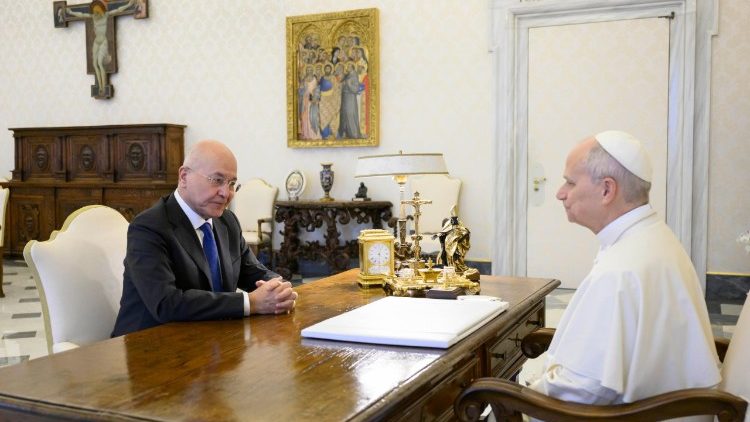
Q: How was your meeting this morning with Pope Leo XIV?
It was truly a great honor for me to meet His Holiness. I was keen to have this audience early on in my tenure. I've only been in this position as High Commissioner for Refugees for less than four weeks, so it was a great opportunity for me to speak to His Holiness about the plight of refugees.
I'm gratified for his unrelenting support for refugees worldwide, and his moral authority really matters. His support for what we do at UNHCR is absolutely important. We emphasize the need for our partnership with the Church and with faith-based organizations as we try to deliver on our mandate of helping refugees worldwide.
The voice of the Pope and his moral authority is of consequence. We consider this an important partnership and asset that we rely on, as we move to deliver on our mandate in helping refugees worldwide.
Q: You took office on January 1. What are the priorities of your mandate?
I'm taking this responsibility at a time of immense challenge: unprecedented levels of displacement, at a time of shrinking humanitarian space, and limited resources available to deal with the scale of the problem that we have.
My priority will be a focus on advocacy to provide more resources to the needs of the refugee population around the world, but at the same time to really deliver on our mandate. This means protection for refugees, providing emergency life-saving assistance to people who are in desperate need, but also working hard on durable solutions.
It's not good to see so many refugees condemned to a situation of protracted displacement for five years or more, sometimes a decade or even two. These people are stuck in camps dependent on international humanitarian aid. That is not acceptable. We really need to move beyond that, towards more inclusive and durable solutions.
I was in Chad and Kenya last week where I met refugees who have been in some of these communities for the last 25 years or so, since 2003, and more were arriving literally the day before. This tells me that we need to do more about people who are condemned to situations of protracted displacement.
That is something that the UNHCR cannot do on its own. It requires a more collective effort with other UN agencies, but also host nations and the international community and development banks. In that way we can create conditions for these host nations to accommodate refugees and include them in their national lives as contributors instead of just being dependent on humanitarian aid.
Countries like Kenya, Ethiopia, Uganda and Chad are adopting more inclusive policies and accommodation for refugees, allowing them into their national system, the health services, education system, the job markets, access to legal services and financial services.
This needs to be encouraged through development aid so that this is beneficial to the host nations and also allows for inclusion of refugees beyond a life in a camp because the end of the day, refugees are not just numbers.
They are people with agency. They deserve dignity. They deserve protection.
Q: How is UNHCR responding to the current emergencies across the world, considering the drastic funding cuts suffered in recent months, mainly due to the reduction in aid from the United States? What impact will this have in the coming months?
The United States has recently allocated $2 billion of assistance to the pooled fund at the United Nations with the United Nations Office for the Coordination of Humanitarian Affairs (OCHA). This is welcome and we are hoping for more assistance coming that way.
But, undeniably, given the scale of the problem, the resources available are very limited. We need to mount a far more active campaign of advocacy to bring in more resources. At the end of the day, helping with the plight of refugees is a collective international responsibility. If you look at the numbers, they are really staggering and the needs are real, so we need more resources, no doubt about it.
By the same token as well, we should be adapting more. We should be enhancing our reform agenda and creating more efficiencies in the system so that the help available is really getting to the people it is intended for.
We are already—together with other UN agencies—engaging in some of these reform and efficiency drives to make sure that the international aid system is far more responsive and far more cost-effective.
Q: The number of refugees and those who are displaced is constantly increasing, reaching record numbers of people fleeing from conflict, human rights violations, and climate crises. It is a growing trend and nothing seems to be able to stop it... What are the most pressing issues for UNHCR at the moment, and where are the most urgent needs?
If one goes to the countries surrounding Sudan and looks at the refugee influx from the country, there is definitely an urgent need. If one speaks of the situation in the Democratic Republic of Congo, it's an urgent need.
If one talks about Venezuela and the dynamics there, it's an urgent need. Or if one looks at the Rohingyas, where many people have been stuck in camps and in this situation for the last two decades. One cannot but classify and categorize it as an urgent need. It’s a very difficult situation to say where the urgency is.
While we focus on the day-to-day needs of people, humanitarian assistance is also vital to look at pathways for durable solutions.
We have to work hard at finding sustainable solutions that allow these refugee communities to be included in national life and to be self-reliant. These solutions also need to be consistent with their fundamental human rights of protection and dignity, but also be helpful to the host nations that they are in today.
Q: What worries you the most in your current role?
Lack of resources is fundamental, and every crisis that comes asks more of our resources, and there are many crises around the world.
In that context, I want to say that the world is called upon to do more to prevent conflicts from escalating and to contain and resolve. The displacement crisis has one fundamental solution and that is peace and having people have the choice of going back to their homes in security and in dignity.
Q: What appeal would you like to make to the international community?
It's our legal responsibility as an international community to protect and provide assistance to people who are in need. We also need to help provide durable solutions for those who have been displaced. This is a legal responsibility, it's a moral obligation and it speaks to our collective humanity. This is the moral thing to do and it's also the right thing to do.
Q: You spoke earlier about the importance of having close partnerships with the Church and faith-based organizations. How can religious entities help UNHCR?
Faith-based organizations and Church organizations have been out there helping. I can attest from personal experience the important work that they have done and the important partnership that they have with the United Nations.
My hope is that we can also work far more with other faith organizations and work on this interfaith philanthropy that can come together to speak to the core values of our faith in terms of humanity, and in helping our fellow human beings who are in need.
Thank you for reading our article. You can keep up-to-date by subscribing to our daily newsletter. Just click here.