
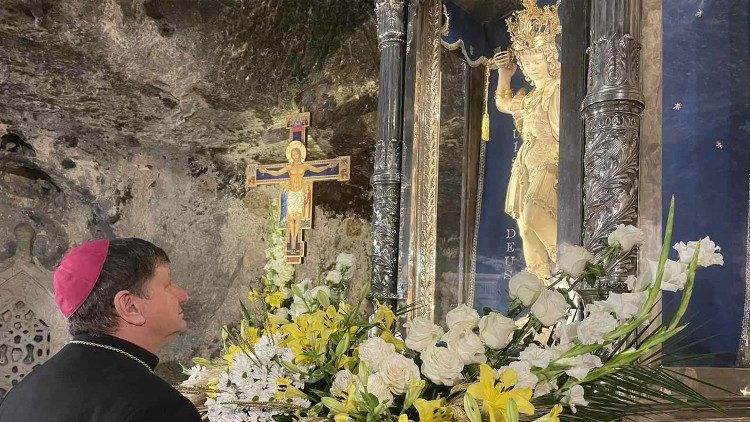
Ukrainian bishop: 'In the solidarity we receive, we find strength and hope'
By Sr. Alina Petrauskaite and Svitlana Dukhovych
Thirty-five years after the restoration of independence, which brought the Ukrainian people genuine and lived religious freedom, the nation continues to face the dramatic ordeal of war.
In an interview with Vatican News, Bishop Vitalij Skomarovskyj, Bishop of Lutsk and president of the Conference of Catholic Bishops in Ukraine (Latin Rite), describes the devastating reality and the enormous price that people are forced to pay in defending their country. Echoing Pope St. John Paul II’s warning that war is a great scourge, the bishop also highlights the extraordinary and enduring chain of solidarity and material and spiritual support that has come from every corner of the world.
Your Excellency, are 35 years of independence a short time or a long time?
From a historical perspective, 35 years is not very long. But for us here in Ukraine, if we look back at everything we have experienced during this period, it represents an extremely long and eventful stretch of time. We went through the severe economic crisis of the 1990s and the subsequent effort to recover. And now, since 2014, we have effectively been living in a state of war, which escalated into a full-scale invasion in 2022. So, although it is only a brief fragment in our thousand-year history, for us it contains an immense journey.
What has the restoration of independence meant for the spiritual life of Ukrainians?
Today we live in an independent state and enjoy genuine freedom of conscience, not merely freedom written on paper. Every person has the opportunity to profess and bear witness to their faith. Naturally, as in any country, there may be bureaucratic issues, but freedom of conscience is guaranteed by the Ukrainian Constitution and is a reality experienced in everyday life. For us, this gift is extraordinary and unique, especially when we look at the past.
The Soviet Union formally recognized the right to freedom of conscience in its Constitution; however, for ideological reasons, the Church and religion were systematically persecuted. At certain times the persecution was brutal; at other times it was more subtle. Believers were imprisoned, some gave their lives for their faith, while others were simply denied any opportunity for advancement: they could not become teachers or doctors or hold public positions. It was a time of real trial.
Even under the previous tsarist regimes, the Catholic Church—and in fact all the churches—had faced severe restrictions. Even the Orthodox Church, which at the time was the state Church of Imperial Russia, suffered from a suffocating state “embrace” that prevented it from freely carrying out its spiritual mission.
That is why these 35 years of independence and religious freedom represent an absolutely unique experience for our country. Of course, the Church now faces new challenges and unprecedented problems, but whenever we celebrate Independence Day, we thank the Lord for the priceless gift of freedom enjoyed by our community.
It is often said that, during times of persecution, people’s faith was stronger because it was tested by suffering. By contrast, today, when churches are open and people can freely proclaim the Gospel, faith seems to have weakened. What do you think?
The reality is that life has changed radically. In the past, during persecutions, many people were afraid to have their children baptized because they feared reprisals at work. Today, quite rightly, no one forbids such things anymore.
However, today people may risk devoting their entire lives to their careers or material well-being, neglecting time for others and for God, and eventually coming to see faith as something non-essential.
I would like to give an example based on my own experience. When I worked in a seminary during the Soviet era, the state imposed strict controls on candidates, creating countless obstacles. As a result, anyone whose motivation was weak or whose character was fragile would not even manage to enter the seminary, or would leave soon afterward.
If it was discovered that a young man—perhaps someone who had completed military service or attended university—wanted to enter the seminary, he would be subjected to intimidating “interviews” and pressured about the reasons for his decision. Entering the seminary was a difficult undertaking: some young men had to try for ten years before succeeding.
Today, by contrast, there are no such barriers. And yet, sadly, we see that the number of people who want to enter the seminary is very small, sometimes close to zero. Even in recent times, I have observed that many young people who began the seminary journey later realized that it was not the path for them.
In short, we live in a completely different context, with very different circumstances.
Your Excellency, you often share the pain of families and take part in solemn funeral ceremonies for the men and women who pay the highest price for freedom, giving the supreme gift of their lives. Can this immense sacrifice be given meaning, and how do you face this trial pastorally?
We are in a situation in which Ukraine is forced to defend itself because we have been attacked. I do not know how many of those who choose to defend their homeland do so while explicitly thinking, “We are offering our lives.” In reality, they want to live; they hope to survive. But as soldiers, they are doing a job that involves mortal danger.
Unfortunately, defenders are killed, struck by bullets and fragments of enemy shells. Ukrainian citizens have to go into the fight to defend themselves because there is no one else who can do it in our place.
Our people are forced to go to the front to protect their country. This is a value so great that we struggle to fully comprehend it.
We call it the Fatherland; it is our common home, our shared dwelling. When an enemy enters by forcing open the windows and breaking down the doors, anyone would defend their family and loved ones. Here, it is a matter of our common home, of the bond that unites all of us Ukrainians. That is why Ukrainians have risen to defend their land.
The price to be paid is truly enormous, but so is the threat hanging over us. The enemy did not come simply to impose a different political system on us or dictate new electoral rules. They came to kill and destroy. And that is why, in response to this aggression, Ukraine is forced to defend itself.
What has this time of war “revealed” to you personally?
Certainly, this has been a completely new experience, very different from my previous ideas about war, which I had formed by reading books, watching films, or following reports about wars in other parts of the world. This reality is completely different. I could never have imagined that war was actually like this.
I would say that all of this has led me to agree fully with St. John Paul II: war is a great scourge, and if there is even the slightest possibility of avoiding it, everything must be done to do so.
Peace is an immense gift, while war is an immeasurable evil for anyone caught up in it. I have come to understand profoundly that prayer for peace has immeasurable value, because peace is an extremely precious good.
We probably understand its value most clearly when peace is gone, when there is war and everyone is in danger: children, the elderly, the weak and the strong—no one is excluded. It is then that you understand how precious peace—the absence of war—is for a people and a nation.
Another great experience has been solidarity—the extraordinary closeness shown by so many people from every corner of the earth toward the Ukrainian people. And this solidarity, together with material and spiritual support, is enduring: people do not grow tired of praying for us and helping us.
This is a tremendous gift. Such solidarity does not come from being forced to give it; it comes directly from the heart. It is the voice of people’s hearts.
And all of this gives us so much strength and hope. We continue to pray that this war will end as soon as possible.
Thank you for reading our article. You can keep up-to-date by subscribing to our daily newsletter. Just click here.


