
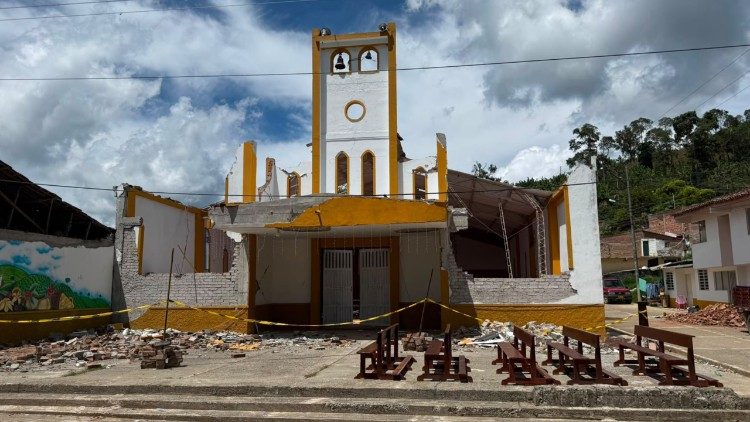
Caritas Colombia: Aid cannot end when the headlines fade
By Sebastián Sansón Ferrari
“We stand in solidarity with those who are suffering at this time.”
With these words, Bishop Juan Carlos Barreto Barreto, Bishop of Soacha and president of Caritas Colombia, sums up the Catholic Church’s commitment in response to the emergency caused by the earthquake on Monday, August 10, which affected municipalities across five regions of the country.
According to official reports cited by the Caritas Colombia president, more than 200,000 people have been impacted by the earthquake. The numbers include more than 300 deaths and thousands of injuries, as well as severe damage to homes, apartment buildings, hospitals, and educational institutions.

In response to this reality, the Church has organized its efforts at several levels. The local Caritas is working alongside the Colombian Bishops’ Conference and Caritas organizations in the country’s ecclesiastical jurisdictions, together with local and national authorities, civil society organizations, and international cooperation agencies.
“As a Church, we can coordinate our efforts, but we must also join forces with the efforts of civil society and the State,” Bishop Barreto explains, referring to the campaign “With Colombia to the Very Last Corner,” which has mobilized financial and essential goods to assist affected communities.
A Church organized across the country
The scale of the emergency has required a coordinated response. Caritas Colombia held meetings with those responsible for social ministry in the hardest-hit areas—around 14 ecclesiastical jurisdictions—and subsequently coordinated efforts with the directors of social ministry in all 78 jurisdictions across the country.
This is complemented by communication with partner Caritas organizations in Latin America, Europe, and the United States, as well as with international cooperation agencies, which have been briefed on the situation and asked for support.
The response is not limited to distributing aid. Caritas is also keeping priests, religious communities, and parish communities informed through official reports on casualties and damage, promoting prayer initiatives, and encouraging people to make financial and contribute essential goods.
Food, shelter, and medicines
During these first few weeks, priority is being given to food. But the needs are broader: tents, mattresses, and equipment for preparing food are among the requests coming from the affected areas.
Some people remain unable to return to their homes, some of which have been destroyed and others severely damaged. Medicines are also needed, while the Church’s Health Ministry has established a psychological support line staffed by professionals providing personal support amid the emergency.
For Bishop Barreto, this initial response has been made possible by the solidarity generated both within Colombia and abroad. The resources received have made it possible to address immediate needs: food and a place where people can spend the night.
“We are very grateful and very encouraged by the response that has been given so far,” he says.
But the president of Caritas Colombia warns that the emergency will not end when media attention begins to fade.
“Aid should not be limited to these first few weeks”
One of Bishop Barreto’s central appeals is for solidarity to be sustained over time.
“These first few weeks sometimes receive the greatest media attention,” he explains, but the bishop reminds people that longer-term challenges will follow: rebuilding colleges, universities, schools, and hospitals, as well as homes, parishes, and churches that have been damaged.
“We have to persevere in this commitment to help, which must be sustained over time,” he insists.
Caritas Colombia has already developed a coordinated plan that will be adapted to the needs of each area. The first stage includes food assistance, health supplies, and conditions that allow people to rest at night. Later, efforts will have to focus on restoring normality in educational institutions and rebuilding homes, some completely and others only partially.

Caritas Colombia’s accumulated experience in emergency situations—from armed conflict to natural disasters and floods—provides an important resource for this new crisis. At the same time, the organization seeks to learn from other Caritas organizations and integrate its efforts with those of the State and civil society. The goal, explains the Bishop of Soacha, is an action that is “coordinated, organized, and appropriate.”
“First aid” can also be spiritual
Amid this humanitarian response, the Church has also sought to address another dimension of suffering—one that cannot be alleviated with food, medicine, or a roof over one’s head.
Bishop Barreto describes an initiative of the Archdiocese of Bogotá, which has sent 80 priests to the hardest-hit areas to offer Spiritual First Aid. “They are also very important,” the president of Caritas Colombia acknowledges.
The mission officially began on August 19. The priests, organized into teams and working in coordination with the bishops of the local dioceses, traveled to Pereira, Cali, Palmira, Cartago, Buga, and Buenaventura.
Their mission is simple and, at the same time, profound: to meet with those affected, listen to them, talk with them, pray with them, and offer the Sacrament of Reconciliation. It is about accompanying people as they navigate the shock and pain of losing their homes, possessions, familiar surroundings, and even loved ones.
Cardinal Luis José Rueda Aparicio, Archbishop of Bogotá, explained that these first days are when affected communities face the greatest number of questions and challenges. For this reason, the priests are going out to meet them and convey a message of reassurance—the Church loves them, and Christ remains with them.
“What we seek is to see the suffering Christ in the midst of these communities and accompany them with a word of hope,” Cardinal Rueda said.
This spiritual mission is therefore integrated into the response that Caritas Colombia is describing at the national level: a Church seeking to share not only resources, but also “prayer, life, and hope.”
A special focus on children
The emergency has also increased the vulnerability of children and adolescents. The loss of parents, separation from family units, and the inability to return home can expose them to marginalization, trafficking, and other forms of exploitation.
For Bishop Barreto, the response must address this dimension through what is known as a culture of care. Caritas Colombia is seeking to understand the specific circumstances in each area, speaking with ecclesiastical jurisdictions, in order to provide a comprehensive response that includes the protection of minors.
“The Lord walks at our side”
Faced with an emergency that will require a lengthy recovery, the president of Caritas Colombia turns once again to the solidarity that has already been mobilized.
His gratitude extends to the Colombian people, to Caritas organizations that have sent assistance, to international cooperation organizations, and to the international community. Bishop Barreto also asks government leaders to put humanitarian assistance first, “beyond ideologies.”
He has a special message as well for those sustaining the Church’s work on the ground: bishops, priests, religious communities, parish communities, and Caritas workers.
“We know that these are difficult times for them,” he acknowledges. But, Bishop Barreto adds, “the Lord strengthens the spirit of those who place their trust in him.”
The response to the earthquake, therefore, is presented as a journey that has only just begun. First come food, shelter, medicines, and accompaniment. Then reconstruction and the restoration of people’s independence. And throughout the entire process, a pastoral presence called to remain alongside those who suffer.
“We know that the Lord walks at our side and invites us to keep walking together,” concludes Bishop Barreto.
In collaboration with the Archdiocesan Office of Communications of Bogotá
Thank you for reading our article. You can keep up-to-date by subscribing to our daily newsletter. Just click here.


