

Apostolic Nuncio celebrates Mass marking Guam’s Liberation anniversary
By Deborah Castellano Lubov
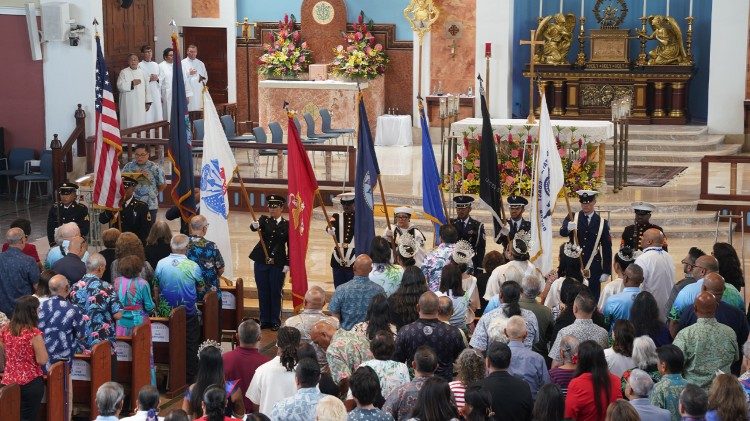
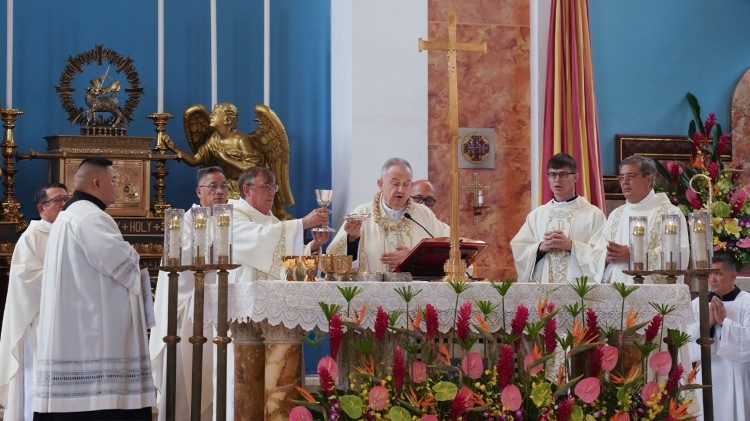
The Apostolic Nuncio to New Zealand and Apostolic Delegate to the Pacific Islands, Archbishop Gábor Pintér, presided over a Mass on 21 July 2026 to mark the 82nd anniversary of Guam’s liberation from Japanese Imperial Forces at the Dulce Nombre de Maria Cathedral-Basilica in Hagatña.
The Pope’s representative to the Pacific Islands celebrated the Eucharistic celebration alongside Archbishop of Agaña, Archbishop Ryan P. Jimenez, and priests of the Archdiocese, bringing Pope Leo XIV's spiritual closeness to the people of Guam.
Guam observes Liberation Day each year on July 21, with events giving thanks to God while honoring the United States Marines and U.S. Army soldiers who fought to restore freedom to the island’s people.
The Mass, followed by a solemn Memorial Service in the Basilica, also honored the faith and courage of those who suffered and died during the war.
Invasion and liberation of Guam
On December 8, 1941, many people had gathered to celebrate Mass for the Feast of the Immaculate Conception and to honor Guam’s patroness, Santa Marian Kamalen, at the same site of the old Agaña Cathedral, until it was interrupted by the Japanese warplanes bombing the island. War had begun, and the small American territory island of Guam was drawn into the Second World War.
Although less widely remembered than the attack on Pearl Harbor one day earlier, Guam was invaded by the Japanese forces a little more than four hours later on 8 December.
Until the island was liberated on July 21, 1944, the occupation had caused great suffering for Guam's people.
The Pope's spiritual closeness and emphasis on peace
The Nuncio addressed a congregation of more than 800 people, including World War II survivors, as well as the Governor of Guam, along with government, military, and civic leaders.
He said, “The Holy Father asks me to assure you of his prayers for the people of Guam, for the Archdiocese of Agaña, for every family, and especially for those who continue to carry within their hearts the memories of the suffering endured during the dark years of the Second World War.”
Thousands more followed the Mass locally and abroad through the Basilica’s livestream.
The Apostolic Nuncio also renewed Pope Leo XIV’s frequent appeals for peace and disarmament, urging the faithful to pray for nations affected by war and conflict.
Dialogue instead of destruction
“Our prayer this morning," he said, "therefore extends far beyond Guam. We pray for every place where violence still wounds God’s children,” he said. “We pray that political leaders may choose dialogue instead of destruction, and that military power may always remain at the service of peace and justice.”
In his opening remarks, Archbishop Pintér remembered those who suffered during the war years.
“We remember the men, women, and children whose earthly journey ended during those tragic years,” he said. “We remember those who never returned home. We remember those whose wounds remained long after the weapons became silent.”
During his homily, the Apostolic Nuncio reflected on the day’s Gospel reading from the passage according to St. Matthew and the story of Jonah’s deliverance from the belly of the great fish.
“For Christians, the sign of Jonah points directly to Christ Himself,” Archbishop Pintér said. “Just as Jonah spent three days in the belly of the great fish before emerging alive, Jesus would spend three days in the tomb before rising from the dead.”
He stressed that God’s greatest answer to human suffering is the Resurrection.
While “the Cross appeared to be a defeat," he said that "Easter revealed victory" and "the Resurrection became a new beginning.”
Archbishop Jimenez thanks God for the gift of freedom
Reflecting on the significance of the celebration, Archbishop Jimenez described the Liberation Day Mass as a deeply unifying moment.
“The Liberation Day Mass at the Cathedral-Basilica," he said, "beautifully embodied what the Church is called to be: one Body of Christ,” adding that “seeing clergy and religious, lay faithful, civic leaders, members of the Armed Forces, veterans, and people from every sector of our island gathered in prayer reminded us that our deepest unity is found not in our differences but in Christ.”
“Together," Archbishop Jimenez underscored, "we gave thanks for the gift of freedom, prayed for lasting peace, honored those who made great sacrifices for our nation, and entrusted Guam to God’s loving care.”
“It was a profound sign that when we gather around the Eucharist, we become one family, one community, and one people united in the Lord.”
Thank you for reading our article. You can keep up-to-date by subscribing to our daily newsletter. Just click here.


