
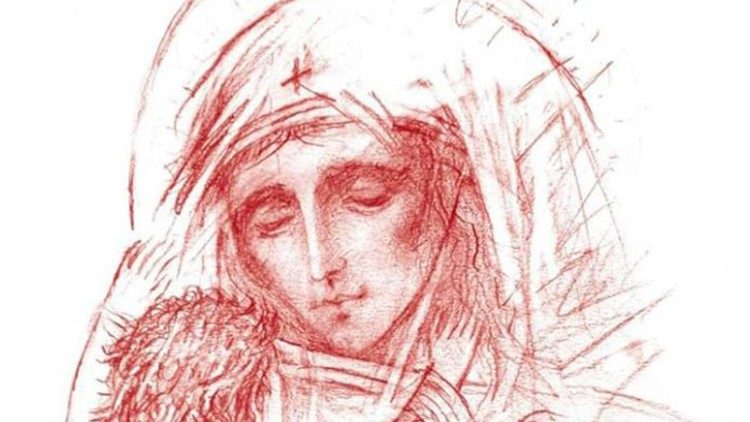
'Undivided Heart‘: Carmen Hernández on mission and virginity
By Debora Donnini
Woman, who bears within her womb “the factory of life,” has a fundamental mission in society. Closely linked to this physical reality is also the meaning of virginity, understood as an eschatological sign that points toward a love directed to Heaven. These themes lie at the heart of the book Undivided Heart: Mission and Virginity in Carmen Hernández, recently published in English and French, edited respectively by Dino Furgione and Giuliano Bonomi.
The author, Josefina Ramón Berná, a lay missionary of the Neocatechumenal Way, has collected around 400 quotations from the Servant of God Carmen Hernández, offering a broad overview of her reflections on women and, in particular, on the relationship between virginity and mission. The text highlights the catechetical and theological depth of Hernández’s thought. Meanwhile, in Madrid, the diocesan phase of her cause for beatification and canonization is currently underway.
United to Christ
In the introduction, Kiko Argüello emphasizes the gift of this vocation and the importance of remaining united to Christ, whether as an itinerant missionary, a religious sister serving in Africa, or someone caring for AIDS patients in a hospital. “Virginity,” he writes, “is an eschatological sign of this spiritual and eternal love.”
Evangelization and virginity
One of the central themes highlighted by the author is the close link between evangelization and virginity, just as virginity and motherhood are also inseparable, even if this may appear paradoxical. María Ascensión Romero, a member of the International Team of the Neocatechumenal Way, reflects on this point in the prologue.
She explains that virginity becomes fruitful through love for Jesus Christ, since authentic love always generates life. Many fruits, she notes, are born from the witness and preaching of those who may not have children according to the flesh, but who give their lives for others. The book points to the many vocations to mission, priesthood, and consecrated life within the Way, as well as the rebuilding of marriages and openness to life, as visible signs of this fruitfulness. Romero also stresses that virginity is entirely grace — a gift that does not arise from moralism, but from God.
Virginity in Christianity
The reflections of Carmen Hernández gathered in the volume also explore the distinction between the priestesses of the pre-Christian pagan world, associated with mystery cults, and the understanding of women in Judaism, where, for example, women light the Shabbat candle within the family.
Already in the Old Testament, the important role of women emerges clearly: figures such as Deborah, Judith, and Esther are presented as women who helped save the people of Israel. Yet they are not priestesses. In Christianity, the author explains, virginity is not connected to the priesthood, but “is directed toward a fullness whose model is the Virgin Mary, placed at the center of the Church.” In this sense, “virginity represents the creativity of God.”
“The factory of life”
Woman, in fact, possesses something immense: the womb, described by Carmen Hernández as “the factory of life and of history.” For this reason, she says in her reflections, “death will always seek to destroy woman.” This struggle can be seen throughout Sacred Scripture, from Eve in Genesis to the woman clothed with the sun in the Book of Revelation.
The volume contains numerous references to female figures of both the Old and New Testaments, to Jewish tradition, to the Fathers of the Church, to the documents of the Second Vatican Council, and to the Magisterium of the Popes. Together they reflect the breadth of formation and culture possessed by Carmen Hernández, alongside her scientific background and her fifty years of missionary experience proclaiming the Gospel throughout the world with Kiko Argüello.
The fatherhood of God
The book also reflects on the fatherhood of God in relation to virginity, on chastity among young people as a path toward discovering one’s vocation, and on priestly celibacy. It further explores the depth of the Hebrew term rahamim — mercy — derived from rehem, meaning womb, expressing a love connected more to maternal compassion than to the heart.
At the center of this theological and catechetical richness is the profound link between love for Christ and mission. As Josefina Ramón Berná writes, Carmen Hernández “wanted to go on mission throughout her entire life because she lived in an intimate relationship of love with Christ. Going out to evangelize was simply a consequence of the irresistible call of the love of Jesus Christ.”
Thank you for reading our article. You can keep up-to-date by subscribing to our daily newsletter. Just click here.


