
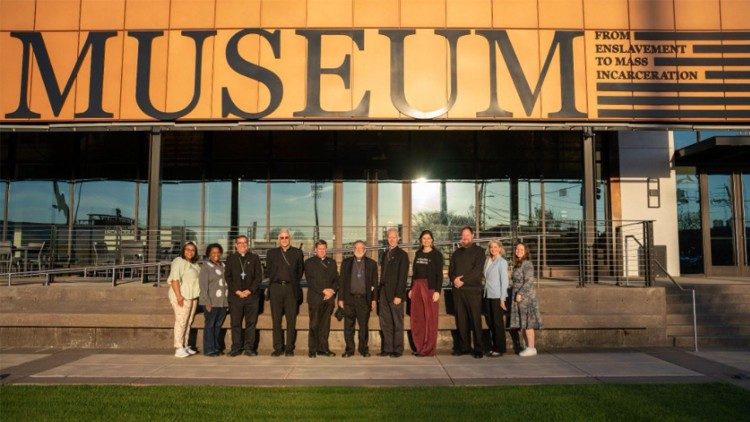
Moved by pastoral letter against racism, US Bishops journey to Deep South
By Krisanne Vaillancourt Murphy, Executive Director of Catholic Mobilizing Network*
Eight years ago, the United States Conference of Catholic Bishops (USCCB) authored a pastoral letter against racism. Open Wide Our Hearts: The Enduring Call to Love explores the questions “what is racism?” and “how do we overcome this evil?”
“Racism,” the bishops write, “is a life issue,” and “a perversion of the Lord’s will for men and women, all of whom were made in God’s image and likeness.” For a society to move on from the “social structures of injustice and violence that make us all accomplices in racism,” the way forward, the bishops said in their letter, must include meaningful, personal encounters:
“To work at ending racism, we need to engage the world and encounter others—to see, maybe for the first time, those who are on the peripheries of our own limited view.” (Open Wide Our Hearts)
Fast forward to just a few weeks ago. In March 2026, I had the privilege of traveling to the Deep South for such an “encounter” with six U.S. bishops, as well as staff and consultors from the USCCB’s Subcommittee for the Promotion of Racial Justice and Reconciliation. This Lenten Experience in Montgomery and Selma, Alabama was the second collaboration between Catholic Mobilizing Network and the USCCB to bring U.S. bishops to Alabama. In the 19th century, Montgomery was one of the most prominent slave-trading locations in the United States. In the 20th century, it became the cradle of the Civil Rights Movement.
The trip provided an opportunity to explore how the legacy of 400 years of slavery, lynching, and racial segregation continues to shape our justice system, and to engage in the restorative work of truth-telling and reconciliation in the United States.
I felt privileged to walk alongside these episcopal leaders as they lived out what they committed to eight years ago. Our experience in Alabama was a journey of truth-telling and an exploration into what is required of the Church, its leadership, and its faithful in order to be ministers of hope and reconciliation in the face of systemic racism in the United States.
Lenten Journey Reveals the Promise of Easter
It was no coincidence that this trip fell during the season of Lent. Our sojourn would be one of head and heart, of remembrance, repentance, prayer, and preparation for Easter’s renewal.
The first day of our journey included an unforgettable meeting with Bryan Stevenson, founder of Equal Justice Initiative (EJI) in Montgomery, Alabama whose decades of inspiring work has provided legal representation to people who have been wrongfully convicted, unfairly sentenced, or abused in state jails and prisons. EJI has become a lifeline for marginalized people in Alabama and a trailblazer in its effective legal and narrative change efforts. Through the development of “Legacy Sites” across the city of Montgomery, EJI elevates the connections between mass incarceration and excessive punishment and the entrenched challenges of racial and economic injustice.
As he expanded on issues of racism and injustice embedded within our criminal legal system, Mr. Stevenson explained how one of the most insidious consequences of the “cancer” of racism is the narrative of racial hierarchy and of Black inferiority. More specifically, he stated that the suspicion of dangerousness and guilt assigned to Black and Brown people is what drives oversentencing and overincarceration of people of color to this day. Just as Lent invites us to reflect on Jesus’ temptation by the devil while fasting in the desert, so too did our Lenten encounter with Mr. Stevenson bring to light how we face temptation today of racism’s social sin.
Against this backdrop, he spoke of Church leaders as key “facilitators of transformation” for society, because they know that confessing the truth and repenting from sin are what opens hearts to redemption and reconciliation. As the United States struggles to reckon with the legacy of slavery and the manifestations of racial injustice today, Mr. Stenvenson encouraged us to help society to be set free from silence and engage in truth-telling, while always holding on to hope.
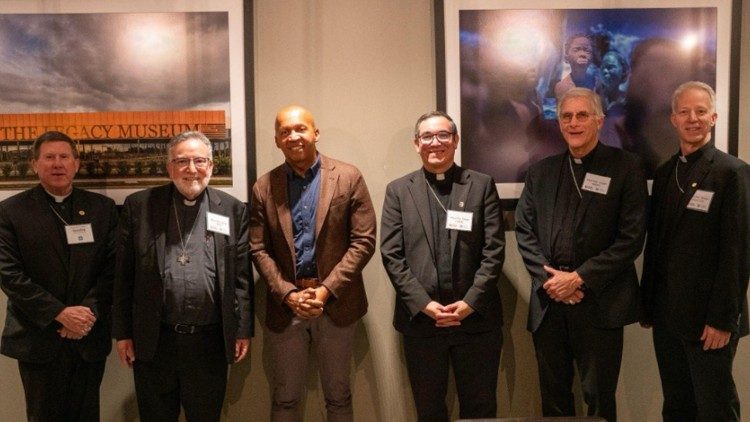
Our meeting with Mr. Stevenson was one of a dozen encounters on a 48-hour journey through Montgomery and Selma. We anchored ourselves throughout these encounters by praying the Stations of the Cross as we visited key sites of the U.S. Civil Rights Movement in the 1950s and 1960s — such as Rev. Martin Luther King Jr.'s parsonage — met with local leaders, and deepened our understanding of the realities of capital punishment today. With our eyes, ears, and our hearts, we contemplated Christ’s journey toward Calvary and reflected on the nearness of our Savior to the suffering we bore witness to.
As Catholics, we understand it is through the witness of the suffering of Christ’s passion that the light of Easter morning comes. The same is true about our Lenten experience in Montgomery and Selma.
Bishop Joseph Kopacz, Bishop of the Diocese of Jackson Mississippi shared, “We have to get to the truth, as Sister Thea Bowman would say, the truth of what the reality was, so that there can be reconciliation.”
In remembering the deep harm and raw pain of racial terror and structural racism, we also heard testimonies of the movement of the Holy Spirit and in the light of faith, resistance, and resilience.
“Despite all the struggles that people have faced in their lives, despite their sufferings and pains of the past,” reflected Bishop Felipe Pulido, Auxiliary Bishop of San Diego, “they still have faith in our Lord Jesus Christ, and that truly gave them hope and resilience to continue their lives.”
Surely, the Cross reveals the depth of God’s love and the empty tomb offers a sign of God’s saving power. Our faith rests in the assurance that life will always have its victory over death. Indeed, the commitment to make this truth-telling journey marked a profound act of Easter hope.
Steps of the Journey
In addition to meeting with EJI founder Bryan Stevenson, we visited all three Legacy Sites established by the organization: The Legacy Museum: From Slavery to Mass Incarceration, the National Memorial for Peace and Justice, and the Freedom Monument Sculpture Park, which honors the lives and memories of the 10 million Black people who were enslaved in the United States between 1619 and 1865.
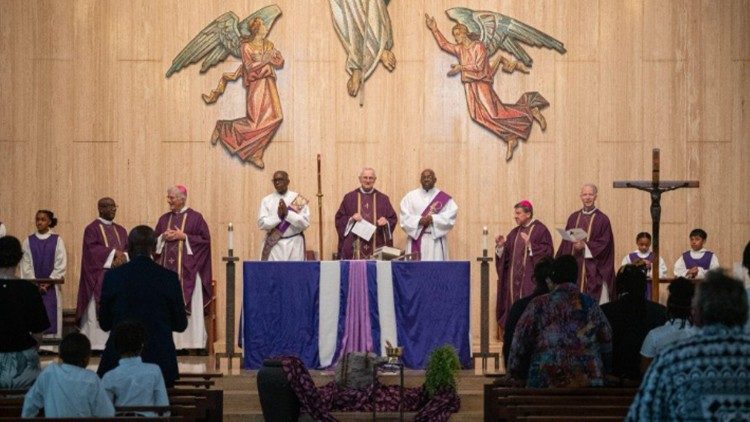
Together we celebrated Mass in Catholic parishes and shared meals with pastors and local leaders — including individuals who have been active in the community since the Civil Rights Movement.
Fr. Manuel Williams, C.R., a Montgomery native and pastor of Resurrection Catholic Missions of the South shared his rich experiences of resilience and hope as a leader of a vibrant Catholic parish engaged in the ministries of education, evangelization, healthcare, social services, and advocacy. Fr. Andrew Jones, pastor of The City of Saint Jude — which was the final stop for the Selma to Montgomery marchers before arriving at the State Capitol on March 24, 1965 — told the history of his parish’s efforts to preserve the Church’s key role in the Civil Rights Movement and shared stories of how the parish expresses its commitment to human rights and social justice today.
These profoundly moving personal encounters were not easy. Bishop William Wack, Bishop of Pensacola-Tallahassee described it this way:
“Some the things that really affected me were seeing the sculptures and the art and the photographs of the true reality of slavery and racism and how that's led to a continuation through lynching and mass incarceration. Just seeing that and then talking to some people who were part of the Civil Rights Movement, you know, in the 50s and 60s, and hearing their voices, that was really important for me as well.”
What the Lord Requires
On the final morning of our trip, we stood at the base of hundreds of hanging steel columns, at the National Memorial for Peace and Justice. The columns stand as a visual reminder of the bodies left hanging in the horrific violence of 4,400 documented racial terror lynchings between 1877 and 1950. Again, we turned to the Passion, concluding with the final Station of the Cross.
We prayed together, recalling the inspiration provided in Open Wide Our Hearts:
“You have been told, O mortal, what is good, and what the Lord requires of you: only to do justice and to love goodness, and to walk humbly with your God” (Micah 6:8).
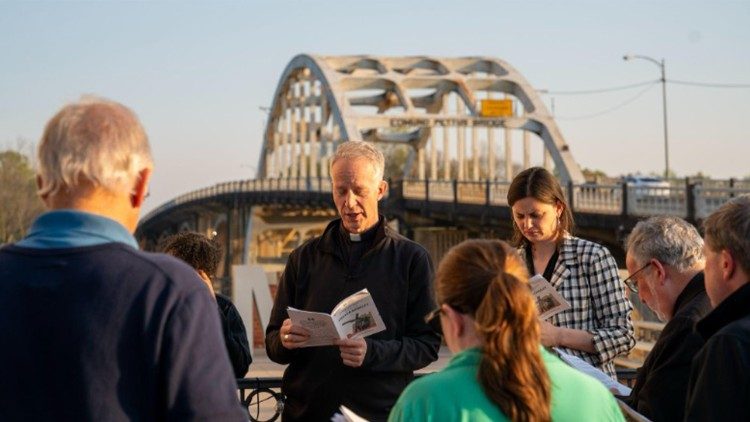
As we work to “do justice,” the pastoral letter reminds us that justice is defined “where we are in right relationship with God, with one another, and with the rest of God’s creation.” Integral to this relational justice commitment is listening to the stories of those who are personally impacted by the sin of racism.
In the effort to “love goodness,” the letter invites us to consider the example of Christ’s suffering on the cross: “It is through his Cross that we learn the greatest lesson about love.” Reflecting on Christ’s own execution at the hands of the state offers an expansive understanding of love that seeks unity and restoration in the face of racial injustice, dehumanization, and division.
And in the effort to “walk humbly with God,” the letter encourages those in positions of Church leadership to “make formal visits to institutions of culture and learning” and to engage in meaningful experiences that deepen understanding of our nation’s complex racial history.
We are an Easter people living in the promise of the Holy Spirit. That is why we accompany one another in Alabama — in a prayerful posture of openness, encounter — and ask for God’s grace to become reconcilers in our wounded world. Our Lenten journey created a profound opportunity to remember our country’s deep wounds of racism. This time together helped us all see more clearly how systemic racism has given way to a pervasive narrative of revenge and retribution that marks our current criminal legal system.
With each Station of the Cross that we prayed throughout our journey, we recited: “Because by your holy cross you have redeemed the world.” This simple prayer reveals the depth of God’s love and His abundant mercy. And through it, our appreciation for this restorative truth-telling work grew within us.
Gratefully, the light of the Resurrection illuminates our path to understanding the depths of suffering in a new way, so that we can spread the Good News of Easter as facilitators of transformation and of restoration, wherever the ravages of systemic racism persist today.
* Krisanne Vaillancourt Murphy is the Executive Director of Catholic Mobilizing Network, a national organization in the United States that mobilizes Catholics and people of goodwill to end the death penalty, advance justice solutions in alignment with Catholic values and promote healing through restorative justice approaches and practices. For more information and to join the movement, visit catholicsmobilizing.org.
Thank you for reading our article. You can keep up-to-date by subscribing to our daily newsletter. Just click here.


