
Cardinal Pizzaballa: 'Concrete actions' needed to rebuild trust in Holy Land
By Roberto Paglialonga
After what has happened and is still happening in Gaza, “it is difficult to see a short-term solution” between Israelis and Palestinians, Cardinal Pierbattista Pizzaballa, Latin Patriarch of Jerusalem, has said.
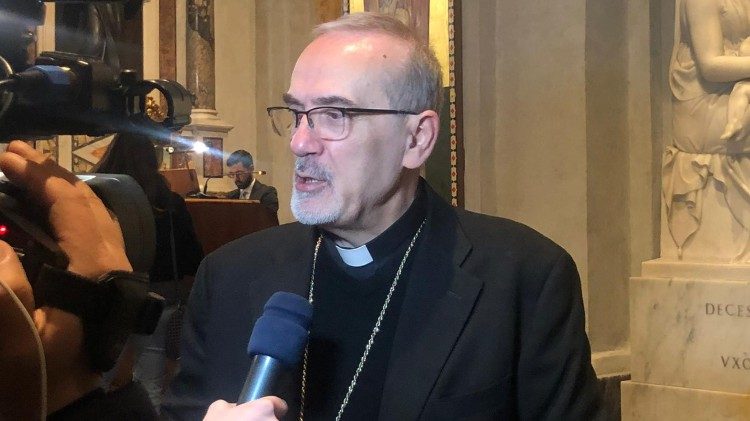
The Patriarch was speaking during an event organized by the National Committee for the 800th Anniversary of the Death of St. Francis, at the Church of San Francesco a Ripa in Rome on Friday, January 6, 2026.
“The wounds are still deep, people are disoriented, with weak leadership. There is no clear vision of the future, of the other being beside you and, in some way, within you,” he continued. “Neither side wants to hear about the other: the relationship has broken down, and this is the first point to consider and from which to begin.”
October 7 and the war in Gaza: “unprecedented events”
October 7 and the war that followed “were unprecedented events,” the Cardinal said. “We ourselves did not immediately grasp the magnitude of what had happened with Hamas’ attack and, subsequently, what was about to unfold with the response of the IDF,” he explained, responding to questions by Maria Gianniti, Jerusalem correspondent for Italy’s national public broadcasting service, RAI.
“We thought there would be a retaliation, like many others that had occurred before, but instead all the parameters we knew collapsed," he stressed.
Doubts about the 'Board of Peace'
In response to a question about Trump administration's 'Board of Peace' project, the Patriarch expressed his concern about any initiative that appears to be primarily aimed at protecting the interests of the major powers, without real recognition of the Palestinian people and their rights.
The need for concrete actions
“Peace and reconciliation are beautiful concepts, but they risk remaining mere slogans if they are not accompanied today by concrete actions, gestures, and testimonies that physically demonstrate the possibility of rebuilding trust,” the Cardinal continued.
It will not be easy or automatic, but “we must be aware that first of all it is necessary to create opportunities for encounter, as well as cultural and social contexts that little by little help people to think differently. Words are not enough,” he insisted.
The Patriarch added that “we need political leadership, but also religious leadership, on both sides, that has some vision and does not base its authority solely on anger and the thirst for revenge.”
He explained that this is a process that will take time. “In the meantime, we must hold firm, convinced that we cannot leave the narrative to extremists, whether Hamas or settlers. And, for us in the Christian community, what is important at this stage is to be there, remaining true to ourselves,” he highlighted.
“The Holy Land teaches us that being a minority is not a tragedy, if one has something beautiful and great to communicate. And we do.”
We must “know how to listen, to understand what faith is telling us at this precise moment: as far as I am concerned, my life belongs to God and to Christ, and therefore it was natural for me to answer yes when asked if I was willing to offer myself in exchange for the hostages held in Gaza,” he emphasized.
Christians can be a sign of unity, “like St. Francis was, as he became a sign for all because he was moved by Christ,” Cardinal Pizzaballa underlined. “This is why his witness has crossed the centuries and still speaks to us today.”
Four visits to the Gaza Strip during the war
After the introductory greetings by Father Paolo Maiello, a Franciscan friar and vicar of the Province of Saint Bonaventure, and by the poet Davide Rondoni, president of the National Committee for the 800th anniversary of the death of St. Francis, the Cardinal shared the experience of his four visits to the Gaza Strip during the war.
“The first time, in May 2024, it was shocking not to recognize places I knew, to see the eyes of people terrified by what was happening, to feel the emotion of the children,” he recalled.
The second visit, “shortly before Christmas of the same year, fatigue had set in among the population, there was a general disorientation, the hunger was evident, the destruction was increasing, and hospitals were out of service.”
July 2025 “was the most difficult moment. We entered after the killing of 3 people in the Holy Family Church and while the IDF was preparing the offensive on Gaza City. I was struck by the smells—of destruction, of death. I will never forget them,” he continued.
The last visit, before Christmas last year, “showed a desire to resume life; I saw faces full of dignity despite everything that had happened.” We moved from food aid to “providing medicines, especially antibiotics, to allow hospitals to treat people.”
The situation of Christians in the Holy Land
The difficulties for Christians are also considerable, the Patriarch stressed. “Our presence in the Holy Land has dramatically declined since I arrived in 1990. Since the beginning of the war alone, at least one hundred families have left Bethlehem,” he explained.
“Unfortunately, many no longer trust that things can change, at least in the near future. We work so that everyone can remain, but we cannot judge those who decide not to. It takes great courage to stay.”
In the Holy Family Church, “they have suffered unspeakable pain; there was a lack of everything. And above all—beyond material things like food, water, and medicine—there was a need for care, for empathy, which they found in the closeness of the Pope and the entire Church.”
In addition to all these issues, there is also the difficult situation in the West Bank, due to the Israeli settlers. “In the only Christian village, Taybeh, there was a new attack just a few days ago. Against Palestinians in general, both Muslims and Christians, there are all kinds of abuses: people are prevented from working, they are deprived of their land, they are subjected to armed assaults and acts of vandalism, their homes are devastated, demolished, or confiscated,” the Latin Patriarch said.
“Our 13 schools in Jerusalem,” he recalled, “constantly face problems with permits for teachers coming, in particular, from Bethlehem. And it is exhausting to have to work every day for things that seem apparently banal—rights that should be firmly established.”
The two-state solution
The Cardinal also stressed how complicated it is to envision and implement the two-state solution at present, adding however that “it is something that must be worked toward.”
“Palestinians have the right to feel like a people and to have a state. Even affirming this possibility is an act of justice; it helps them continue to cultivate the dream of one day having a home of their own.”
An appeal for pilgrims
Lastly, the Cardinal appealed for pilgrims to return. “It is time to return. Enough with emergencies; it is time be courageous. One can come to the Holy Land, one must do so—Bethlehem and Jerusalem are safe,” he insisted. “We need to see that the Church and the Christian community are present, physically present as well.”
Moreover, “it is also an act that says to Palestinians and Israelis alike that we too are here in this land, that we too have our roots here.”
Thank you for reading our article. You can keep up-to-date by subscribing to our daily newsletter. Just click here.


