
Lord’s Day Reflection: Living the grace of Baptism
By Abbot Marion Nguyen
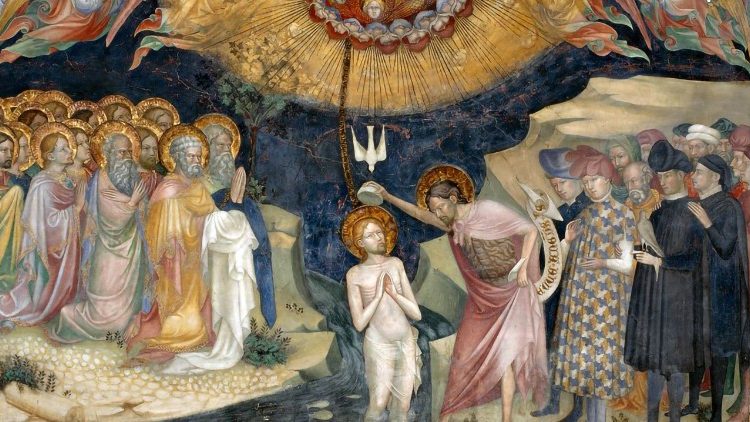
On this feast of the Baptism of the Lord, the Church brings us back to the Jordan, not simply to remember something that happened to Jesus long ago, but to rediscover what has happened to us. The baptism of Jesus reveals what baptism truly gives: not only forgiveness or belonging, but life in the Spirit — already a foretaste of heaven.
As Jesus rises from the waters, the Holy Spirit descends and remains upon Him. The Spirit does not merely touch Jesus and withdraw; the Spirit abides. Everything that follows in Jesus’ public life flows from this moment. This is why we do not call Him simply Jesus, but Jesus Christ — Jesus the Anointed One. In the Acts of the Apostles, Peter looks back on this event and summarizes the entire ministry of Jesus in a single sentence: “God anointed Him with the Holy Spirit and power, and He went about doing good.” Jesus does not first decide to do good and then receive power; rather, because He is anointed, goodness flows from Him.
Saint Bernard of Clairvaux reflects deeply on this verse in his Sermons on the Song of Songs and sees in it a pattern for every baptized person. Bernard insists that we cannot truly do good unless we are first anointed by grace. Even Jesus, in His humanity, does not act by sheer effort or moral resolve, but as the Christ, the Anointed. Without this interior unction, our actions may be generous, but they risk becoming dry — lacking the oil of charity that gives them depth and endurance.
Bernard describes this life of grace through three “ointments,” three movements by which baptism unfolds within us. The first is the ointment of contrition. This is the fragrance of repentance, formed when the memory of our sins is crushed by sorrow and honesty. Though its ingredients are bitter, its scent is pleasing to God because it produces humility. Bernard warns, however, that we cannot remain here forever. To dwell endlessly on sin without hope leads to despair. This ointment is applied to the feet of Christ; it grounds us at the beginning of the journey and protects us from hypocrisy — the danger of appearing religious without interior conversion.
The second ointment is devotion. As the soul heals, its gaze shifts from itself to God. This ointment is composed of the spices of God’s goodness: creation, preservation, and above all redemption. Gratitude replaces self-absorption, and spiritual joy begins to emerge. Bernard says this ointment is poured upon the head, lifting the mind to contemplate the mercy and beauty of Christ. It keeps us from relying solely on ourselves, whether in pride or in discouragement.
At this point, Bernard introduces a powerful warning. He distinguishes between the canal and the reservoir. A canal pours out water as soon as it receives it and often remains dry and cracked itself. A reservoir, by contrast, waits until it is filled to the brim, and then overflows naturally, giving without being depleted. In the life of the baptized, contrition and devotion fill the reservoir. If we rush too quickly into action — into the third ointment — without being filled, we become like dry canals: active, perhaps impressive, but inwardly exhausted. To live as a reservoir is to act from the Holy Spirit, allowing our service to be not the draining of our limited resources, but the overflow of God’s abundance.
Only then does the third ointment appear: the ointment of piety, or compassion. This is the anointing Peter names in Acts — the mercy that moves outward. Its ingredients are the needs and sufferings of others. Unlike the first two ointments, which primarily heal the one anointed, this one is diffused; it exists to be poured out. Bernard teaches that once a soul has been sufficiently “moistened” by grace, charity flows naturally. This is the perfume of the Bride who has become like the Bridegroom — serving not from strain or obligation, but from love.
When works are done from this interior anointing, Bernard says they carry a particular fragrance — the redolentia of Christ. Much human goodness is like a surface perfume: it sits on the skin, masking what lies beneath. But the goodness that flows from the Holy Spirit penetrates deeper than the skin. It permeates the encounter itself. It is the difference between a task completed and a person loved. Because this scent comes from the oil of the Spirit that has soaked into the soul through baptism, it lingers long after the action is finished. It reaches the heart of the other because it originated in the heart of God.
On this feast, then, we are invited to recover the depth of our baptism. When baptism is reduced to an external rite, its power is missed. But when it is lived, it continually anoints us, purifies our love, and draws us into communion. If we allow the Spirit to fill us — to heal us, delight us, and then overflow through us — we too will quietly, faithfully go about doing good, carrying into the world the fragrance of heaven already begun.
Thank you for reading our article. You can keep up-to-date by subscribing to our daily newsletter. Just click here.


