
Holy Land Co-ordination: Stand with people of Holy Land, help foster dialogue
Vatican News
“The people of the Holy Land cry out for our help and prayers; they long for an end to their suffering. Stand with them. Recognise their plea for dignity. Help foster genuine dialogue between communities.”
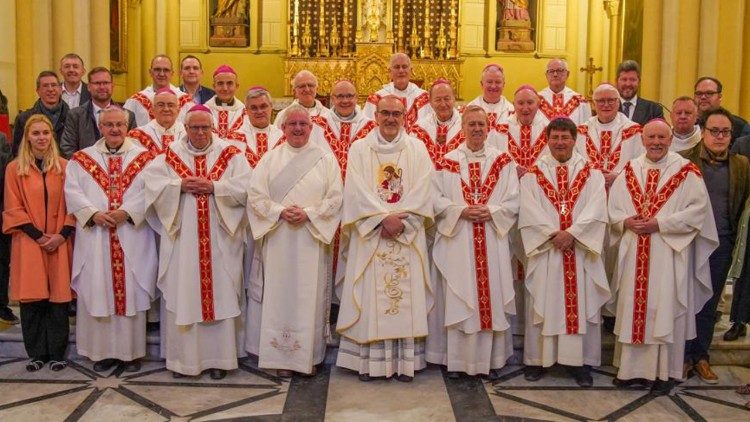
This is the appeal launched by the Co-ordination of Bishops' Conferences in Support of the Church in the Holy Land, better known as the Holy Land Co-ordination (HLC), in a communiqué released on Thursday, January 22.
The HLC was created in the 1990s and is organised by the Catholic Bishops’ Conference of England and Wales (CBCEW). It brings together bishops from across Europe, North America, and South Africa to express closeness, solidarity, and pastoral and spiritual support to Christian communities in the Holy Land.
Every year they embark on an annual pilgrimage to the region, with the 2026 edition taking place from January 17 to 21.
Thirteen bishops participated, representing the Bishops’ conferences from Switzerland, Denmark, Finland, Iceland, Norway, Sweden, Germany, England and Wales, Canada, Scotland, Spain, the United States, France, Ireland, and Italy.
In their final statement at the end of their journey, the HLC also invited Christians to “heed the call of Cardinal Pierbattista Pizzaballa, the Latin Patriarch of Jerusalem, to come on pilgrimage as a sign of our love, support, and solidarity” with the people of the Holy Land.
A struggling land
The HLC explained in their communiqué that their pilgrimage was “to a Land where people are suffering trauma,” and in the 12 months that have passed since their last visit, “the Land of Promise is being diminished and challenged.”
They said they visited Bedouin communities living in the Occupied West Bank who shared “their experiences of a life on the periphery, being observed but often not encountered, their movement heavily restricted by rapidly expanding settlements encircling them on the surrounding hills.”
The HLC also “heard stories about Israeli settler attacks and their continual violence and intimidation, theft of livestock and demolition of property, leaving many unable to sleep at night for fear of further violence.”
“When we asked them who sees their struggles and their cry to live in peace with their neighbors, they replied, ‘Nobody sees us’,” the statement continued.
During the pilgrimage, the HLC also participated in a Mass with the only completely Christian town in Palestine, and the inhabitants also shared stories about their suffering.
"Endless attacks from extremist settlers, uprooting of their olive trees, the seizure of their land and intimidatory acts that make their daily life unbearable, driving many into mass emigration.”
Efforts for peace should prevail over violence
“Gaza remains a catastrophic humanitarian crisis. The people of the West Bank we encountered are demoralised and fearful,” the statement highlighted.
“The courageous Israeli voices which speak out for human and civil rights are increasingly threatened; advocating for marginalised voices is a costly solidarity. We fear that soon, they too will be silenced.”
The bishops underlined how as Christians it is “our calling and duty to give a voice to the voiceless” and to share their suffering and promote human dignity so that the world can work for justice and compassion.
They wrote that the “settlements in the West Bank, illegal under international law, continue to expand by commandeering the land of others” and insisted that the universality of human rights should apply to all, but instead “it is relentlessly replaced by a system where dignity and protection depend on one’s civil status.”
“We affirm Israel’s right to exist and for Israelis to live in peace and security; equally, we call for these same rights to be upheld for all those rooted in this land. We hope that efforts for peace will prevail over violence, and that there will be no more acts of terrorism and war,” the HLC said.
“We also urge our governments to exert pressure on Israel to uphold the rules-based international order and to revive meaningful negotiations toward a two-state solution for the benefit and security of all.”
Resilience of local communities
The HLC also emphasized that they were “deeply moved by the faith and steadfastness of local Christians and also by people of other faiths who work to sustain the hope of their communities.”
Their efforts serve as a reminder “that it is our shared vocation to be ‘salt of the earth’ and ‘light of the world’ and to strive for peaceful coexistence and security across the Holy Land.”
“We also witnessed the courage of those Jewish and Palestinian voices who, despite immense challenges and their own trauma, continue to advocate for justice, dialogue, and reconciliation,” the HLC said.
“Hearing from parents who have lost a child to conflict and can still find a way to forgive offers a powerful witness to the possibility of peace and reconciliation. Few experiences are more devastating. When such a mother or father pleads for an end to violence, the world must listen—and act,” the statement stressed.
The bishops concluded the communiqué by stating that they end this pilgrimage with their “hearts full of compassion for those who are suffering and inspired by those who, by their pursuit of justice, keep the hope of peace alive.”
Thank you for reading our article. You can keep up-to-date by subscribing to our daily newsletter. Just click here.


