
Custos of the Holy Land: 'Return as pilgrims to the Holy Land'
By Michele Raviart - Jerusalem
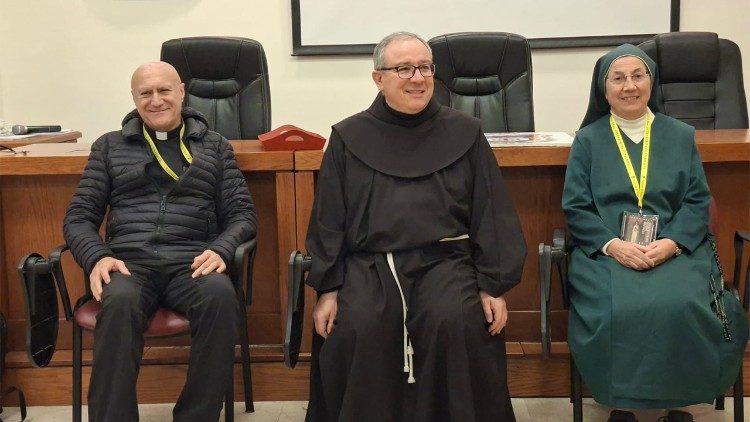
“Fear is not overcome with words; it is overcome with witness. Seeing Christians from all over the world come to the Holy Land to visit the holy places generates hope and strengthens the reason for coming here—not to see a museum, but to encounter a living Church,” said Father Francesco Ielpo, Custos of the Holy Land, on January 7, the day after the end of the Jubilee of Hope.
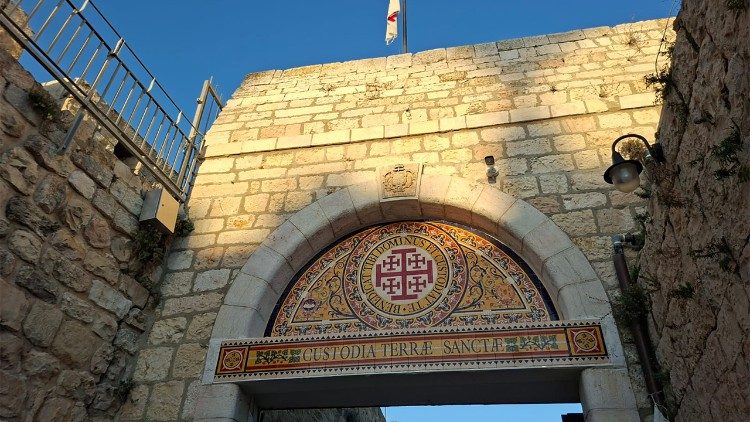
He was speaking to a group of pilgrims from Rome at the Franciscan headquarters in the Old City of Jerusalem.
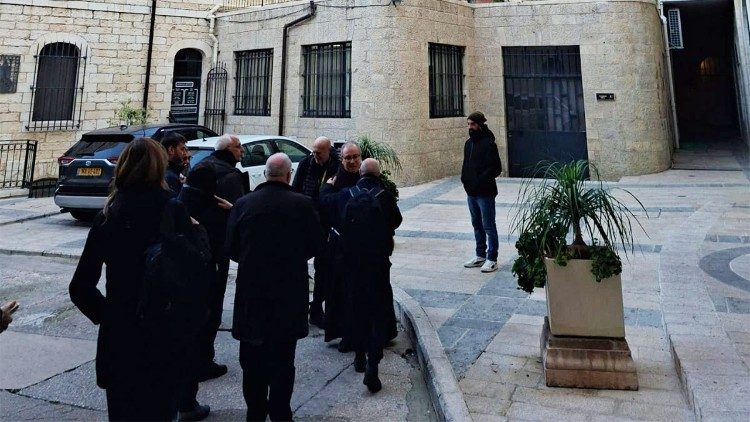
Nearly thirty priests, diocesan officials, journalists, and communicators, led by the Opera Romana Pellegrinaggi (an office of the Vicariate of Rome), came to the holy city to describe how pilgrimages have changed since October 7, 2023, and why it is more necessary than ever to visit the Holy Land
Halting the exodus of Christians
“What can we do to help this land and these peoples?” has been the question most frequently addressed to Father Ielpo in the last months.
After prayer, said the Custos of the Holy Land, the most helpful thing would be to “return as pilgrims to this land.”
Pilgrimages are “one of the principal sources of economic support, primarily—but not only—for the local Christian community,” he explained.
Christians number about 50,000 people in Israel and Palestine, around 6,000 of whom live in Jerusalem. Without this economic lifeline, the concrete risk is the progressive depopulation of the Holy Land.
“We are witnessing a migratory flow of entire families, not only Christian but also Jewish,” Father Ielpo stressed. Pilgrimages, moreover, can be a source of hope and give rise to positive initiatives.
Positive trends
Pilgrims generate hope, Father Ielpo reiterated, and at the end of the Jubilee this means “above all coming to see that, despite everything, we have not been abandoned.”
“There has always been a Church that has remembered us, in different ways and forms,” he continued. “Pilgrims of hope mean that there is always a point from which one can start again, even in these dark times.”
Some tentative signs of recovery were visible in December. All hotels in Bethlehem were fully booked during the Christmas period, and occupancy rates remained at around 70% until a few days ago.
In addition, the Israeli authorities granted 25,000 40-day permits to Palestinians to visit Israel, and for many of them it was their first time in Jerusalem.
We cannot accept spread of antisemitism
“After October 7, 2023, nothing is as it was before. We cannot imagine a return to the way things were, nor would it be right. This land has changed, and this will also change pilgrimages and the type of pilgrim who comes,” said Father Ielpo. “Those who come arrive with many questions and are motivated by faith.”
In this sense, those who accompany groups must be able to help pilgrims “not to take sides”—which does not mean indifference—“but not to polarize in a way that fails to build trust among peoples and instead increases distance. It is one thing to denounce an injustice; it is another to equate an entire population with that injustice,” he explained.
“We cannot accept the growth of antisemitism as a result of political choices,” the Custos of the Holy Land underlined.
He recounted that, on the day after the Hamas attack, many Muslim students at the Custody of the Holy Land’s multi-religious choir school refused to attend lessons with their Jewish teacher.
“I am not the government of this nation; I only want to build the best choir in Jerusalem,” the teacher told them, after a long period of mediation that then allowed the courses to continue.
Recognizing the seeds of good and of the future
Examples like these form the basis of what pilgrimages must become from now on: more focused on helping pilgrims recognize the seeds of goodness and of the future that are already present in the Holy Land.
“In the past, entire pilgrimages took place without any encounter with the local Christian community,” Father Ielpo said. “Perhaps now one can see a little less and meet a little more, not only by visiting the holy places, but by being invited to get to know those realities that already today are bringing people closer together.”
Thank you for reading our article. You can keep up-to-date by subscribing to our daily newsletter. Just click here.


