
Holy See Pavilion at Venice Biennale: 'The ear is the eye to the soul'
By Eugenio Murrali and Paolo Ondarza
The Holy See’s Pavilion at the 2026 Venice Biennale is centered on the concept of listening and is inspired by the work and figure of the German Saint and Doctor of the Church, Hildegard of Bingen.
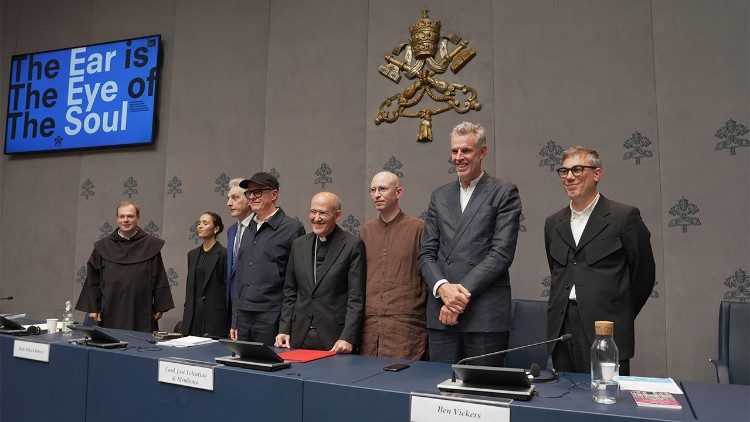
The exhibit is a part of the Biennale's 61st International Art Exhibition, which will take place from May 9 to November 22, 2026. The concept behind the Pavilion, articulated in two separate spaces, was presented on Monday, April 27, during a press conference at the Holy See Press Office.
Cardinal José Tolentino de Mendonça—in charge of the Pavilion and Prefect of the Dicastery for Culture and Education—described it as “an observatory of the world.”
He explained that Pope Leo XIV’s words during the Rosary for peace on April 11 are at the heart of the Pavilion's concept: “We must not allow ourselves to be overwhelmed by the pace of a world that does not know what it is chasing. Rather, we must return to serving the rhythm of life, the harmony of creation and healing its wounds.”
The Holy See’s participation in the Venice Biennale, Cardinal Tolentino de Mendonça added, is “an opportunity to immerse oneself in contemplation and listening. From interiority—an essential dimension—we hope fruits of peace, encounter, and future can emerge.”
In a world marked by conflict and tension, art has much to offer: “We need artists to speak. We must listen to them as we listen to prophets. Art offers us new visions of the world,” he emphasized.
An invitation to slowness and contemplation through St. Hildegard
Slowing down, listening, contemplating, and caring are key themes of the Pavilion, titled “The ear is the eye of the soul”, curated by Hans Ulrich Obrist and Ben Vickers.
According to Cardinal Tolentino de Mendonça, “our time needs new masters,” and Saint Hildegard’s “polyphonic profile” can serve as an antidote to the excess of monotony.
He explained that she can inspire new visions and introduce us to a “lingua ignota” (an unknown language), as in “a creative force that encourages more inclusive social paradigms and fosters communal and fraternal practices.”
The project draws on the chants, writings, and visionary images of the Benedictine abbess, who was canonized in 2012 by Pope Benedict XVI. “She may seem distant as a 12th-century mystic, but her voice is strikingly contemporary, capable of illuminating present-day questions,” the Cardinal pointed out.
A long-term project
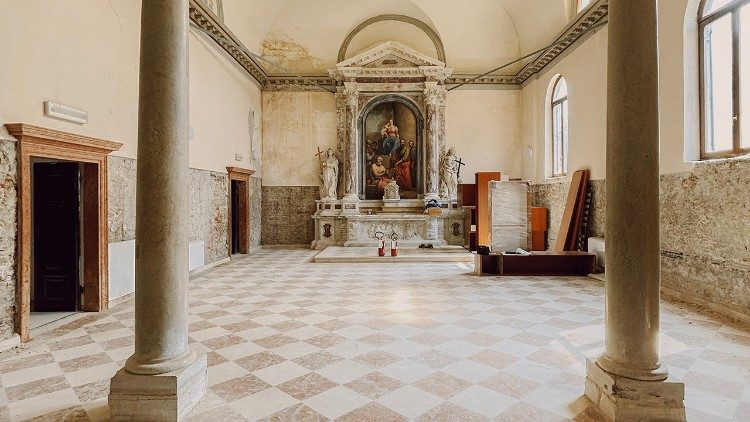
The Pavilion creates a harmonious relationship between works by 24 artists and the spaces in which they are held: the Mystical Garden of the Discalced Carmelites in the Cannaregio area of Venice and the Santa Maria Ausiliatrice complex in the Castello neighbourhood of the city.
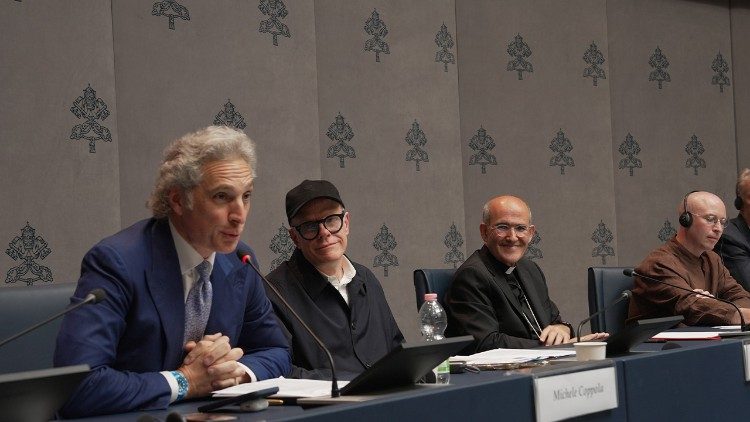
Obrist explained that this latter complex had already been a part of the Holy See’s Pavilion for the Biennale's Architecture Exhibition last year, and said the spatial continuity allows the project to grow sustainably without dismantling previous work.
A holistic experience
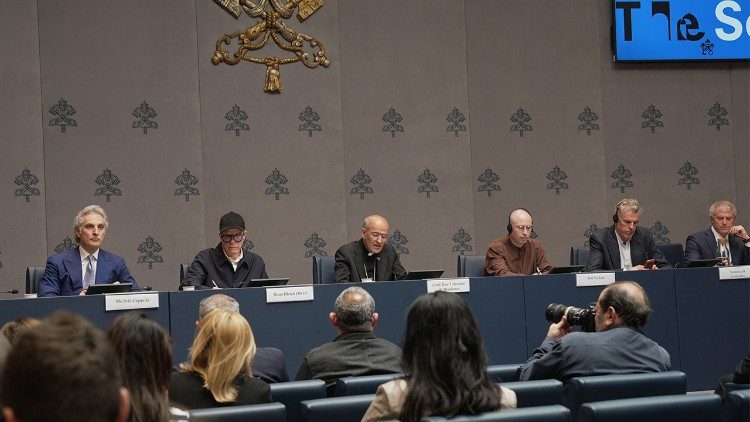
For Obrist, the project has developed over time and was shaped by memories and instances in which he came into contact with the cultural heritage left by Saint Hildegard.
“For Saint Hildegard, sound was a form of knowledge. Music becomes a link between the self and the world, between the microcosm and the macrocosm,” he said, emphasizing the holistic experience awaiting visitors.
Obrist hopes that the Holy See Pavilion will help people rediscover the importance of listening.
Saint Hildegard as a bridge between heaven and Earth
The other curator, Ben Vickers, described Saint Hildegard as a role model, as she knew how to connect heaven and earth through song, while highlighting the primacy of listening.
The Soundwalk Collective, an international experimental sound art collective, played a central role in the creation of the first section of the Pavilion in the Mystical Garden. There, new sound works by musicians, poets, and contemporary artists engage with Saint Hildegard’s legacy through voice, instruments, and silence.
Visitors will be able to walk through the Mystical Garden, a space dedicated to contemplation and not usually accessible to the public, and that was inspired by Saint Teresa of Avila’s book “The Interior Castle.”
Thanks to the use of headphones, visitors will also be able to listen as they walk to compositions by artists such as Patti Smith, Brian Eno, Jim Jarmusch, and Meredith Monk, alongside Benedictine nuns from the Abbey of St. Hildegard in Germany and more.
Visitors will immerse themselves in the sounds of the place, using a tool also created by the Soundwalk Collective to hear the voice of nature in real time, but also that of “one’s interior space,” said Simone Merli, who works for the Collective.
“An immersive experience, the Mystical Garden is a somewhat hidden gem, but one that is very dear to the hearts of Venetians,” Merli explained. “The Carmelites have given us this wonderful opportunity to be part of their daily lives.”

Saint Hildegard and Saint Teresa: guides for the soul
Father Ermanno Barucco, of the Order of Discalced Carmelites, described the Mystical Garden in Venice as a place of silence, beauty, zeal for God and contemplation.
“I imagine Saint Hildegard and Saint Teresa, with their different characteristics, accompanying people into the mystical garden within their souls, where God dwells,” he said.
“These two saints teach us to care for others. Silence compels us to listen within ourselves, to listen to our own conscience, and to ask ourselves if we are building a good, beautiful world for everyone.”
Listening as a path to understanding divine charity
The Santa Maria Ausiliatrice complex, on the other hand, will become a contemporary scriptorium, meaning the place where books and manuscripts were once copied and illuminated.
It will be divided into three parts: a living archive, a space with German author and film director Alexander Kluge’s final work, and the liturgical chant of the nuns of the Abbey of Saint Hildegard.
In the archive, curated in collaboration with Sister Maura Zátonyi and the Academy of Saint Hildegard, visitors will find a library of Hildegardian texts, Portuguese artist Ilda David’s artist books, and a new monastic architectural project by the architecture firm, Tatiana Bilbao Estudio.
Creation, as an act of love
As Pope Benedict XVI wrote in the apostolic letter accompanying the proclamation of Saint Hildegard as a Doctor of the Church, “creation is an act of love by which the world can emerge from nothingness. Hence, through the whole range of creatures, divine love flows as a river. Of all creatures, God loves man in a special way and confers upon him an extraordinary dignity, giving him that glory which the rebellious angels lost.”
Thank you for reading our article. You can keep up-to-date by subscribing to our daily newsletter. Just click here.


