
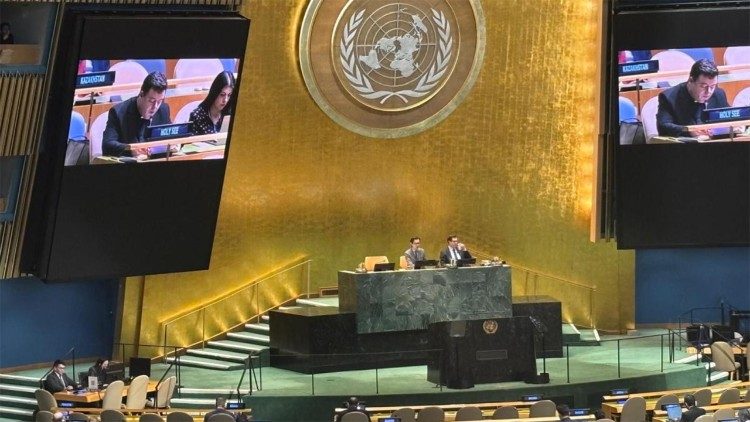
Holy See warns nuclear deterrence heightens global risk
Vatican News
The Holy See has warned that renewed reliance on nuclear deterrence, the modernisation of arsenals, and the growing integration of artificial intelligence into military systems are placing the world on an increasingly perilous path.
Addressing the General Debate of the Eleventh Review Conference of the Treaty on the Non-Proliferation of Nuclear Weapons at the United Nations in New York on Wednesday, the Holy See’s Permanent Observer Mission described the moment as one of “profound gravity.”
Against a backdrop of rising geopolitical tensions and weakening arms control frameworks, the delegation voiced concern over the return of nuclear rhetoric, including threats linked to the possible use and testing of nuclear weapons.
Shift away from multilateral diplomacy
Quoting Pope Leo XIV, it lamented a growing shift away from multilateral diplomacy. A diplomacy rooted in dialogue and consensus, it noted, is being replaced by one “based on force.”
It also highlighted recent attacks on nuclear facilities as a sign of the erosion of long-standing norms safeguarding global security.
Particular concern was expressed over the increasing role of artificial intelligence in nuclear decision-making. The Holy See warned that such systems reduce the time for human deliberation in moments of crisis, increasing “the risk of miscalculation” and obscuring the moral weight of life-and-death choices.
Disarmament, non-proliferation, peaceful use of nuclear energy
Reaffirming the centrality of the Non-Proliferation Treaty, it said its three pillars—disarmament, non-proliferation, and the peaceful use of nuclear energy—remain essential to international peace and security.
On disarmament, it stressed that Article VI imposes a binding obligation to pursue negotiations toward nuclear elimination. That duty, it said, is now more urgent as nuclear powers modernise their arsenals and expand deterrence doctrines.
Such trends, it warned, risk consolidating “a paradigm that is already strategically and morally questionable.” Reliance on deterrence, it added, reflects “an approach to security based on mutual vulnerability sustained by the threat of force rather than on law and trust.”
Catastrophic humanitarian consequences
Recalling the catastrophic humanitarian consequences of nuclear weapons, the Holy See reiterated its support for the Treaty on the Prohibition of Nuclear Weapons, which it said strengthens the moral and legal framework for disarmament.
In its long and articulated statement, it also focused on non-proliferation, calling for stronger International Atomic Energy Agency safeguards and renewed support for a Nuclear-Weapon-Free Zone in the Middle East. Verification alone, it said, is insufficient without addressing “the root causes of insecurity through dialogue and responsible engagement.”
"Peace cannot rest on fear"
On the peaceful use of nuclear energy, the Holy See reaffirmed the right of states to develop nuclear technology for peaceful purposes in line with their obligations, noting its applications in medicine, agriculture, food security, and environmental protection.
Concluding, it recalled Pope Leo XIV’s appeal for “a peace that is disarmed and disarming.” Authentic peace, it said, cannot rest on fear. It must be built instead on “trust, dialogue, and the recognition of our shared humanity.”
Thank you for reading our article. You can keep up-to-date by subscribing to our daily newsletter. Just click here.


