
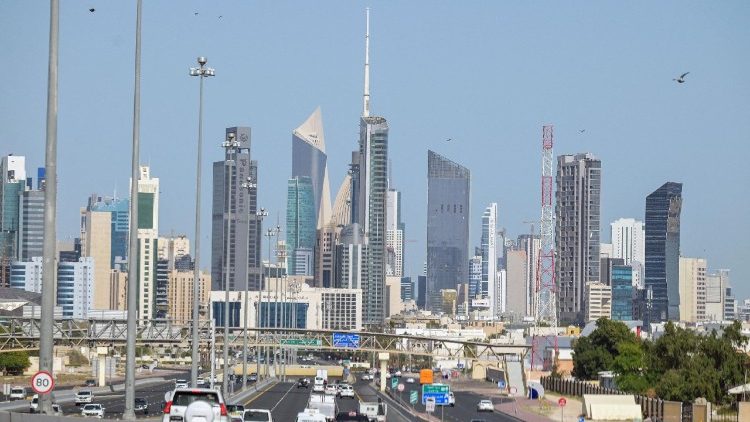
Nuncio to Kuwait: ‘A long war benefits no one in region already under strain’
By Delphine Allaire
Five people have been killed in the Gulf since Saturday, February 28, all of them foreign nationals: one in Kuwait, three in the Emirates, and one in Bahrain.
On Monday, March 2, new explosions were heard in Dubai, Abu Dhabi, Doha, and Manama. In Kuwait, thick smoke rose from the US embassy.
Iranian strikes are shaking these states of the Arabian Peninsula, long considered havens of security.
In the following interview with Vatican News, Archbishop Eugene Nugent, Apostolic Nuncio to Kuwait, Bahrain, and Qatar, describes the situation and the Church’s desire for peace.
Q: What is the current situation in Kuwait, where you are based?
The situation is dramatic and worsening day by day. We hardly slept at all last night because of a series of explosions heard from 2:00 AM onward, followed by incessant sirens. This morning, we learned that the American embassy here in Kuwait was attacked by a drone. Fortunately, there were no deaths, but there was damage, including a fire inside the embassy.
Again this morning, we learned that two American military aircraft were shot down near the US air base “Ali al Salem,” which I know quite well because I go there regularly to celebrate Mass. There is an Italian contingent right next to it.
We are trying to remain calm, of course, but it is somewhat frightening, it must be said. Around the nunciature, we have seen no damage. We are the only embassy in the Shaab district, a quiet part of the city.
The diplomatic district, which also houses the Iranian embassy, is fairly close, but our neighborhood is calm. Military bases and airports are the main targets, as well as Terminal 1 of Kuwait Airport, which was hit on the very first day by a drone.
Q: Bahrain and Kuwait are being affected by the war. How is it being experienced in states that ordinarily promote interreligious dialogue and peaceful coexistence?
We are all somewhat shocked by what is happening. We had hoped that the dialogue and negotiations underway would bear fruit. We were truly surprised when the war broke out on February 28.
Fortunately, the Holy Father’s message this Sunday at the Angelus, and his appeal for prayer for peace in this region, as well as for dialogue and negotiation, were well received here. We shared it widely.
The same is true of the message from the Apostolic Vicar of Northern Arabia, Bishop Aldo Berardi, inviting people to prayer and solidarity at this time, which was also well received.
Q: What voice can be raised at a time when attacks and reprisals are evolving minute by minute in every direction?
We remain in contact with the authorities and ambassadors, at least to encourage them to use every possible means to bring this war to an end. Sadly, once a war begins, no one ever knows when it will end.
Everything is accelerating, but we must still try every avenue. A long war benefits no one and will benefit no one, especially in a region already tried by many conflicts.
Q: How can diplomacy be renewed in the face of entrenched hostility?
At the moment, the weapons are making the noise. We must try the traditional means of diplomacy and negotiation. We hope that, with President Donald Trump’s statement indicating that there would be talks with the new regime in Iran, dialogue can begin.
We are hoping for a reasonable dialogue with all parties. For the moment, that is quite difficult because the situation in Iran is very complex. There are many factions within the country, and it is difficult to understand the geopolitical dynamics. We must try dialogue at every level. Diplomacy is the only way to put an end to this war.
Q: In Bahrain in 2022, Pope Francis described war as “a dramatically childish scenario,” denouncing that, “In the garden of humanity, instead of tending the whole, we play with fire with missiles and bombs.” How do those words resonate today?
They seem prophetic. They are powerful words that speak to everyone. For centuries, humanity has engaged in many conflicts, but in the end, we must seek fraternity and find what we have in common.
We have lived in this region for centuries. Every country is bound to seek peace and harmony. We pray very much for this. Last week, we celebrated Mass at the cathedral here in Kuwait for the fourth anniversary of the war in Ukraine. Four days later, war broke out here.
Only prayer—and, during Lent, fasting—are important. It is also Ramadan. Christians and Muslims are both in a time of fasting and prayer. Let us implore God to grant us the gift of peace.
Q: What support can you offer to the local Church and to the faithful who are shaken?
I am in daily contact with Bishop Aldo Berardi and with the parish priests in the three countries for which I am responsible: Kuwait, Bahrain, and Qatar. I try to encourage and support them. Some churches are still open, but others are closed, so there are private Masses.
At the nunciature, we celebrate Mass every morning at 7:30 AM and in the afternoon, at 5:00 PM, we pray the Rosary for peace. We also have prayer groups on WhatsApp. I encourage everyone to remain calm and to pray to the Virgin for this gift that we all need.
Q: How important is devotion to Our Lady of Arabia in such a context?
Our Lady of Arabia is fundamental; our faithful have deep devotion to her. Muslims, too, have great devotion to Maryam, who is mentioned several times in the Qur’an.
In this dramatic moment, we pray very much to the Virgin, Queen of Peace. It is through her intercession with her Son that the war will come to an end.
Thank you for reading our article. You can keep up-to-date by subscribing to our daily newsletter. Just click here.


