
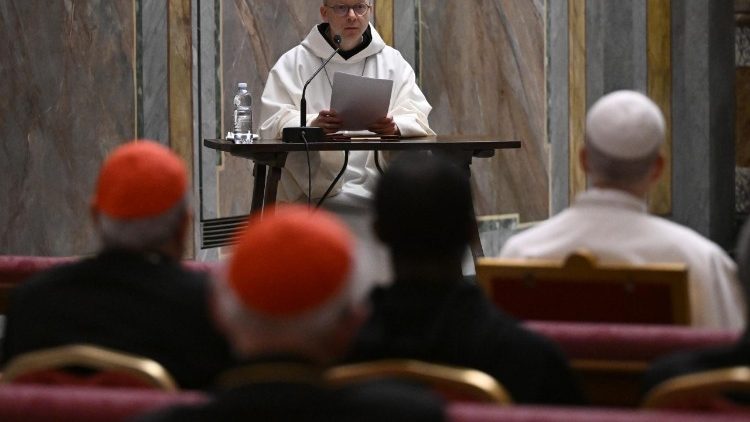
Lenten Retreat: Bishop Varden reflects on communicating hope
By Bishop Erik Varden, OCSO*
On 11 October 1962 Pope Saint John XXIII solemnly opened the Second Vatican Council. The Council’s ‘greatest concern’, he said, would be ‘that the sacred deposit of Christian doctrine should be guarded and taught more efficaciously. That doctrine embraces the whole of man, composed of body and soul. It bids us, pilgrims on this earth, tend towards our heavenly home.’
Less than a week after the pope’s discourse, the Cuban Missile Crisis broke out. Man looked set to blow himself out of the water of his earthly sojourn, with no thought of an eschatological goal. With the wounds of World War II still raw, our race was generating ghastly new prospects of self-destruction.
A climate of precariousness surrounded the Council; at the same time this period was charged with fervent hopes for a new society founded on human rights, fair trade, and technical advances. The Council wished to speak into the time’s ‘anxious questions about the current trend of the world, the place and role of man in the universe, the meaning of man’s […] strivings, the ultimate destiny of reality and of humanity’. Not only did it address the questions. It pointed towards their resolution, announcing that Christ, crucified and risen, incarnates the future of mankind. The Council set the Church the task of enunciating Christ in such a way that he will appear clearly and compellingly as the answer to the present time’s most urgent issues without compromising for a moment the sacred deposit of doctrine.
We may ask ourselves whether in the sixty years that have passed since the closure of the Council confidence has always and everywhere been kept in the power and efficacy of this deposit. Each Christian generation is bound to consider itself in view of the contrast Paul draws to the Ephesians between the measure of the stature of the fulness of Christ made manifest in unity of faith and knowledge, in mature manhood, and a childish state of being tossed to and fro, carried about with winds of doctrine, drawn, now by cunning, now by crafty wiles, now by facile optimism.
Christ calls us to communicate hope to the world. To have Christian hope is not necessarily to be an optimist. A Christian forswears wishful thinking, making a determined option for the real. Demagogues promise that things will get better. They claim demiurgical power to change communities within an electoral term, distracting the masses from felt disappointments by hand-outs of bread, tickets to circuses, and defamations of adversaries. How different are Christ’s words. He tells us, ‘The poor you will always have with you.’ He affirms that nation will rise against nation. Persecutions will come. A man’s enemies will be members of his own household. There is no lame resignation in these statements. The Lord obliges us, his disciples, to labour without respite for a new, healthy humanity formed by charity, in justice. He tells us to ‘cure the sick, raise the dead, cleanse the lepers, cast out demons’. We are to enact the beatitudes, making the glory hidden within them shine. But as we go about this we are reminded: ‘Without me you can do nothing.’
Christ is the light of the nations, Lumen Gentium. He alone, doing the Father’s will, acting in the Spirit, can renew the face of the earth. In him we put our trust, not in passing stratagems.
He can act through us if we consent to being patient. Lent shows us that God, suffering the wound of his philanthropy, is at his most active in his Passion. The hope he entrusts to us is not hope in a finally modernised, digitised, sanitised Vale of Tears. Our hope is in a new heaven, a new earth, in the resurrection of the dead.
The time in which we live is hungry to hear this hope proclaimed. We have considered some signs surrounding us: new religious awareness among the young; the return of the category of truth to public discourse; a search for roots. Global institutions and alliances are breaking down. We are exposed to strategic, ecological, and ideological peril. It is natural that people of sense and good will should ask what, in the midst of such uncertainty, stands a chance of lasting. Tired of building their lives on sand, they seek solid rock. Meanwhile, their heart is disquieted. The Fathers of the Second Vatican Council affirmed, in Gaudium et spes, that the best aspirations and darkest dread of the present time must raise an echo in the hearts of Christians. For a Christian is no stranger to anything that is ‘genuinely human’.
Permit me to share one such echo that resonates in me.
A year ago, on 8 February 2025, the American singer Gracie Abrams gave a concert in Madrid. She is a young woman with everything going for her. She is beautiful, prosperous, successful. In Madrid she wore a white silk dress. It could have been a wedding dress, a garment of joy, had it not been for its long, black shoulder ribbons, portents of a sorrow that, when she started singing, made up the core of her message.
There is in her texts a piercing sadness that borders on, perhaps touches, despair. Abrams was born in 1999. Her song Camden begins with the line, ‘I never said it, but I know that I can’t picture anything past 25’. The song evokes a need to hide grief, to ‘bury baggage till it’s out of sight’ while outwardly toeing the line, calling it fine, hoping that somebody might ‘notice how I’m trying’. A mantra-like refrain runs: ‘All of me, a wound to close, but I leave the whole thing open.’
Abram’s Madrid performance of Camden was filmed and posted to YouTube by a fan who wrote: ‘Insane. No words. Cried. Died. Dead.’ Thousands attended that concert. They sang along, all of them, knowing the winding text by heart, having made it theirs. Teenage Weltschmerz is nothing new. Each generation finds its way of outing it. There is, though, a singular quality to the lament of our time. We cannot dismiss it as the fetishisation of desolation. Hearing, and watching, Gracie Abrams sing, one does not doubt the depth of experience out of which her cry arises. It is uncanny to hear it picked up, cadence after melancholy cadence, by a packed young crowd: ‘I just wanted you to know, I was never good at coping. […] I really hope that I survive this.’ Is ‘hope’ an appropriate term in the circumstances? In fact, I doubt it. What stands out in the lyrics is hopelessness before an ever-present menace.
Gracie Abram’s fans are mostly girls. A stereotype suggests that lads are different, attracted instead to dour recognition of life’s hardship, set to bear it with bushily bearded, manly fortitude. Anyone who goes out and talks to young people, or spends time in a confessional, knows that the stakes are less clearly distinguished. The consciousness of being wounded permeates our times like a smoky mist.
How striking to live Lent in such a context, to fix our gaze on a wounded, distended body and affirm that here hope is found. For centuries the Church was cautious about displaying the wounds of Christ’s Passion. She was busy framing in words the paradox that constitutes the heart of the Christian proposition: that in Christ divinity and humanity are both integrally present, that this man ‘born of the Virgin Mary’ is likewise ‘God from God, Light from Light’. Only once the Council of Chalcedon had refined the conceptual framework required to safeguard this equilibrium was the Christian spirit free to envisage, not only in words but in art, graphically, the freely assumed humiliation of God-made-man. The crucifix emerged as the supreme Christian emblem. It came to take centre stage in cultic practice, at least in the West, where representations of a wounded God became the focal point of churches and other edifices, gradually forming public consciousness.
Reminding the Christians in Corinth of his coming among them, Paul wrote: ‘I did not come proclaiming the mystery of God to you in lofty words or in wisdom. For I decided to know nothing among you except Jesus Christ, and him crucified.’ The categorical centrality of Jesus’s saving Passion suffused the doctrine of this peerless preacher of reconciliation, mercy, graced transformation, joy, and eternal life. Courage is required to follow his example in a culture that tempts us to market a happier Gospel prognosticable in terms of fixed processes and set results. Around us, the cross-overshadowed naves of ancient cathedrals are handed over to mini-golf. Sanctuaries are used for secular skits designed, in desperation, to display ‘relevance’. Meanwhile, a stone’s throw away, in the secular arena, the young disconsolately sway, softly singing that life is an open wound and that there is no balm in Gilead.
Two contradictory tendencies mark contemporary efforts to deal with wounds. On the one hand, people readily display acquired, inherited, or imagined wounds as markers of identity. They may have good reasons, causes based on calls for justice. But as we have heard Bernard explain, motivational prospect is lost to us if we root our sense of self in attachment to a wound. We risk being mired in anger, a passion that displaces aspirations to healing with affirmations of self-righteousness. Anger and its reflection, bitterness, can lock us in perversely self-satisfied despair.
On the other hand there are efforts to airbrush wounds. We hear it insinuated that wounds should not exist and that, if they do, sick limbs should be removed. In societies become transactional, unproductive or unlovely elements have no place. They are seen as freak occurrences, met with harshness. This attitude is evident in ongoing controversies about abortion and euthanasia, as in recurrent talk about eugenics. It is seen in dystopic dreams of relieving societies of undesirables, whom certain politicians would confine in reservations or drop off the edge of a cliff.
One can interpret this development in different ways. It seems hard to deny that the eclipse in public consciousness of the figure of the Crucified, the Wounded-yet-Unovercome, has something to do with it. A civilisation that, at some level, seeks its measure in an image that affirms the stature of patience and redemptive suffering is changed. It may learn empathy, which is not spontaneous to fallen humankind.
Reverence for Christ’s wounds defined Christian sensibility for centuries. It found expression in devotion to relics of the Passion; in Stations of the Cross; in poems and paintings; in works of music from Renaissance Lamentations through Bach’s Passions to nineteenth-century hymnography. It was expressed in the cult to the Sacred Heart that spread worldwide in the wake of revolutionary furies. At the heart of it was respect for the tremendous mystery of suffering, constitutive of the human condition as we know it. The Cross lets us own reality while it affirms the non-finality of wounds, which can be healed and become sources of healing.
To root ourselves within this mystery of faith is to work a constructive revolt against several fallacies: against the political fallacy that society, and the state, should be run on an evolutionary model in view of human perfectibility; against the anthropological fallacy of a normative standard of ‘health’ deployed to mark divisions between lives ‘worth living’ and lives ‘not worth living’; against the cultural fallacy that ascribes to wounds a fatal, deterministic power; and against the psychological fallacy that surrenders to hopelessness, mesmerised by the voice that whispers in our ear, at dead of night, regarding our most intimate hurts: ‘It will always be like this’.
Christ’s Passion lets us lament without rage. It opens us to compassion, which is an epistemological category apt to prepare a graced insight like Job’s: ‘I had heard of you by the hearing of the ear, now my eye sees you.’ We may call out to the Crucified-and-Risen-One: ‘My Lord and my God!’ The Gospel states that Christ’s wounds, after his rising, were not done away with, but rendered glorious. The world’s wounds can be, too, when Christ’s oil and wine are poured upon them.
The Cross is to believers at once symbolic and the memorial of an event. The symbol of Christ’s Passion is not one we engender. It has been given us. It interprets us, not we it. This is worth insisting on as we swim against the tide of a symbolic capitalism set on ‘producing knowledge’. In this virtual world, ‘facts’ are artefacts. Narratives, images, and data are trafficked to perpetuate change, thereby to further consumption. It is hard to understand something and to change it at the same time. As a result, the quest for clarity plays a minor role in current public discourse, whose flitting rhetoric and erratic symbols are rather designed to befuddle.
Yet the human being craves understanding. It is defined by its need to ask: ‘Why?’ It needs the Church’s clear thinking and Christ-centred hope. It needs her confident sense of direction. It needs her symbols, which are realistic, different from the world’s, focused on an historically wounded body, on the dying of death, on the eternal destiny of ‘the whole of man, composed of body and soul’. The sublime perspective of our faith is founded on realities that happened and that, within the communion of Christ’s mystical body, happen still. We profess that a transforming Benevolence has saturated human suffering even in its most extreme manifestations, reaching right into the very depths of hell, and that no desolation therefore is final.
Such is our Gospel. Our time is crying out for it. The young lamenting in our parks with heavy hearts hunger for it. They do listen when it is presented ‘with authority’ by Christians able at once to expound and display the truth of it without compromise, showing Christ’s gracious power to renew and to transform lives.
At Clairvaux in 1139, Bernard preached his last sermon on Psalm 90 on the eve of Easter. It breathes the delight of an athlete who has finished the race. A monk’s life, says St Benedict, should be a continuous Lent, ever focused on Christ’s victory over death. The liturgical season reveals the thrust of our existence as such. Bernard makes this explicit. Life’s trials are birth pangs. They make us discover what it means to be alive: ‘We live fully when life is vital and life-giving.’ We are born to bear fruit. There is a ‘hope of glory’ in tribulation, Bernard tells his monks before he corrects himself and says, no, glory is in tribulation, the way the fruit is in the seed. He exclaims: ‘My brothers, glory hides in tribulation now; eternity hides in the present moment, a sublime, immeasurable weight in this lightness.’
The inversion is complete. What weighs us down now lacks lasting substance. The weight of glory draws us upwards, towards a magnificent, multiple glory. Configured to a full share in Christ’s life, we shall know the patient joy of God who proclaims in Psalm 90, ‘I am with him in tribulation’. He also says: ‘My delight is to be with the sons of men.’ ‘Oh Emmanuel’, Bernard responds: ‘God with us!’ He adds: ‘Hail, full of grace, the Lord is with you’, delicately outlining the Marian character of graced growth into authentic Christian maturity. God knows what we desire and thirst for, what is to our taste. We must not to settle for too little. We must know, and proclaim, in whose image we are made, what greatness we are, by grace, capable of.
On the morning after preaching this last sermon, Bernard will have opened his Gradual to sing the introit of Easter: the lovely Resurrexi in the sixth, ‘grave’, mode, a musical expression of upward-surging gravity. This liturgical composition proclaims the resurrection with quiet wonder. It lifts the Church’s praise before the empty tomb into the eternal embrace of the Trinity. Drawn finally into that embrace by Christ’s Paschal victory we shall see as we are seen, know as we are known. We shall at last love perfectly.
For now, still, we know and see in part as we keep vigil in the night. We work. We serve. We teach. We do battle when we must. We endeavour to love and honour each other, our eyes fixed on Jesus, the pioneer of our faith. He, the Lamb of God, is our lamp. His kindly light, also when hidden, is full of gladness.
* Bishop Erik Varden, Bishop of Trondheim, Norway, was asked to preach the 2026 Spiritual Exercises for Pope Leo XIV, Cardinals residing in Rome, and the heads of Dicasteries of the Roman Curia, which runs from Sunday, February 22, to Friday, February 27. Here is the link to his website.
Thank you for reading our article. You can keep up-to-date by subscribing to our daily newsletter. Just click here.


