
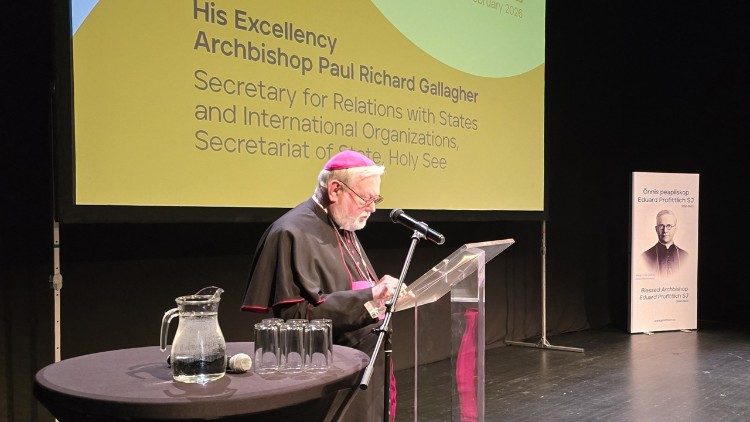
Archbishop Gallagher: God can rebuild nations from the ashes of hatred
By Salvatore Cernuzio
Archbishop Paul Richard Gallagher, Secretary for Relations with States and International Organizations, is in Tallinn, Estonia to participate in an international conference (February 20-21) dedicated to Blessed Eduard Profittlich. He was a German-born Jesuit, who was an apostolic administrator in Estonia during the Soviet regime and a martyr for peace and freedom.
Archbishop Profittlich is a symbolic figure – beatified on September 6, 2025 in Tallinn – representing the union of "diplomacy and holiness."
The red thread between diplomacy and holiness
Archbishop Gallagher’s address referred to the Jesuit as the "red thread, thin but unbreakable", that links "high diplomacy" with the "mission of the great pastors who have marked the history of the Church, even in these Baltic lands."
Archbishop Profittlich died at 51 in 1942 in the Kirov prison, where he had been incarcerated and awaited execution by firing squad on false charges of espionage, "a victim of a system that hated truth and humanity."
Archbishop Gallagher highlighted how the Jesuit’s sacrifice "reveals that diplomacy, as understood by the Church, and pastoral work, though operating in different spheres, share a common root: service to truth for the love of God and humanity, against all forms of oppression."
Builder of bridges and hero of history
Of German origin, Archbishop Profittlich became Estonian by "love and choice." He realized that in order to fulfill his mission in Estonia, he could not remain an "outsider". Therefore, he deliberately chose to become "all things to all people," especially choosing to stay during the Soviet occupation of Estonia rather than returning to Germany like many other "Baltic Germans."
Consequently, he shared in the tragic fate of the Estonian people. "His decision to stay was also his highest diplomatic act," Archbishop Gallagher affirmed. In fact, as Blessed Profittlich noted in his diaries, he drew "incredible happiness" and a "deep sense of peace" from it.
Like many saints, the archbishop was able to "strip himself of his national, cultural, and social identity." Thus, he was more than a pastor; he was "a true pontifex," "an extraordinary builder of bridges and mediator" in a land where the Catholic presence was a minority.
The Secretary for Relations with States noted that the Jesuit "knew how to weave a network of human and diplomatic relationships that helped elevate the dignity of an entire people. His mission was not political, yet it had an immense political impact."
Blessed Profittlich "gave Estonia a moral voice at a time when great totalitarian ideologies sought to stifle its identity." For this reason, Archbishop Gallagher said, he is today regarded as "a great hero of Estonian history."
Truth - the soul of human thinking and action
Even during brutal interrogation and imprisonment, Blessed Profittlich’s courage never waivered. "He remained faithful to the supreme truth: Love is the only force capable of overcoming evil!" Archbishop Gallagher highlighed.
This is why, in an era of conflicts and threats, his story "urgently speaks to us," reminding us that "in the mission of saints, as in high diplomacy, truth is not an accessory but becomes the soul of human thinking and action."
The Church's diplomatic efforts to overcome divisions
The Estonian archbishop never hesitated to assert the truth through words and deeds, "aware that nothing is more dangerous than silence when human dignity is at stake." This spirit motivated many men and women in the last century in this part of Europe, during the struggle for freedom and independence.
"This same spirit must guide every diplomatic action of the Church today, aimed at overcoming divisions. Holy Pastors do not negotiate on the truth of humanity. Their answer is a resolute yes to life and a firm no to tyranny," Archbishop Gallagher stated.
Both pastoral and diplomatic missions, he continued, "must always aim to bridge distances, avoid increasing divisions, and make room for dialogue and encounter, with the ultimate beneficiary always being the good of the human person. True peace must be the fruit of this virtuous work, in which there are neither winners nor losers."
The impossible becomes possible
From this comes the call to be "artisans of peace," ready to testify that "the love of God is the only force capable of rebuilding nations from the ashes of hatred." The Secretary for Relations with States also praised the "faithfulness" and "pastoral action" of the Catholic Church in Estonia, which, despite being a small community, "has endured countless and great sufferings."
"Divine mercy" allowed "the evolution of events and made the rebirth of faith possible even where it was most contested, as it happened in this noble land," he stressed, recalling Pope John Paul II’s visit to Prague one year after the fall of the Berlin Wall. "A visit that just a few months earlier, everyone would have considered impossible."
This is the point: what seems unthinkable can, with God, become possible. We must trust in Him, the archbishop urged, and the peace that today seems "impossible" will come to fruition.
Thank you for reading our article. You can keep up-to-date by subscribing to our daily newsletter. Just click here.


