

The ‘lifting of the anathemas’, sixty years on
By Joseph Tulloch
In the popular imagination, the year 1054 marks the moment when the Catholic and Orthodox Churches went definitively into schism.
According to a widespread narrative, it was at this point that the Churches of East and West, which had been slowly drifting apart for centuries, declared one another to be ‘anathema’, bringing into effect a split which endures to this day.
It was only nearly a millennium later, in 1965, that the leaders of both Churches – Pope Paul VI and Patriarch Athenagoras I of Constantinople – finally expressed their regret for the events of 1054, in a declaration widely referred to as the ‘lifting of the anathemas’.
No schism?
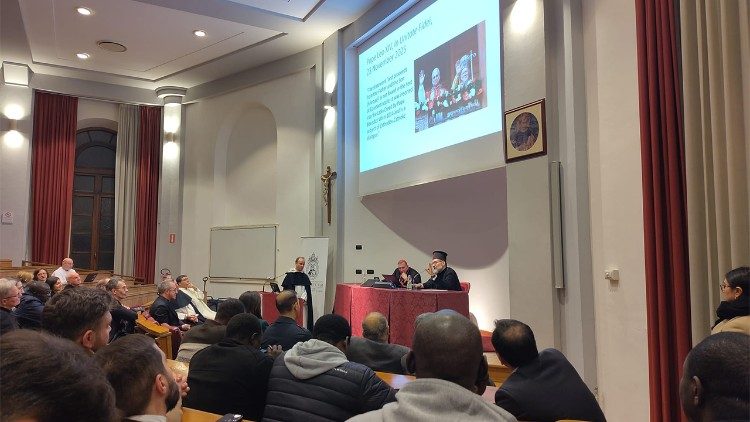
On Wednesday evening, this declaration was the subject of a conference at the 'Œcumenicum', the Institute for Ecumenical Studies at Rome’s Pontifical University of St Thomas Aquinas, entitled ‘60th Anniversary of The Lifting of the Anathemas: Healing of Memories and Christian Unity’.
The conference featured Cardinal Kurt Koch, Prefect of the Dicastery for Promoting Chrisitan Unity, and Archbishop Job Getcha, Metropolitan of Pisidia, co-chairs of the Joint International Commission for Theological Dialogue between the Catholic Church and the Orthodox Church.
Yet, as the event’s moderator, Fr Hyacinthe Destivelle, pointed out in his introductory remarks, the name of the conference was something of a misnomer, since in reality “there were no anathemas, and no lifting”.
Speaking to Vatican News after the event, Metropolitan Job was even clearer: in 1054, “there might have been a rupture of communion" between the two Churches, but “there was no schism”.
Sister Churches
So what did happen in 1054?
In his speech, Cardinal Koch explained that what the Latin legates in Constantinople delivered was not an anathema directed against the Greek Church in general, but rather a bull of excommunication targeting three specific individuals, including Patriarch Michael Cerularius. When the Patriarch and his synod responded in kind several months later, they also pronounced an excommunication which was limited to a few individuals, in this case the papal legates.
Moreover, Cardinal Koch emphasised, at the time that the original bull of excommunication was pronounced by the legates, the Pope - Leo IX - who had sent them to Constantinople had been dead for several months, meaning their action had “no canonical value”.
There is thus a “fundamental difference” between the events of 1054 and the events of 1965, the Cardinal said, in that the former was limited to a small group of individuals, whereas the latter stressed the bonds between two Churches.
While the 1965 Joint Declaration did not immediately bring about unity, the Cardinal said, it did usher in an “ecclesiology of sister Churches”, according to which both Churches regard the other as legitimate and express their desire to learn from one another – a necessary first step on the ecumenical journey, which, Cardinal Koch said, will one day be followed by the restoration of Eucharistic communion.
Synodality, primacy and the filioque
In his address, Metropolitan Job of Pisidia highlighted the work of the many historians from both the Catholic and Orthodox Churches who have undermined the traditional narrative of the ‘schism’ of 1054.
Among them is Martin Jugie, the French Catholic priest and scholar born in 1878 who, Metropolitan Job said, argued that the mutual excommunications of 1054 were not the beginning of a schism between the two Churches, but rather “the first, failed attempt to end it”.
The Metropolitan also highlighted the powerful wording of the 1965 Joint Declaration, in which both Pope and Patriarch declared their intent to “commit these excommunications to oblivion”.
Metropolitan Job went on to emphasise the progress that has been made on resolving theological differences between the Catholic and Orthodox Churches, particularly on the issue of synodality and primacy. He also highlighted the choice by successive Popes not to recite the filioque clause of the Creed – a key cause of historic tension between the Churches – in ecumenical settings, describing Pope Leo XIV's decision to omit the clause during ecumenical vespers in Rome in September of last year as a sign of "great hope".
Indeed, the Metropolitan stressed, so much progress has been made at a institutional level that a key priority must now be ensuring its broader reception – unity between the two Churches, he emphasised, will only come once it is desired and worked for not only by the hierarchy, but by the clergy and laity too.
Thank you for reading our article. You can keep up-to-date by subscribing to our daily newsletter. Just click here.


