
Pasolini: May the Church foster encounter as she sets out to know God
By Tiziana Campisi
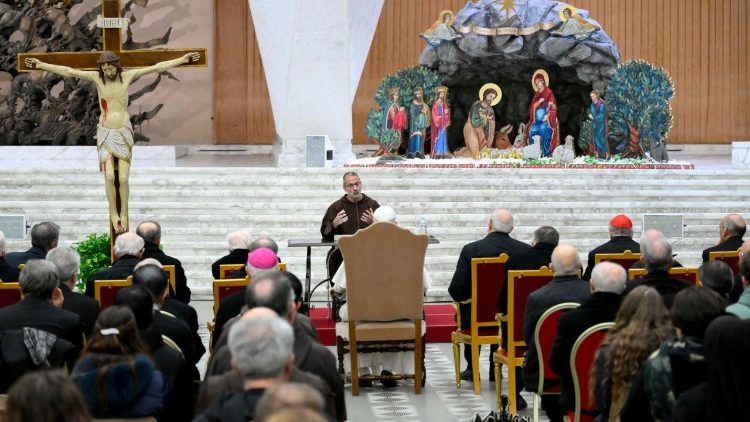
Recognizing the coming of Jesus Christ “as a light to be welcomed, expanded, and offered to the world” is the “challenge” that Christmas and the Jubilee invite us to undertake. The preacher of the Papal Household, Father Roberto Pasolini, emphasized this challenge at the beginning of his third Advent meditation, on the theme “The Universality of Salvation”, delivered this morning, December 19, in the Paul VI Hall before Pope Leo XIV and the Roman Curia.
The Light that reveals
The Capuchin friar offered a reflection on the universal manifestation of salvation, on Christ, the “true light,” who is “capable of illuminating, clarifying, and guiding the entire complexity of human experience,” who "does not erase man’s questions, desires, and searches, but connects them, purifies them, and leads them toward a fuller meaning.”
The world has not embraced this light because “men loved darkness rather than the light.” The problem, Father Pasolini explained, is “our willingness” to welcome the light, which “is necessary and beautiful, but also demanding: it unmasks pretense, lays bare contradictions, forces us to recognize what we would rather not see,” and for this reason, “we often avoid it.”
Yet, the priest noted, “Jesus does not contrast those who do evil with those who do good, but those who do evil with those who practise truth.” This means that "to welcome the light of the Incarnation, it is not necessary to already be good or perfect, but to begin to practise truth in one’s life: to stop hiding and to accept being seen for who one is,” because “God is more interested in our truth than in superficial goodness.”
The Church, a community that lives the light of Christ
For the Church, this means “embarking on a journey of greater truth,” which “does not mean exhibiting moral purity or claiming impeccable consistency,” but “presenting oneself with sincerity,” and “recognizing our resistance” and “fragility.” The world does not expect “the image of a flawless institution, nor another discourse indicating what should be done,” said Father Pasolini, but it “needs to encounter a community that, despite its imperfections and contradictions, truly lives in the light of Christ and is not afraid to show itself for what it is.”
The Magi, for example, demonstrated a singular way of being authentic by “walking the path of the Lord,” the priest explained. They set out from afar, demonstrating “that in order to welcome the light of Christmas, a certain distance is necessary,” to allow us “to see things better: with a freer, deeper gaze, more capable of surprise.”
Instead, the habit of “looking at reality too closely” can make us “prisoners of predictable judgments and overly consolidated interpretations.” This can also happen to “those who live permanently at the center of ecclesial life and bear its responsibilities,” observed the preacher of the Papal Household, because “daily familiarity with roles, structures, decisions, and urgencies can, over time, narrow our outlook”. Thus, there is the risk of failing to recognize “the new signs through which God makes Himself present in the life of the world.”
The unexpected ways of God
If Christmas Day celebrates “the light [that] has entered the world,” Epiphany emphasizes that “this light does not impose itself, but allows itself to be recognized… it manifests itself within a history still marked by darkness and searching,” and is “a presence that offers itself to those who are willing to move.”
“Not everyone sees it the same way, not everyone recognizes it at the same time,” because “the light of Christ allows itself to be encountered by those who accept to step outside themselves, to set out on a journey, to seek,” the Capuchin friar emphasized, adding that this is also true “for the journey of the Church,” since “not everything that is true appears immediately clear, nor is everything that is evangelical immediately effective.” Sometimes “the truth asks to be followed even before it is fully understood.”
In this regard, Father Pasolini mentioned the experience of the Magi, “who do not advance supported by established certainties, but by a fragile star, which is nonetheless sufficient to set them on their journey.” The wise men who came to Bethlehem from the East teach us that “to encounter the face of God made man, it is necessary to set out on a journey.”
This, the preacher of the Papal Household emphasized, “is true for every believer,” and especially for those who have “the responsibility to protect, guide, and discern.” “Without a desire that remains alive, even the highest forms of service risk becoming repetitive, self-referential, incapable of surprise.”
For Father Pasolini, the star that guided the Magi, is also “the sign of the discreet calls with which God continues to make Himself present in history.” The wise men, who “do not know the Scriptures of Israel” but read the heavens, remind us “that God also speaks through unexpected ways, peripheral experiences, questions that arise from contact with reality and await to be heard.”
‘Remaining seated’
But another important aspect that emerges from the story of the Magi is the attitude of inquiry. The refusal to set out on the journey in search of Christ, “remaining still,” can lead to “the temptation to settle into a position that appears reassuring, made up of certainties and established habits, but which over time risks becoming a form of interior immobility,” which slowly isolates us, often without us realizing it.
This is what happens to Herod, who appears “to be attentive: he questions, calculates, plans,” but does not set out for Bethlehem. He does not accept “the risk and surprise of what might happen,” and delegates the task of going to the Magi, reserving the right to be informed of developments. “It is the attitude of those who want to know everything without exposing themselves, remaining sheltered from the consequences of real involvement,” the Franciscan friar stated, warning against an “abundance of knowledge” that lacks “real involvement.” “We know many things, but we remain distant. We observe reality without letting it touch us, protected by a position that shelters us from the unexpected.”
It happens, then, that in the Church one can “know the doctrine well, preserve tradition, celebrate the liturgy with care, and yet remain static.” “Like the scribes of Jerusalem, we too can know where the Lord continues to be present—in the peripheries, among the poor, in the wounds of history—without finding the strength or courage to move in that direction,” the preacher of the Papal Household warned.
The courage to rise
In short, in order to encounter God, “the first step is always to rise: to leave our inner refuges, our securities, our established view of things,” Father Pasolini insisted, specifying that “getting up requires courage. It means abandoning the sedentary lifestyle that protects us but immobilizes us, accepting the fatigue of the journey, exposing ourselves to the uncertainty of what is not yet clear,” just as the Magi did, leaving their homeland and crossing “distances without guarantees, guided only by a faint and discreet sign,” not knowing what they would find but trusting in the light that preceded them.
This means hoping.
Father Pasolini also noted the Magi’s humility. Having arrived in Bethlehem, they adored the Child, set out, searched, and opened themselves to the mystery: “Getting up and then kneeling down: this is the movement of faith. We stand up to step outside ourselves, not to put ourselves at the center. And then we lower ourselves, because we realize that what we encounter is beyond our control.”
For the preacher of the Papal Household, “this is true in our relationship with God, but also in our everyday relationships … when the other surprises us, disappoints us, or changes” and we need to stop imposing our own point of view and “learn to truly listen.”
And, broadening our perspective, it also applies to the Church, which “is called to move, to go out, to encounter people and situations that are distant from her,” and “also to know how to stop, to lower her gaze, and recognize that not everything belongs to her or can be controlled.” Then “the gift of salvation can become universal: to the extent that the Church accepts to leave her own securities and look with respect at the lives of others, recognizing that even there, often in unexpected ways, something of the light of Christ can emerge.”
The true light of Christmas
A final aspect on which the preacher of the Papal Household invites us to reflect is that “if God has chosen to dwell in our flesh, then every human life carries within itself a light, a vocation, a value that cannot be erased.” This must lead us to conclude that “we did not come into the world merely to survive or to pass the time in the best way possible,” but “to attain a greater life: that of the children of God.”
And so the Church’s task is “to offer the light of Christ to the world. Not as something to be imposed or defended, but as a presence to be offered,” allowing anyone to approach.
“From this perspective, the mission does not consist of forcing the encounter, but of making it possible,” concluded Father Pasolini. “A Church that offers Christ’s presence to all does not appropriate His light, but reflects it. She does not place herself at the centre to dominate, but to attract. And precisely for this reason, she becomes a place of encounter, where everyone can recognize Christ and, before Him, rediscover the meaning of their own life.”
“This perspective” he claimed, “forces us to rethink our missionary habits. We often imagine evangelizing means bringing something that is lacking, filling a void, correcting a mistake”; but “Epiphany points to another path: helping others recognize the light that already dwells within them, the dignity they already possess, the gifts they already hold.”
Therefore, the catholicity of the Church consists in “guarding Christ in order to offer Him to everyone, with the confidence that beauty, goodness, and truth are already present in each person, called to be fulfilled and to find their fullest meaning in Him.”
In conclusion, then, for the preacher of the Papal Household, “the true light of Christmas 'enlightens every man' precisely because it is able to reveal to each person his or her own truth, his or her own calling, his or her own likeness to God.”
Thank you for reading our article. You can keep up-to-date by subscribing to our daily newsletter. Just click here.


