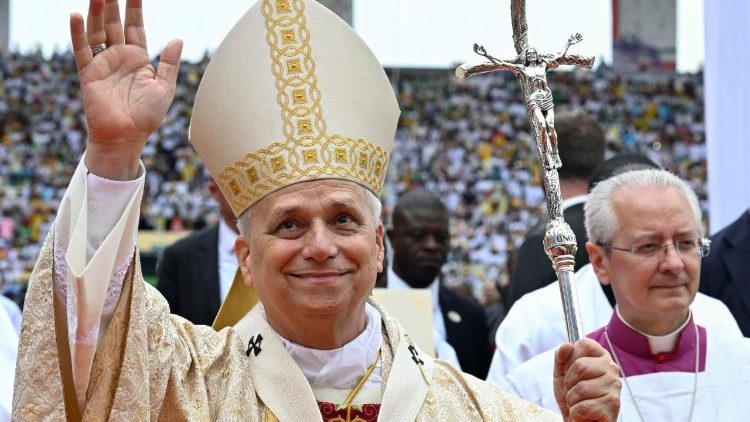
Cardinal Ambongo: Pope Leo's Africa visit promoted human dignity
By Francesca Sabatinelli - Malabo
The choice of countries visited illustrates the diversity of Africa’s challenges: interreligious dialogue in Algeria, the pursuit of peace in Cameroon, and the call for a fairer distribution of wealth in Angola and Equatorial Guinea.
In an interview with Vatican media, Cardinal Fridolin Ambongo Besungu, Metropolitan Archbishop of Kinshasa and President of the Symposium of Episcopal Conferences of Africa and Madagascar (SECAM), expressed this, as he emphasized the importance of Pope Leo’s Apostolic Visit to Africa, 13-23 April.
Moreover, the Cardinal highlighted the significance of the Holy Father's appeals to political leaders, especially those which urged them to curb the exodus of young people by creating dignified living conditions locally.
Your Eminence, how would you assess Pope Leo XIV’s Apostolic Journey?
I am happy, I am content, on behalf of all the people of Africa. For us, it is a source of pride but also a responsibility, because this means that the universal Church of tomorrow will have to engage with the African Church, and this is a responsibility for us that we must embrace.
Secondly, it is important to highlight the choice of the four countries. One is an Arab, predominantly Muslim country, which received from the Pope a message on the importance of freedom for Christians living there. He then visited Cameroon, a country struggling with coexistence among communities, where he delivered a strong message about peace and living together harmoniously. The other two are resource-rich countries, and the Pope’s message focused on the need for a just distribution of wealth: goods for the benefit of all.
For us African Catholics, I believe the main message was about deepening our faith and understanding our identity as Catholics. We must first know ourselves before engaging with others. The primary message for the Church is this: to recognize our Catholic identity. During the trip, the Pope visited all aspects of the Church in Africa, which I found very inspiring.
From a sociopolitical perspective, he emphasized peace, justice, and good governance. This applies to all these countries. Pope Leo XIV visited Algeria, an Arabic-speaking country with a largely Muslim population; Cameroon, which is partially French-speaking and partially English-speaking; Angola, which is Portuguese-speaking; and finally Equatorial Guinea, the only Spanish-speaking African country.
What is the face of the Church that the Pope encountered?
It is twofold. First, it is a young, dynamic Church, confident in its future. This was evident in all of the Pope’s recent engagements: a Church full of young people, and they represent the future. On the other hand, it is a Church facing many challenges: poverty, lack of justice in some countries, and difficulty living peacefully in contexts where power is manipulated. This is the Church the Pope came to meet, and his visit was seen as encouragement to continue striving for the future. It is an incredible source of encouragement for us and for Catholics—a moment of confirmation in our faith.
The Pope spoke very strongly about freedom, equality, and denounced the gap between the few wealthy and the many, many poor, calling for respect for human dignity. How much do you think this message will resonate in these four countries?
I see the Pope’s message as prophetic. By that, I mean that when a prophet speaks, some listen, others do not. This was true with Jesus during his time on Earth, and it will also be true for Pope Leo’s message.
And regarding the population, how important were the Pope’s words in giving them courage? The joy of the people, especially young people, was visible. Will the Pontiff’s message give them confidence and strength to move forward?
The value of the Pope’s message is that it is a call to the conscience of leaders in Africa to create opportunities for the future of young people. We saw so many enthusiastic young people, but we must also think of all those leaving the continent in search of paradise elsewhere, many of whom end up in the Sahara desert or at sea. This shows that something is wrong in Africa. The Pope’s message to leaders is rightly: create conditions that allow young people to enjoy life here, rather than forcing them to go elsewhere to seek happiness.
Are you optimistic?
Very much so. I continue to believe in the future of this continent, especially my own country, the Democratic Republic of the Congo, which is suffering today. But I believe in the future.
Cardinal Ambongo, what emotion are you left with?
The first emotion I feel is pride. I feel proud and happy, and I think all Africans share this feeling now. I hope it will continue into the future. There will also be fruits for the Church in Africa, whose role should be recognized universally. Considering the work Pope Leo has done in his first year of pontificate, we are confident about the future.
Thank you for reading our article. You can keep up-to-date by subscribing to our daily newsletter. Just click here.