A rain-soaked message of mercy inside Bata Prison
By Claudia Torres – Bata, Equatorial Guinea
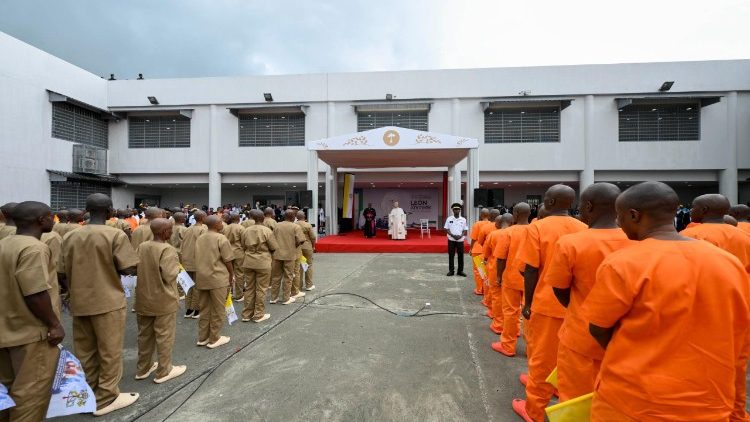
A striking scene awaited Pope Leo XIV at Bata Prison in Equatorial Guinea on 22 April: hundreds of men and women stood quietly in neat rows, heads shaven, Vatican flags and flags with pictures of the Pontiff dangling from their hands. Some wore olive-green prison uniforms, others bright orange. On their feet they wore similarly colored rubber slippers.
They stood quietly, all facing the small stage from where the Pope would soon greet them.
As the Holy Father entered, all the inmates started to sing and dance, the flags in their hands no longer hanging limply at their sides but waving energetically over their heads. The high concrete and plaster walls of the rectangular courtyard amplified the sound of the choreographed welcome. “Nuestro Santo Padre, te damos gracias. Ora por nuestros pecados y nuestra Libertad,” they sang. “Our Holy Father, we thank you. Pray for our sins and our freedom.”
The Holy Father took in the scene attentively, waiting for the inmates to finish their song. He listened to testimonies from some of those serving sentences, who thanked him for his visit and expressed their desire for peace, reconciliation, and a fresh start.
Then the rain started, just as Pope Leo was about to speak. At first it was a light trickle, but in the span of a few minutes it crescendoed into a heavy downpour. Members of the press hurriedly opened their umbrellas but soon gave up and scurried off to find shelter.
But the men and women in their monochrome uniforms and rubber slippers stayed where they were. They didn’t have umbrellas. They couldn’t hide from the rain. They stood in their neat lines, their eyes fixed on their guest as he spoke.
“In some places, it is said that rain is a sign of God’s blessing,” the Pope began, acknowledging the sudden weather shift. “Let us pray that this may indeed be the case,” he said, “and let us also live this moment as a sign of God’s closeness, a God who never abandons us.” The Pope went on to give inmates what he called a “simple” message, namely, that “no one is excluded from God’s love!”
He stressed that “every effort should be made” to ensure that incarcerated people “are given the opportunity to study and to work with dignity while in prison,” because, he added, “life is not defined solely by one’s mistakes.” There is always the possibility, he said, “to start over, learn and become a new person.”
After the Pope’s remarks, which were received with loud applause and cheers, the inmates presented the Holy Father with a wooden cross they had made for him. The Pope lifted it up so all could see, and the cheers became a deafening roar. Then he showed them the statue of Saint Francis of Assisi he had brought for them.
It was a particularly symbolic gift, as a decisive part of Saint Francis’ spiritual journey came about during his months-long detention in prison after the Battle between Assisi and Perugia (1202-1203). That period of solitude and trials put him on a path of conversion towards the radical joy of the Gospel, showing that true peace comes from a profound transformation of the heart.
And what to say about the inmates’ farewell to the Pope? On a normal day, the scene that played out at the end of the visit could have been confused with a prison riot, inmates breaking formation and rushing towards the exit, their frenzied chants reverberating over the sound of the pouring rain. But this was no ordinary day and those men and women weren’t inciting chaos. They were expressing their longing for the freedom they had lost, many due to “difficult and complex circumstances,” as the Pope said in his remarks.
Perhaps they experienced some form of that lost freedom in those moments, singing and dancing with the Pope in their midst, praying with the messenger of peace who went where few could have imagined he would ever go.
Thank you for reading our article. You can keep up-to-date by subscribing to our daily newsletter. Just click here.