
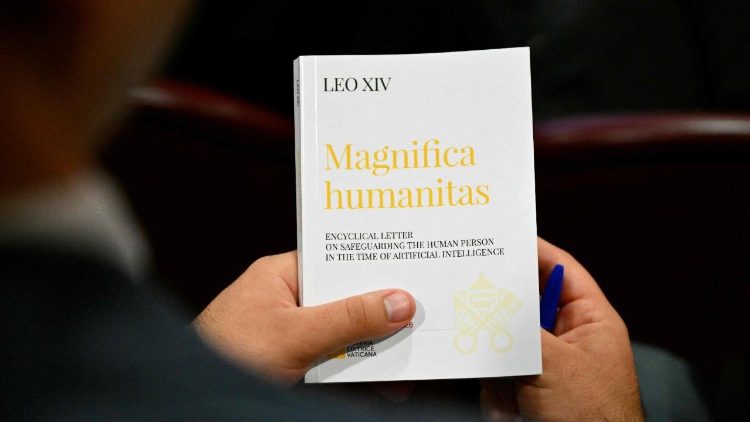
Microsoft AI Director: Magnifica humanitas valuable for AI development
By Devin Watkins
Massive advances in consumer-facing artificial intelligence systems in recent years have led the Church to engage more deeply with companies building the technologies of the future.
That movement has led to criticism of the Church’s engagement with tech companies to help direct the development of AI, as well as to criticism within the tech world of those who dialogue with the Church.
But by pushing religion and theology to an “optional realm,” developers risk missing out on more deeply understanding how their customers think, according to Taylor Black.
Mr. Black serves as the Director of AI and Venture Ecosystems in the Office of the Chief Technology Officer at Microsoft and as the inaugural Director of the Leonum Institute for AI and Emerging Technologies at the Catholic University of America.
These dual roles—along with his role as a permanent deacon with the Byzantine Catholic Eparchy of Phoenix—offer Mr. Black the opportunity to reflect philosophically on the future of AI while helping direct Microsoft’s capital investments in AI startups.
Speaking to Vatican News in his personal capacity, Mr. Black pointed out that technology has no anthropology or specific view on the human person.
Rather, generative or agentic AI products are probabilistic, guessing the next word in a sequence, every action based on data on which it has been trained and the user’s prompt.
The result is that users are co-creating their experiences, and products must be based on a good understanding of the user’s way of thinking.
In response to this new tech development paradigm, in January 2025, the Dicastery for the Doctrine of the Faith and the Dicastery for Culture and Education released “Antiqua et nova: Note on the Relationship Between Artificial Intelligence and Human Intelligence.”
Then, on May 25, 2026, Pope Leo XIV exercised his papal magisterium with the publication of his first encyclical Magnifica humanitas.
Both documents seek to apply the Catholic Church’s deep experience and understanding of the human person to the emerging technology of AI.
Mr. Black said Pope Leo’s encyclical recognizes that AI can shape its users’ development if they forego critical thinking and accept whatever the AI chatbot proposes without verification.
This risk is especially relevant for children, whose prefrontal lobe continues developing into their mid-20s, said Mr. Black.
He gave the example of a parent who leaves their child with a morally dubious adult, who may be very knowledgeable but may also give information the parent would not want their child to have, even if not in a malicious way.
In an attempt to be helpful, AI can also change our voice or our face, sometimes pushing our real self to the side in favor of an ideal version.
“It's forming us in a way that we can assent to if we feel like it,” said Mr. Black. “But again, if we're children, then we can't really fully assent to that shaping without our own creative input to it, of our voice, of our way of being in the world, as well as adults can.”
******
Q: You’re deeply involved in artificial intelligence and other emerging technologies, both at a philosophical level and at a financial level with Microsoft. How can Magnifica humanitas help direct the tech industry’s ethical development of AI?
[Taylor Black:] I think that one of the reasons the tech industries have gone to a variety of different religious traditions in seeking out a better understanding of the human person is that when we are making products of a generative or agentic AI nature, they're probabilistic.
What that means is that the user of our products now is co-creating their experience along with the thing that we have built.
This is new in the history of tech products. Generally, prior to AI, we were able to make things that were deterministic. We knew what would happen when the user used our product.
Now we have a less good sense of what the user is able to co-create. As a result, we need to understand our user better to understand the possible outcomes of their using our particular products.
Tech doesn't have anthropology. It espouses none. It doesn't claim to be an expert in human anthropology.
But now we have to consider it more deeply because it impacts the way in which our products themselves are built, the way in which they're developed, so that our users have a better experience and quite honestly we're able to keep them as users because they are finding value in their interaction and co-creative acts with our products.
Q: Your job at Microsoft is to choose which startups get access to funding for their ideas and business plans. How can the encyclical and the relationship between the Church and Big Tech guide your peers’ work as capital allocators?
It again goes back to this product-thinking. If we have a product or a startup that has come up with something that utilizes AI, and if they have contemplated a user that doesn't exist as a result of having a thin anthropology, then their product is not going to have as great success in the market as it might have if it actually respected the way in which humans think and the way in which humans judge.
And so as a result of this kind of thinking, and as a result of the way in which the encyclical articulates this, we're very interested in the startups and products that better respect the way in which humans actually operate, because as a result, their customers—the startup's customers, the Big Tech's customers—are going to have a better experience of actually using the thing.
As a result, it matters very deeply to us how a startup or a product goes about their design methodology, the way in which they think about responsible AI, and the way in which they build the interfaces and the interactions that these AIs have because of the way in which AI integrates more deeply into the human person's own cognition and more deeply into the ways in which individuals or teams interact with regard to more agentic interfaces.
Both of these presuppose a better understanding of the human person than tech has so far had to think about because of the way in which the technology more deeply integrates with the human person.
Q: As founding director of the AI Institute at the Catholic University of America, and as a father, how do you hope to use Magnifica humanitas to teach young people about how to interact with AI?
In fact, I was just giving a talk earlier this week to a number of parents at my kids' classical method Catholic school here in the Seattle area.
One of the things that we talked about was the encyclical's recommendation that we'd be very careful about what kind of screen interfaces as well as social media interfaces and of course AI interfaces for kids, particularly because there's a great deal of judgment required when you're using these agentic AI interfaces and these generative AI interfaces, because you're having to discern whether the thing that they are you're being told is true.
Additionally, there's another concern here too with regard to being able to develop one's own voice before having one's voice developed for you.
Both these things have shaped the conversation that I had with these parents as well as my own parenting with regard to minimizing tech exposure for my kids before they have the intellectual capacity to really wrestle with it well.
I like to remind people that children not only have software problems, but they also have hardware problems in the sense that they don't have a completely formed prefrontal lobe until they're in their early 20s.
That I think should give us some pause and some reflection on the kinds of experiences that we offer kids in this sense.
I gave an example as I was talking to these parents of leaving your kid alone with a brilliant but morally ambiguous adult friend of yours.
The adult friend probably could give some great insight with regard to stars and galaxies and chemistry and writing and all of these different sorts of things.
But as a result of being morally ambiguous, they may also tell your children things that they shouldn't hear, or ought not be told, or tell them to say things that they probably shouldn't be saying, not even in a malicious sort of way. It's in a kind of purely statistical probability sort of way. But the child doesn't have the equipment to make that discernment as well as we fully formed adults might.
There's also this interesting aspect, and Pope Leo refers to this in the encyclical as well as in some comments earlier this year, with regard to being able to own one's own voice and one's own image.
I think when he's meditating on that aspect, we as adults had the benefit of growing up and spending a lot of time developing our own way of thinking and our own way of writing and speaking without the use of these generative AI tools.
The generative AI tools, in their bullheaded attempt to be helpful, craft our language. They can change the way in which our voice sounds. They can change the way in which our face looks in digital media, such that it's not our own.
It's forming us in a way that we can assent to if we feel like it. But again, if we're children, then we can't really fully assent to that shaping without our own kind of creative input to it, of our voice, of our way of being in the world, as well as adults can.
Now that we have these tools, we're able to shape something for us that does perhaps sound more like what we've hoped to have sounded like over the course of our lives.
For children, it can be a miss. It can be a way in which their own voice gets pushed in a direction that they themselves may not entirely intend.
Q: The release of Pope Leo’s encyclical is a stepping stone for the Church’s journey with AI. What do you think the next steps should be for the Church’s relationship with AI developers?
I think there's some really interesting work being done by a number of nonprofits and research groups in this space, of taking what the Church has said at a broad and high level and implementing it in the actual structure and building and engineering of these systems.
Indeed, the encyclical itself calls out the moral and cultural and societal weight of the work that these developers are doing.
I'm looking forward to a deeper relationship between the theory that the Vatican is able to propose and the practice that we as builders have to go through when we're actually putting hands to keyboard or voice to agent when developing these tools.
That's really where the rubber hits the road, and being able to have that interplay, being able to have the technologists bring the problem to the Church or bring the problem to philosophy and theology and say: 'This is how it works from a technical standpoint.'
And having that insight from the theologians, the philosophers, and the Church, can say: 'As a result of you telling me how this technology actually works, you should design it or make it go in this direction.'
That interplay, that having to work through the hard conversations in the actual building, is underlined throughout the entire encyclical, which I very much appreciate, and I look forward to the deepening and development of those kinds of relationships.
Q: Catholics have been criticized from some corners for interfacing with what some people see as morally dubious AI developers, and at the same time developers have received criticism for even dialoguing with the Church and wondering what right the Church has to speak on these social issues. Have you noticed any kind of that criticism from the developer’s side?
I have and I think it is not a very thoughtful criticism on either side, quite honestly. The reason being is that it usually has its basis, I find, in the rather naive way in which the United States has separated Church and State, which is, of course, a historical artifact that is an interesting one.
But as a result, it kind of leaves religion, theology, and these deeper kinds of questions in an optional realm rather than in the real way in which all of us experience the need for the transcendent or the need for worship. That's my theoretical answer.
In the concrete, of course, we're trying to more deeply understand how our customers work. When we built products prior to the advent of AI, we would watch our customers work through an interface or do a set of tasks, see how they went about them, observe them actioning the tasks with the tools that we had built, and then change the interface or change the way in which the tool worked in a deterministic sort of way so that the user was better able to complete their task.
Now, our user research, now, of course, watching somebody type in a question and then not be happy with the response—all of that is happening inside that person's head.
And so now we have a second-order ability to understand how that user is actually encountering our products and co-creating what they're hoping to co-create as a result of working with this generative AI interface.
That begs questions about the human person, just from a product-making standpoint.
So, not being able to explore what different conceptions of the human person are by dialoguing with entities that have very strong views on what the human person is and how the human person functions, I think, is a misguided and short-circuited way of actually building products that customers know and love.
And it's entertaining to me that tech companies, large and small, would truncate the reality of product making purely on the basis of historical artifacts like the separation of Church and State.
Thank you for reading our article. You can keep up-to-date by subscribing to our daily newsletter. Just click here.


