
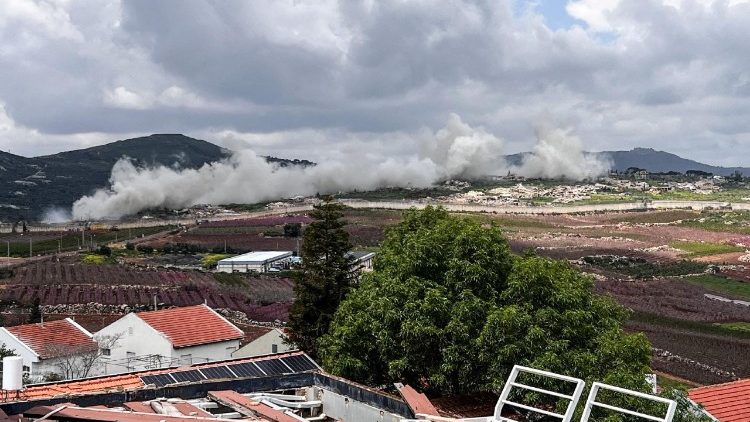
Last Christian village on Israeli border: 'We want a Lebanon that lives in peace'
By Guglielmo Gallone
“We want a Lebanon that lives in peace and serenity; we want to find jobs for our young people; we want families no longer to feel forced to leave their village.” Because “the Lord has taught us to love everyone. I love everyone: Shiites, Sunnis, Druze—everyone. But the time has come to raise our voices even more: we no longer want war.”
This is how Father Toni Elias, the Maronite parish priest of St. George in Rmeich, responded to the news that the ceasefire announced overnight by Iran, the United States, and Israel will not apply to Lebanon.
The resilience of Rmeich
“We expected this,” Father Elias shared. “Rmeich is the last Christian village before the border with Israel. We are not near the border—we are on the border. We are the only ones - together with two other villages - still holding out in the Bint Jbeil area. Here, everyone immediately understood that a truce in southern Lebanon was unlikely, simply because the Israeli army has already moved past us and because of the scale of its engagement in this campaign.”
Israeli attacks on the morning of April 8 proved that the ceasefire does not extend to Lebanon. Air strikes hit the southern parts of Beirut in southern Lebanon and the eastern Bekaa Valley - areas where Hezbollah is allegedly more prominently present.
Israel has called it the biggest wave of air attacks of this conflict as it hit over 100 of what Israel described as Hezbollah command centers and military sites in 10 minutes.
Celebrating Easter
Despite this, Father Elias explained that his community still managed to celebrate Easter. “We thank the Lord for this because, even though this year we had to forgo the Easter Vigil, we were still able to celebrate Holy Week with wholehearted participation. This is the core of our resistance: faith, trust in the Lord, and surrender to Him. Not giving up—rather, trusting in the Lord. This is what truly makes us a resilient people in the midst of this tide of war and conflict that surrounds us.”
The Church’s closeness and essential needs
This trust is also reflected, Father Elias continued, in the support the community has received. “Since we raised our voices, the Church has never failed to show its closeness. Both in the previous war and in this one, there has been great support.”
He expressed the community's great appreciation for Pope Leo's prayers. “Just this morning, the Apostolic Nuncio, Archbishop Paolo Borgia, asked us how we are and what our needs are. These days, I am compiling a list of medicines. There are people with cancer or undergoing serious treatments. Some need very specific or very expensive medicines, which cost a lot or are no longer available. We need these essential goods, and above all, a humanitarian corridor.”
Father Elias explained he is trying to send this list to the Order of Malta, which is working closely with Caritas in the area. “We,” Father Toni Elias concluded, “carry the full burden here in the parishes, and we are also trying to understand how to obtain support. We remain steadfast in our peaceful resistance.”
Thank you for reading our article. You can keep up-to-date by subscribing to our daily newsletter. Just click here.


