
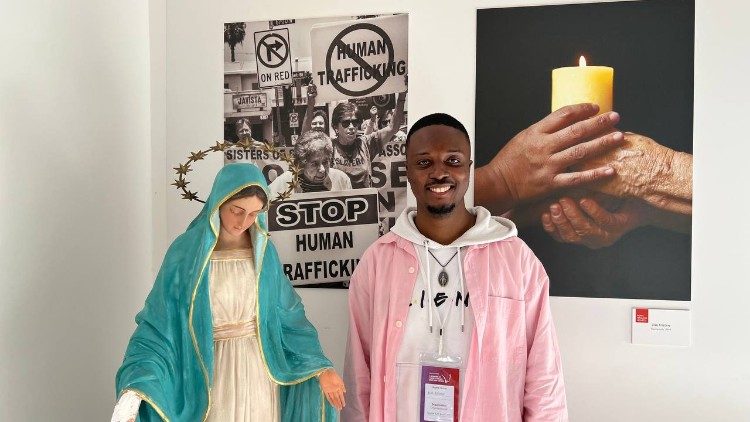
Talitha Kum Youth Ambassador: ‘Use all platforms to end trafficking'
By Fr. Mark Robin Destura, RCJ
In the run-up to the International Day of Prayer and Awareness Against Human Trafficking celebrated annually on 8 February, Talitha Kum Youth Ambassador from Botswana, Lone Botshelo, speaks about the urgency of confronting modern slavery through faith, creativity, and digital advocacy.
Having joined the Youth Ambassador program in 2024, Lone admits that he initially knew little about human trafficking in his own country. “I didn’t realize how alive and real it was in Botswana,” he explains. Through training and field experience, however, he began to recognize how deeply the issue affects vulnerable communities, particularly women and children.
“This journey has opened my eyes,” he says. “It has helped me see that trafficking is not something distant. It is happening among us.” For him, this awakening became a call to live with purpose and commitment.
Alongside his work in finance and his activities as a content creator, Lone has been involved in youth ministry and social action. His interest in issues such as climate change, mental health, and social justice naturally led him to anti-trafficking advocacy.
“I love living in purpose,” he reflects. When he learned about Talitha Kum’s mission, he immediately felt called to participate. “It wasn’t just another project,” he says. “It was a way to serve.”
Arriving in Rome to take part in the international gathering of Talitha Kum, Lone describes the experience as both moving and challenging. Although he arrived too late to join the group in meeting the Pope, he quickly became immersed in the week’s activities and workshops.
“We are here to pray, to learn, and to act,” he says. “Being among young people from so many countries makes you realize that this is a global struggle.” For him, the gathering reinforces the sense that the fight against trafficking transcends borders.
One of the initiatives promoted by the network in the week before the International Day was a candlelight procession and a prayer vigil to raise awareness about the scourge and pray for the victims.
Digital mission against human trafficking
For Lone, social media is one of the most powerful tools available to young advocates today. “We live in the digital age,” he notes. “Everyone is online, from teenagers to grandparents. So why not use that space for awareness?”
In Botswana, they regularly produce videos, reflections, and creative content about human trafficking. During the novena to Saint Josephine Bakhita, a former slave and patron saint of trafficking victims, they shared daily meditations linking her story to the present realities.
“Through trends, vlogs, and storytelling, we can reach people who might never attend a seminar,” he explains. “Digital platforms can become spaces of education and conversion.”
With around 40 members of Talitha Kum, they focused first on their own parish in the Diocese of Gaborone. Their work includes: Parish visits and post-Mass talks, distribution of brochures and educational materials, youth workshops, school assemblies and community outreach programs.
Dialogue with Institutions
One of the most significant initiatives was a national panel discussion, which brought together Church leaders, social workers, law enforcement officers, and government leaders of Botswana. Around sixty participants attended in person, while many more followed online and through the radio.
“This kind of dialogue is essential,” Lone insists. “It shows that the Church, government, and civil society can work together.” He believes that collaboration strengthens prevention and victim support.
Looking ahead, Lone’s priority is to expand the Talitha Kum program beyond the Diocese of Gaborone. He also hopes to deepen cooperation with government agencies under Botswana’s National Action Plan against Human Trafficking and other institutions with the mission to protect the vulnerable.
“We want to walk with the government, not go against it,” he explains. “Whether through funding, training, or shared projects, partnership is the key.” For him, sustainable change depends on coordinated action.
A vision of hope
Lone’s main message is “Human trafficking thrives where people are silent. Our task is to speak, to educate, and to protect.”
He believes that young people, empowered by faith and technology, can become agents of transformation. “If we use our voices wisely,” he concludes, “we can help restore dignity to those who have been treated as invisible.”
“In the digital world and in real life,” he adds, “we must never make it easy to exploit human beings. Every person deserves freedom.”
Thank you for reading our article. You can keep up-to-date by subscribing to our daily newsletter. Just click here.


