
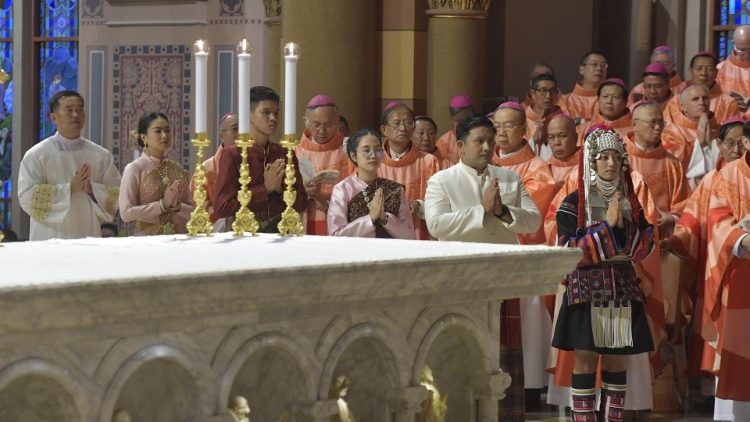
Thai Bishops call Catholics to act as ‘moral force’ in upcoming polls
By Chainarong Monthienvichienchai, LiCAS News
The Catholic Bishops of Thailand have reminded the faithful that they have a vital role to play as a “moral force” and “social conscience” in safeguarding a truthful and just electoral process.
In a message addressed to parishioners nationwide and released on January 27, Archbishop Francis Xavier Vira Arpondratana, president of the CBCT, stressed that voting is not merely a civic right but a moral responsibility rooted in the Church’s social teaching.
“The Church invites all Christians to recognize that voting is a moral obligation for the common good,” Archbishop Vira said. “Exercising the right to vote is not simply a legal duty, but a moral requirement that citizens must collectively fulfill for the good of society.”
Citing the Catechism of the Catholic Church, the Archbishop recalled that citizens are called to contribute to the common good through concrete actions such as paying taxes, defending the country, and participating in public life through voting. Neglecting to vote, he noted, constitutes a failure to participate responsibly in society.
The pastoral letter offers guidance to Catholic voters as the campaign period intensifies ahead of the election, which will determine all 500 seats in Thailand’s House of Representatives, whose members will nominate the new prime minister.
According to the CBCT, authentic democratic participation does not end at the polling booth. “Participation includes monitoring, scrutinizing, and upholding moral truth at every stage of the electoral process,” the statement said, adding that abstaining from voting may be morally permissible only in exceptional cases where no candidate meets minimum ethical standards.
The Bishops also warned against reducing democracy to procedural rules alone. “True democracy is not merely the result of laws and regulations,” Archbishop Vira said, “but arises from the acceptance of fundamental values such as human dignity, human rights, and the common good.”
Without these values, he cautioned, democracy risks becoming a “disguised dictatorship” that ultimately oppresses the people, citing the Compendium of the Social Doctrine of the Church (No. 408).
The CBCT urged Catholic voters to choose candidates who respect human dignity, prioritize the common good over personal or factional interests, and demonstrate genuine concern for local communities, especially the poor and the vulnerable.
Drawing from Scripture, the pastoral letter recalled God’s instruction to Moses to select leaders who are “capable, God-fearing, trustworthy, and incorruptible” (Exodus 18:21).
Such leadership, the Bishops said, reflects God’s vision of power exercised not for personal gain but as “power for service,” in line with the Church’s social doctrine.
The Bishops also addressed political leaders and public officials directly, calling for integrity throughout the electoral process.
Quoting Jesus’ teaching that “whoever is faithful in small matters will be faithful in great ones” (Luke 16:10–11), the statement warned that even minor acts of vote-buying or electoral fraud sow the seeds of corruption that can destroy a nation.
Political corruption, it said, is a betrayal of the people and a grave violation of social justice.
Acknowledging long-standing challenges in Thai elections, including vote-buying and increasing political polarization, the CBCT expressed hope that the upcoming polls would become “a testament to our love for God and for one another.”
The Bishops called the faithful to prayer, asking God to grant wisdom and discernment to all citizens so they may choose virtuous leaders and sound public policies.
They also prayed that those elected would govern with integrity and lead the nation toward “true peace, justice, and fraternity.”
Thank you for reading our article. You can keep up-to-date by subscribing to our daily newsletter. Just click here.


