
President of Guatemalan bishops: Peace, justice against violence
By Federico Piana
Days after the Guatemalan government declared a 30-day nationwide state of siege, the president of the Guatemalan Bishops’ Conference, Bishop Rodolfo Valenzuela Núñez, spoke of the “caution and fear” evident in the country.
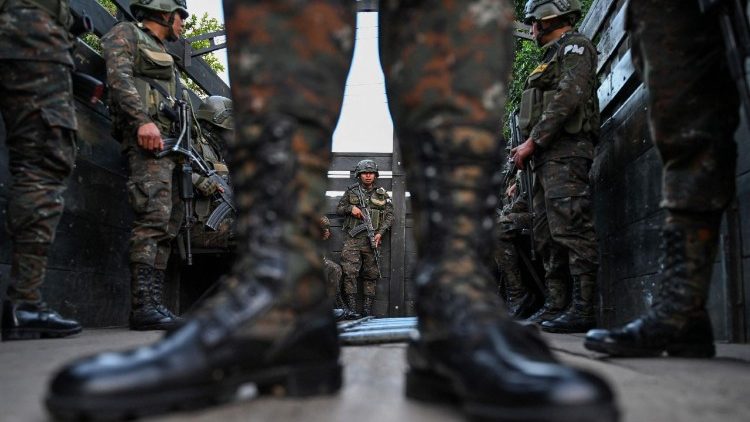
“Among citizens, caution and fear prevail. There is a sense that the government reacted fairly quickly”, he explained. In Guatemala City, the capital of the Central American nation, people are still afraid to leave their homes, even though dozens of police officers and soldiers in riot gear are patrolling neighborhood by neighborhood in search of members of criminal gangs.
These gangs killed ten police officers in terrorist-style ambushes after, last Sunday, members of criminal groups held in three different prisons sparked riots that were later quelled by law enforcement.
Targeted checks
Recent reports indicate that among the more than 200 people arrested under the 30-day state of emergency approved by Parliament, at least 20 belong to Barrio 18 or Mara Salvatrucha. These are two of the most powerful gangs, violently dominating the country, especially Guatemala City and its surrounding department.
The president of the Bishops’ Conference explained these prison riots were orchestrated by gangs in an attempt to secure more lenient detention conditions for their members. They happen, above all “because the prisons are in the hands of organized crime. Gang members control the prisons, there are corrupt prison officers, and there is also a compromised judicial system that, in those detention centers, fails to enforce the law.”
Hidden interests
Moreover, police checks and enforcement efforts infuriate the gangs and trigger violent attacks against the State, similar to those seen at the start of this week.
Bishop Valenzuela shared that the Guatemalan president has stressed that these groups want to keep the country from living “in transparency and justice.” The bishop highlighted that “ultimately, those responsible are not only the members of criminal gangs, but also the economic and ideological interests that stand behind them.”
A widespread evil
After issuing an appeal for reason and peace, and expressing their intention to support the families of the slain police officers, the bishops addressed the authorities. They urged them to honor the promises made during the election campaign and to fight with every means against the widespread evil of corruption.
Bishop Valenzuela pointed out that “the Bishops’ Conference believes the government has serious weaknesses, but that it must nonetheless be supported in a battle which—from the outset—was known to be unequal and difficult, against dark political and economic forces and their interests.”
To reinforce his argument, Bishop Valenzuela remembered Monsignor Juan Gerardi, Father Hermógenes López, the Missionaries of the Sacred Heart, and many other religious and lay people who were victims of violence in the not-too-distant past: “These figures encourage us on a path of resistance and hope.”
Masses suspended
Last week in the area of the Archdiocese of Santiago of Guatemala, police found the bodies of three women—one of them pregnant—and two adolescents, possibly killed in a gang-related feud. This recent surge in violence has required as a precaution, Bishop Valenzuela revealed, “the suspension of Eucharistic celebrations and evening church gatherings.” In the rest of the country, he added, “thanks be to God, pastoral activities are continuing normally.”
More than a security issue
The prison riots and killing of police officers not only generate fear for national security, but may also represent a direct attack on the entire development of the political process. “The population is particularly concerned, because this could truly change the country’s immediate future. This year the so-called second-degree elections will take place, in which judges of the courts of justice and constitutionality, as well as of the Supreme Electoral Court, will be elected,” Bishop Valenzuela said. “If corruption within these bodies is not brought to an end, nothing else will function. There are vested interests seeking to obstruct these institutional changes.”
A crucial moment
The bishops are increasingly convinced that organized crime can be confronted by strengthening the intelligence tools of the State and the armed forces, but not through summary justice. “We oppose,” Valenzuela warned, “arbitrary actions that accuse and condemn those responsible for violence against the people without due process.” He stressed, however, that arresting foot soldiers is not enough; it is also necessary to stop the sophisticated and shrewd minds hiding behind them.
“I reiterate,” he concludes, “it is necessary to clearly identify the hidden interests spoken of by the president and apply the force of the law to them as well. For this reason, we truly consider the political moment that will lead to the election this year of honest individuals to the judiciary to be crucial. We bishops insist that Christians, in harmony with the Church’s teaching, engage in politics and government. Unfortunately, with rare exceptions, their absence is all too evident.”
Thank you for reading our article. You can keep up-to-date by subscribing to our daily newsletter. Just click here.


