
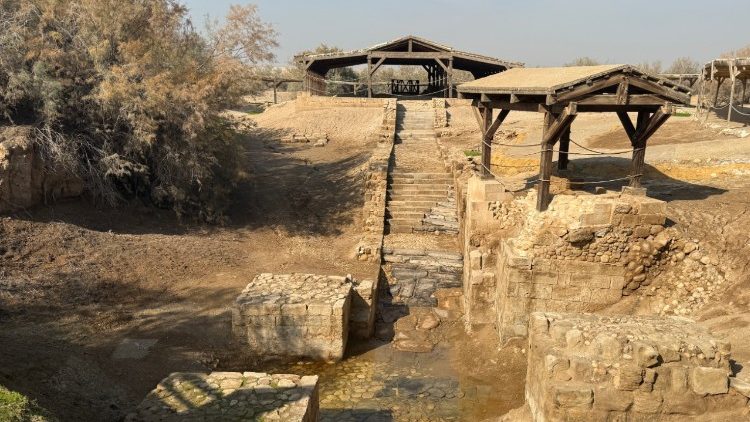
Bethany Beyond the Jordan, the Place of Jesus’ Baptism
By Fr Pawel Rytel-Andrianik – Al-Maghtas
The Gospel of John says that John the Baptist baptized beyond the Jordan: “This took place in Bethany beyond the Jordan, where John was baptizing” (Jn 1:28). It also says: “He went away again across the Jordan to the place where John at first baptized, and there he remained” (Jn 10:40).
“Bethany beyond the Jordan” is not the Bethany near the Mount of Olives, which Jesus often visited, but another Bethany. Origen (3rd century), John Chrysostom (4th century) and the Christians of that time emphasized that “Bethany beyond the Jordan” was then known as Bethabara. This name appears in some manuscripts of the Gospel of John that refer precisely to “Bethany beyond the Jordan” (Jn 1:28). It also appears on the sixth-century Madaba map, which identifies in this way the place of Jesus’ baptism. Bethabara is also mentioned in the Talmud. Today this place is known as Al-Maghtas, which in Arabic means “baptism” or “immersion”.
Archaeological Evidence
Until the beginning of the 4th century, Christianity—often persecuted in the Roman Empire—was not able to build official places of worship. Nevertheless, the Christians of the first centuries passed down from generation to generation the memory of the sites connected with the life of Jesus.
Between the end of the 5th and the beginning of the 6th century, the Byzantine emperor Anastasius I Dicorus had the first church dedicated to John the Baptist built at the site now known as Al-Maghtas. This church was destroyed by floods and earthquakes. The structure was rebuilt several times, but probably by the 7th–8th century only ruins remained.
One pilgrim at the time, known as Theodosius (around the year 530), wrote about the church: “Five miles north of the Dead Sea, at the place where the Lord was baptized, there stands a solitary column, on which an iron cross is fixed; there is also the church of Saint John the Baptist, built by Emperor Anastasius. The church is very high, built over large chambers because of the flooding of the River Jordan”.
At this site, the Basilica of the Holy Trinity was also built. The name of the church recalls the fact that during Jesus’ baptism the Trinity was revealed: God the Father speaking from heaven and the Holy Spirit in the form of a dove above Jesus. Archaeological excavations indicate that it was a large church, at least 27 meters long and more than 15 meters wide, although today only a few ruins remain.
In addition to these churches, archaeologists have identified a lower basilica, hermits’ caves, chapels, mosaics, marble floors, and a huge cross-shaped baptistery, all built close to one another at the site now known as “Bethany beyond the Jordan” – Al-Maghtas.
Near Al-Maghtas, excavations have also uncovered the hill of Tell al-Kharrar, known as Elijah’s Hill (Jabal Mar Elias), linked to the prophet Elijah. In the Byzantine period, probably in the 5th century, a monastery was erected there in his honor.
UNESCO: Outstanding value for humanity
In 2015, the area of “Bethany beyond the Jordan” (Al-Maghtas), including Tell al-Kharrar, was added to the UNESCO World Heritage List. The official website says: “‘Bethany beyond the Jordan’ is of immense religious significance to the majority of denominations of Christian faith, who have accepted this site as the location where Jesus of Nazareth was baptised by John the Baptist. This reference encouraged generations of monks, hermits, pilgrims and priests to reside in and visit the site, and to leave behind testimonies of their devotion and religious activities, dating to between the 4th and the 15th century CE”.
The Popes at ‘Bethany Beyond the Jordan’
The first Pope to visit Al-Maghtas was John Paul II during the Jubilee of the Year 2000. Pope Benedict XVI visited the site in 2009 and inaugurated the construction of the church commemorating the Jesus’ baptism in the Jordan. In 2014, Pope Francis visited the site and met Syrian and Iraqi refugees, sick children, and people with disabilities who had found refuge in Jordan.
The new Church of the Baptism of the Lord was solemnly consecrated in January 2025. Representing Pope Francis, the Secretary of State of the Holy See, Cardinal Pietro Parolin, presided over the ceremony. It is currently the largest Catholic church in Jordan, and the area also includes churches of other Christian denominations.
Thank you for reading our article. You can keep up-to-date by subscribing to our daily newsletter. Just click here.


