
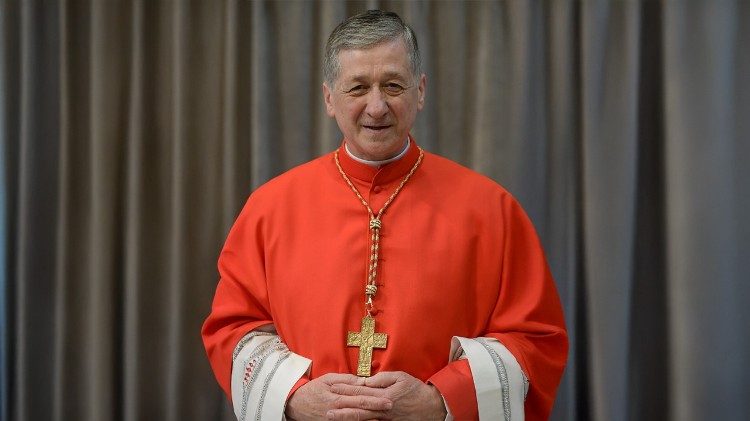
Cardinal Cupich responds to debate over Keep Hope Alive Award
By Vatican News
Cardinal Blase Cupich has expressed his sadness concerning polarisation within the Catholic Church that has become apparent in recent days. He reflects on his fifty years of priesthood, including 27 as bishop, noting that in this time he has seen the divisions within the Catholic community “dangerously deepen”.
These divisions, he said, “harm the unity of the Church and undermine our witness to the Gospel”. Bishops, he continued, cannot simply ignore this situation, “because we have a duty to promote unity and assist all Catholics to embrace the teachings of the Church as a consistent whole”.
Cardinal Cupich is referring, in particular, to the debate that followed his nomination of US Senator Dick Durbin for the Keep Hope Alive Award.
For and not against
The Archbishop of Chicago planned to recognize Senator Durbin for his work on immigration policy. “The decision to present him an award was specifically in recognition of his singular contribution to immigration reform and his unwavering support of immigrants, which is so needed in our day”, says the Cardinal.
Following the announcement, numerous members of the Catholic community, including several US Bishops, have expressed their disapproval at the Archdiocese of Chicago’s decision, given the Illinois Democrat's support for legal abortion. Senator Durbin has since decided not to accept the award.
In his statement, Cardinal Cupich stresses that this situation reflects the reality of our world, in the United States in particular, where, he says, “Catholics find themselves politically homeless”. He explains that “the policies of neither political party perfectly encapsulate the breadth of Catholic teaching”.
Cardinal Cupich acknowledges the pain caused by the recent controversy, stressing that it reflects a broader challenge within both the Church and American society. The temptation, he says, is to retreat into condemnation whenever a political leader holds views opposed to elements of Catholic teaching. Yet such an approach, he warns, risks deepening division rather than fostering dialogue.
Cardinal Cupich calls for encouragement for the good people do, even when there is disagreement on other issues. Praising the good work of others, he says can, open the door to reflection and collaboration. By recognising the contributions individuals make, Catholics can create space for growth, mutual learning, and a shared commitment to the common good.
All can influence each other
Reflecting on the Keep Hope Alive celebration itself, Cardinal Cupich explains that his intention was to create a space for mutual reflection. He hoped Catholics advocating for immigrants at the U.S.–Mexico border might also reflect on the Church’s defence of life in the womb. Likewise, he hoped those dedicated to defending the unborn might widen their circle of protection to include migrants facing existential threats. “Both groups are Catholics,” he insists, and must remember that the Church is not defined by a single issue.
At the same time, Cardinal Cupich underlines that this event should not be misinterpreted as a weakening of the Church’s stance on abortion. Quoting the Catechism, he reiterates that abortion is a moral evil and the Church's teaching on the subject “remains unchangeable.” The Church, he says, will continue to advocate for laws protecting human life, as well as for the right to religious freedom.
Looking back to the U.S. bishops’ strong response to Roe v. Wade, he recalls their unwavering defence of the unborn, while also emphasising the Church’s long-standing commitment to immigration.
Finally, Cardinal Cupich stresses, “We can move forward, if we Keep Hope Alive.”
Pope Leo's comments
Speaking at a press conference on Tuesday, Pope Leo responded to a question by a US journalist on the matter, stressing that “it is very important to look at the overall work a senator has done during, if I am not mistaken, 40 years of service in the United States Senate.”
The Pope acknowledged the difficulties and tensions but emphasised that “it is important to consider many issues related to the teaching of the Church.” He underlined that saying, “I am against abortion,” while supporting the death penalty or agreeing with the inhumane treatment of immigrants in the United States is not truly pro-life.
“These are very complex issues," the Pope said. "I do not know if anyone has the full truth on them, but I would first of all ask that there be greater mutual respect, and that together — as human beings, in that case as American citizens or citizens of Illinois, as well as Catholics — we say: ‘We need to look closely at all these ethical issues and find the way forward as a Church.’ Church teaching on each of these issues is very clear.”
Thank you for reading our article. You can keep up-to-date by subscribing to our daily newsletter. Just click here.


